



Exhibition Quality Cabinet
Exhibition quality cabinet designs represent the finest achievements of nineteenth and early twentieth century makers, built for display at major expositions rather than standard domestic use.
Exhibition Quality Cabinet
When you search for an exhibition quality cabinet, you are looking at ambitious furniture designed by master craftsmen to demonstrate technical mastery and artistic ambition at international fairs or trade exhibitions. These pieces often carry documented provenance from prominent retailers or maker workshops.
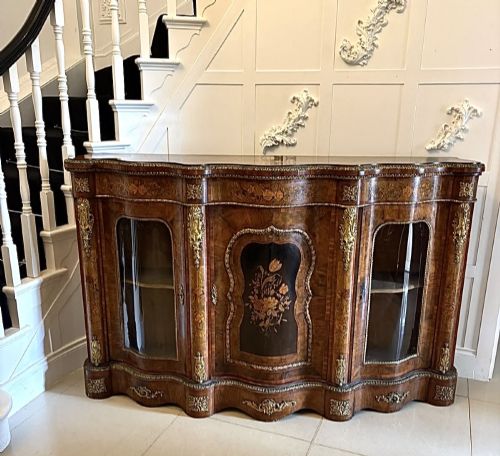
On this page, the most common forms you will encounter are credenzas, display cabinets, and side cabinets, frequently originating from the Victorian period alongside eighteenth century and early twentieth century examples.
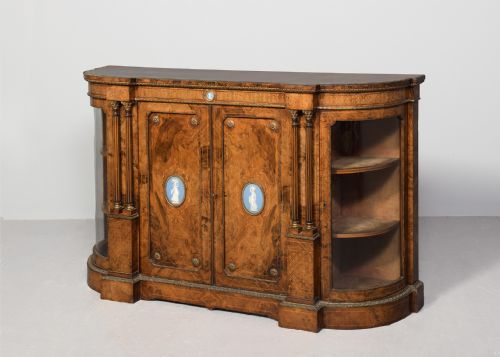
The selection ranges from serpentine burr walnut credenzas to satinwood vitrines and inlaid mahogany breakfronts, reflecting the high standards demanded by elite commissioners.
Materials and Technique
Cabinetmakers utilised rich timber veneers such as burr walnut, satinwood, kingwood, and amboyna, laid over sturdy foundational woods to create striking grain patterns and decorative marquetry panels.
Metal mounts in gilt ormolu, hand-carved ebony details, and inset porcelain plaques were integrated alongside traditional joinery to elevate the visual complexity of each form.
Surface finishes involved meticulous French polishing that enhanced the natural figures of the timber while protecting complex geometric or floral inlay work.
Exhibition Quality Cabinet Retail Price Guide 2026
Typical asking prices for exhibition quality cabinet among the pieces listed under this phrase on Sellingantiques today, from the lower quarter to the upper quarter. They describe what is for sale here now, not the wider market.
The selection includes pieces spanning the eighteenth, nineteenth, and early twentieth centuries, featuring woods like satinwood, burr walnut, and mahogany.
Variations in Quality
The distinction between standard nineteenth-century production and works made for exhibition lies in the depth of hand-carving, the complexity of the marquetry, and the selection of figured veneers.
Superior examples demonstrate precision in the alignment of gilt bronze mounts, the integration of hand-painted porcelain panels, and the structural integrity of serpentine or breakfront forms.
Edwards and Roberts·Maple and Co·Holland and Sons·Wilkinson and Sons·Whytock and Reid·Pietro Ferrario
The Exhibition Quality Cabinet Glossary
- Credenza
- A low cabinet or sideboard, frequently fitted with glass doors and curved side sections, popular during the Victorian era for displaying porcelain and decorative objects.
- Marquetry
- The art of applying pieces of veneer to a structure to form decorative patterns, often utilising contrasting timbers to create pictorial designs.
- Ormolu
- Gilt bronze mounts cast and chased by hand, applied to furniture corners, friezes, and feet to provide metallic contrast against dark or figured wood.
- Vitrine
- A glass-fronted display cabinet designed specifically for the exhibition of fragile or valuable collectibles.
- Serpentine
- A furniture front or surface curved in a wave-like shape, featuring a convex centre flanked by concave ends that requires exceptional joinery skill.
Exhibition Quality Cabinet: Frequently Asked Questions
What defines an exhibition quality piece?
These cabinets represent the pinnacle of nineteenth-century craftsmanship, specifically produced by notable workshops to showcase advanced techniques and superior materials at public exhibitions.
They incorporate finer veneers, more elaborate hand-carving, and superior metal mounts than standard commercial furniture of the same period.
Where were these cabinets placed in a home?
In period interiors, large credenzas and display cabinets stood in drawing rooms or formal reception spaces to hold and exhibit valuable porcelain, silver, and curiosities.
Smaller side cabinets and vitrines functioned similarly in drawing rooms or private salons, serving both as decorative focal points and functional storage.
How do I care for burr walnut surfaces?
Burr walnut veneer requires stable indoor humidity and protection from direct sunlight to prevent the timber from drying out and the delicate grain patterns from splitting.
Regular dusting with a soft, dry cloth is sufficient, supplemented occasionally by traditional beeswax applied sparingly to nourish the polished surface.
How can I identify the period of a cabinet?
Dating relies on examining construction methods inside the carcase, the style of the brass hardware, and the specific revival motifs used in the marquetry or carving.
Victorian pieces often favour burr walnut and robust ormolu mounts, whereas eighteenth-century examples display lighter satinwood and more restrained Neoclassical proportions.