
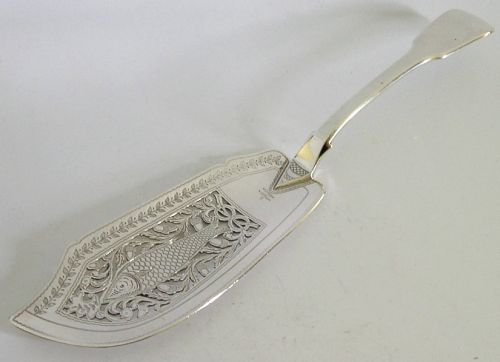
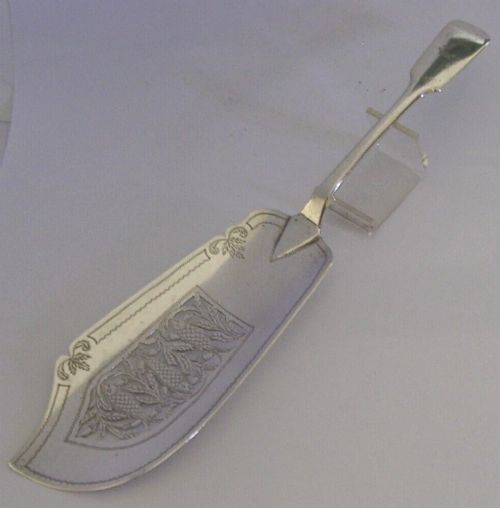


Engraved Sterling Fish Slice
An engraved sterling fish slice is a dining implement designed for serving fish, combining practical utility with ornate metalwork.
Engraved Sterling Fish Slice
An engraved sterling fish slice is a serving utensil designed for the dining table, appearing in forms from the Georgian and Victorian periods.
You are most likely to meet solid silver blades featuring pierced decoration, often paired with handles of bone or ebony.
The evidence shows these servers span the eighteenth and nineteenth centuries, originating from English and French makers.
How they were made
Makers shaped sterling silver and higher purity silver through piercing and engraving techniques to create intricate patterns upon the blade.
Handles incorporated contrasting materials such as bone, ebony, silk, and velvet alongside the silver construction.
Listings span the Georgian, Victorian, and eighteenth-century periods, utilising sterling silver, bone, and ebony.
What varies in quality
The standard of engraving and the complexity of the pierced work dictate the distinction between simpler examples and finer pieces.
The choice of handle material, whether solid silver, bone, or ebony, influences the overall character and balance of the server.
Thomas Daniell·Charles Boyton
The Engraved Sterling Fish Slice Glossary
- Sterling silver
- A silver alloy containing 92.5 percent pure silver by mass, standard for British plate.
- Pierced
- Work where portions of the metal blade are cut away to form decorative patterns.
- Fiddle pattern
- A traditional nineteenth-century flatware handle shape featuring a narrow stem that broadens at the end.
- Crested
- Bearing an engraved family crest or heraldic badge on the handle or terminal.
Engraved Sterling Fish Slice: Frequently Asked Questions
What is an engraved sterling fish slice used for?
These utensils served fish courses at formal nineteenth-century dining tables. The wide blade allowed the server to lift delicate portions without breaking them.
Today, collectors use them primarily for display or occasional ceremonial serving during formal meals.
How do I distinguish a Georgian fish slice from a Victorian one?
Georgian examples often display simpler lines or eighteenth-century French pierced work. Maker marks and assay office symbols provide the most reliable dating evidence.
Victorian pieces frequently incorporate fiddle pattern handles or come paired in fitted cases.
Are the handles always made of silver?
Many examples feature solid silver blades and handles. However, some pieces utilise alternative materials for the grip.
Bone, ebony, silk, and velvet appear in the evidence alongside solid sterling silver formations.
Do these servers come alone or in sets?
They appear both as individual pieces and as matched pairs within fitted presentation cases. Single slices often bear family crests or specific maker attributions.
Paired sets usually date from the later Victorian period.