


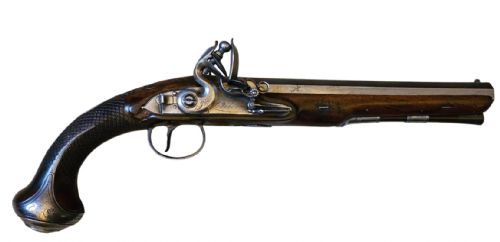
Engraved Steel Flintlock
These engraved steel flintlock pieces are historical firearms combining precise metalwork and traditional stocks, sought after for their period mechanics and decorative detail.
Engraved Steel Flintlock
When you search for an engraved steel flintlock, you enter the world of historical firearms from the seventeenth, eighteenth, and nineteenth centuries. The selection spans forms such as pocket pistols, travelling pistols, greatcoat pistols, and Scottish Highland scroll-butt arms.
The pieces you encounter reflect diverse origins, including London makers, Scottish workshops, French ateliers, and Balkan or Ottoman regions. Styles range from Georgian and Regency to French Rococo and Ottoman Empire designs.
Pocket pistols with cannon barrels and box-lock mechanisms appear alongside larger military and duelling arms. Walnut, hardwood, and iron feature heavily alongside steel, brass, and silver elements.
How they were made
Makers shaped the primary action and barrel from steel and iron, frequently incorporating brass and silver mounts. Stocks utilise walnut and other hardwoods, sometimes accented with wire inlay or mother-of-pearl.
Engraving was applied by hand to metal surfaces, decorating lockplates, trigger guards, and mounts with scrolls and patterns. Mechanisms relied on precise fitting of springs and the flintlock ignition system to strike a spark against steel.
Rat-tails and cannon barrels sound like kitchen utensils, but they actually helped eighteenth-century travellers keep footpads at a safe distance.
What varies in quality
The crispness and depth of the steel engraving dictate much of the visual merit across these pieces. Sharper, more detailed chisel work on mounts and lockplates separates standard production from finer workshop output.
The integration of materials also defines the tier of a piece, such as the precision of silver wire inlay in the wood stock or the harmony between brass mounts and iron components. Maker signatures stamped on locks or barrels add historical documentation.
John Campbell of Doune·Twigg·Thomas Henshaw·I Parr·Meyer & Mortimer·J Robinson·Barber of Newark·A.W Spires
The Engraved Steel Flintlock Glossary
- Flintlock
- A firearm ignition mechanism that uses a flint held in a cock to strike a steel frizzen, creating sparks to ignite the priming powder. This system dominated military and civilian arms for centuries.
- Snaphaunce
- An early precursor to the flintlock mechanism with a manually operated frizzen cover. It represents an intermediate step in firearm evolution.
- Cannon barrel
- A barrel turned with rings or flares near the muzzle resembling a naval cannon, common on eighteenth-century pocket pistols. This shape allowed the barrel to be unscrewed for loading.
- Scroll-butt
- A distinct stock shape curving downward in a scroll profile, typical of Scottish Highland pistols from the mid-eighteenth century. This form provided a secure grip for the user.
- Box-lock
- A firearm action where the breech and lockplate are forged as a single unified box housing the internal mechanisms. It offers a clean exterior appearance.
Engraved Steel Flintlock: Frequently Asked Questions
How do I date an engraved steel flintlock?
Dating relies on stylistic clues, barrel signatures, proof marks, and the evolution of lock mechanisms. Eighteenth-century pieces often feature distinct scrollwork and barrel shapes compared to later nineteenth-century examples.
Examining the wood stock style and mount ornamentation further helps narrow the period of manufacture.
What is a pocket pistol used for?
Pocket pistols were compact personal defence weapons carried by travellers and civilians during the eighteenth and nineteenth centuries. Their small size allowed them to be concealed in pockets or greatcoat folds.
Despite their modest dimensions, they utilised standard flintlock or box-lock mechanisms for close-range protection.
How should I clean steel and wood?
Maintenance requires gentle removal of dust and light conservation using specialist museum waxes or oils on metal surfaces. Harsh abrasives must be avoided to preserve original finishes and engraved details.
Wood stocks benefit from minimal handling and occasional neutral conditioning to prevent drying.