







Engraved French Clock
An engraved french clock brings precision engineering together with ornate surface decoration, offering reliable timekeeping housed in elaborate metalwork.
Engraved French Clock
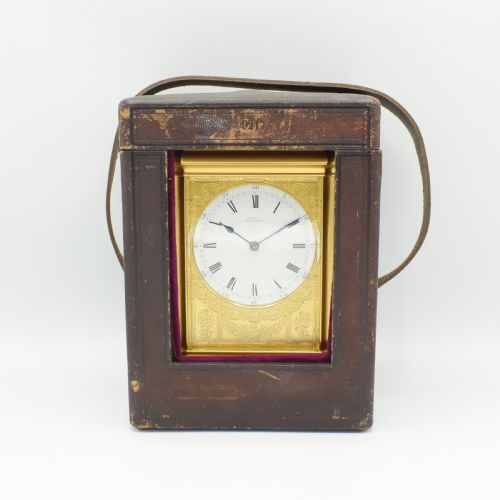
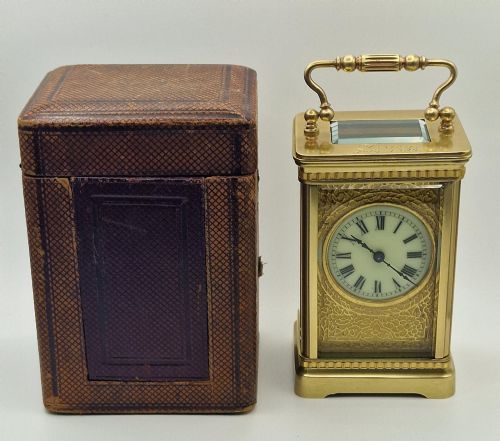
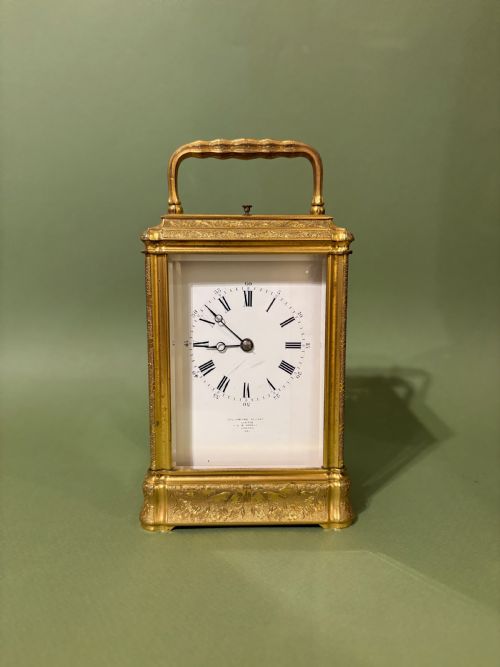
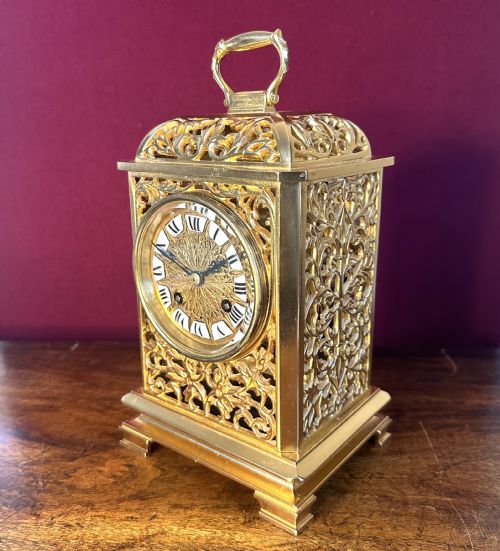
An engraved french clock is a portable timepiece or mantel clock originating from the nineteenth century, most frequently encountered as a brass carriage clock featuring detailed hand-chiselled decoration across the outer case. These pieces span from small travelling timekeepers to large repeating mantel clocks, often incorporating glass panels that reveal the internal mechanical movement.
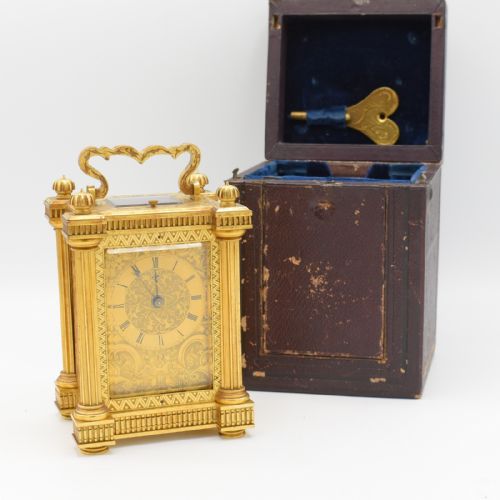
The objects listed on this page encompass various formats including gorge cases, oval frames, and four-glass mantel designs spanning the eighteen-fifties to the turn of the twentieth century. Makers and retailers from Paris and London shaped this period, producing timepieces styled in French nineteenth-century motifs, Egyptian Revival, and Victorian Gothic Revival.
Buyers seeking an engraved french clock encounter objects defined by complex brass frames, porcelain enamel dials, and platform escapements. The surviving examples demonstrate domestic timekeeping requirements of the Victorian era, combining functional utility with decorative metalwork.
How they were made
Makers constructed the primary housing of an engraved french clock using brass, gilt brass, or gilt bronze, casting heavy metal plates that were subsequently finished by hand. Craftsmen utilised sharp burins to cut floral, geometric, or architectural patterns directly into the exterior surfaces of the metal cases.
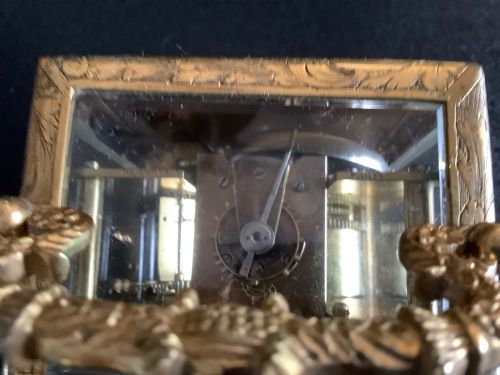
Interior mechanical components relied on steel gears, brass wheels, and platform escapements, often fitted with enamel dials and painted numeral masks. Workshops integrated glass panels into the top, sides, and back of the frames to display the movement and allow light to reach the escapement.
Engraved French Clock Retail Price Guide 2026
Typical asking prices for engraved french clock among the pieces listed under this phrase on Sellingantiques today, from the lower quarter to the upper quarter. They describe what is for sale here now, not the wider market.
Listings feature items dated from the 1850s through to the early 20th century, executed in brass, glass, and enamel.
What varies in quality
The depth and crispness of the hand-engraving separate standard production pieces from workshop highlights, where burin work covers every exposed surface including the platform and interior mask. Cases with fully engraved sides, cornices, and handles require considerably more labour than those with plain panels and minimal border decoration.
Mechanical complexity distinguishes basic time-only models from repeaters, alarm clocks, and grand sonnerie movements that strike the hours and quarters on gongs or bells. The inclusion of signed backplates by established makers adds historical depth to the internal engineering.
HENRI JACOT·Margaine Of France·Delépine-Barrois·Gontard & Bolviller Paris·Mappin and Webb·D. Munsey of Cambridge·Charles Frodsham·Drocourt·Paul Garnier·Bourdin·Tiffany·E.J.Dent·L Epee·Alfred Hollinge·Soldano·Pons
The Engraved French Clock Glossary
- Carriage clock
- A portable spring-driven timepiece designed for travelling during the nineteenth century, equipped with a top handle and a protective leather outer case.
- Platform escapement
- The miniature regulating assembly containing the balance wheel and hairspring, visible through the glass top of a clock case.
- Repeater
- A mechanical complication allowing the clock to chime the hours and quarters on demand when a button or pendant is pressed.
- Gorge case
- A distinctive rectangular carriage clock case style featuring a stepped cornice and base with curved mouldings.
- Grand sonnerie
- A striking train that sounds the hours and the passing quarters automatically without requiring user intervention.
- Mask
- The decorative plate surrounding the enamel dial, frequently engraved or gilded to match the exterior brass case.
Engraved French Clock: Frequently Asked Questions
How do I wind a carriage clock?
Winding requires a matching key inserted into the arbours located on the base or backplate of the movement. Turn the key gently until resistance indicates the mainspring is fully tensioned.
Avoid overwinding the mechanism, as excessive force can damage historical springs. Most nineteenth-century examples require winding approximately once every week to maintain continuous operation.
What is a repeater mechanism?
A repeater mechanism allows the clock to chime the current time audibly upon pressing a button or lever on the case. This function was useful for checking the hour during darkness before electric lighting.
These systems operate via complex gear trains separate from the standard timekeeping and alarm functions, requiring careful adjustment by a specialist horologist.
How do I identify the maker?
Maker marks and signatures typically appear engraved on the movement backplate, behind the dial mask, or stamped onto the brass frame components. Examining these hidden areas often reveals serial numbers and workshop symbols.
Retailers frequently placed their own names on the dial face while the original manufacturer stamped the internal movement plates.
Are these clocks suitable for daily use?
These timepieces function well in domestic settings provided they receive proper mechanical servicing and are placed on stable surfaces away from direct sunlight and drafts. Regular care ensures the balance assembly operates accurately.
Due to their age, historical movements benefit from professional cleaning every few years to prevent wear on the brass pivots and steel arbours.