





English Tunbridge Ware
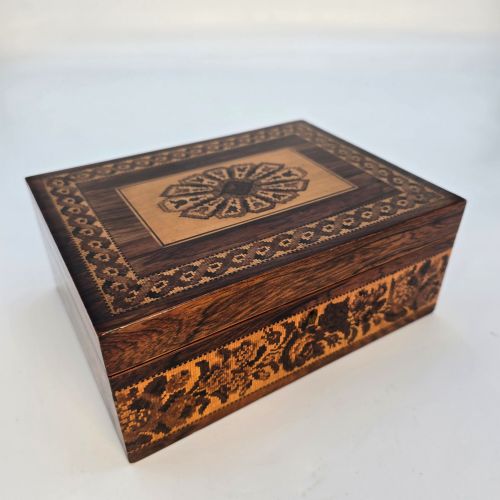
English Tunbridge ware brings together tiny mosaic timber tiles to form intricate architectural scenes, floral panels, and geometric borders.
English Tunbridge Ware
English Tunbridge ware comprises small wooden containers and desk accessories decorated with remarkable mosaic wood inlay. The pieces span tea caddies, jewellery boxes, book slides, and glove boxes, mostly originating from the nineteenth century.
Makers housed their intricate tesserae designs upon rosewood, walnut, and sycamore carcasses. Buyers will encounter both modest trinket boxes and elaborate architectural pieces featuring panels of castles or butterflies.
Materials and Mosaic Techniques
Craftsmen built these objects using numerous native and exotic timbers, including holly, boxwood, walnut, and rosewood, to achieve natural colour variation without resorting to stain. Woods such as sycamore and ash frequently form the primary structure for white ware pieces.
The defining technique relies on bundling dyed and natural wood rods into geometric matrices, which are then sliced thinly across the grain to produce hundreds of identical mosaic tiles for assembling pictorial panels.
English Tunbridge Ware Retail Price Guide 2026
Typical asking prices for english tunbridge ware among the pieces listed under this phrase on Sellingantiques today, from the lower quarter to the upper quarter. They describe what is for sale here now, not the wider market.
Listings feature nineteen-century tea caddies, book slides, and picture frames constructed from rosewood, walnut, and sycamore.
Assessing the Standard of Execution
Superior execution shows in the microscopic precision of the timber tesserae, where individual mosaic elements remain virtually indistinguishable to the naked eye. Pictorial panels depicting buildings or fauna require exceptional mastery of perspective and shading.
The choice of foundation timber and secondary details, such as brass fittings or fine internal linings, separates standard production from ambitious workshop output. Preservation of the fragile mosaic surface without extensive timber replacement dictates the standing of any given piece.
Edmund Nye·Henry Hollamby·Barton·G Wise
The English Tunbridge Ware Glossary
- Tunbridge Ware
- Wooden objects decorated with mosaic wood inlay originating from the town of Tunbridge Wells. The tradition reached its peak during the Victorian era.
- Mosaic Inlay
- A decorative surface created by assembling thousands of tiny cross-sections of coloured wood rods. This method produces pictorial and geometric patterns.
- Treen
- Small handmade wooden objects for domestic or personal use. Many Tunbridge items fall within this broader category of turned and carved wooden artefacts.
- Book Slide
- An adjustable desk accessory designed to hold a row of books upright. These pieces often feature inlaid panels on the sliding ends.
English Tunbridge Ware: Frequently Asked Questions
What woods are used in english tunbridge ware?
Craftsmen utilised dozens of naturally coloured timbers to supply the palette for mosaic panels. Commonly recorded woods include rosewood, walnut, boxwood, holly, and sycamore.
The natural tones of these varied timbers eliminated the need for artificial dyes when creating intricate floral or geometric designs.
How do you date english tunbridge ware?
Dating relies on the structural form, the style of the mosaic motifs, and the primary woods employed. Georgian and Regency examples often include painted white ware or simpler geometric bands, whereas Victorian pieces frequently display complex pictorial scenes of castles and flora.
Maker labels pasted to the interior also help anchor pieces to specific nineteenth-century workshops.
What were these boxes used for?
These lidded boxes served various domestic and desk functions for affluent households. Common forms include tea caddies for storing valuable leaves, stationery boxes for correspondence, and sewing caskets for needlework.
Smaller trinket boxes and stamp cases sat upon parlour tables as ornamental conversation pieces.
Are all pieces made in tunbridge wells?
The vast majority of these mosaic items originated from specialist workshops operating in Tunbridge Wells and the surrounding Kent area during the nineteenth century. The technique developed from local woodworking traditions into a distinct manufacturing industry.
Retailers in London and other major cities subsequently distributed these souvenir items to travellers.