





English Stoneware Water Jug
An english stoneware water jug brings sturdy utility and rich texture to the table, forged from heavy vitreous clay to hold liquid safely.
English Stoneware Water Jug
When you search for an english stoneware water jug, you encounter robust vessels designed primarily for practical use at the table or sideboard. These objects span from the Georgian era through the Victorian period, reflecting evolving domestic habits and decorative tastes.
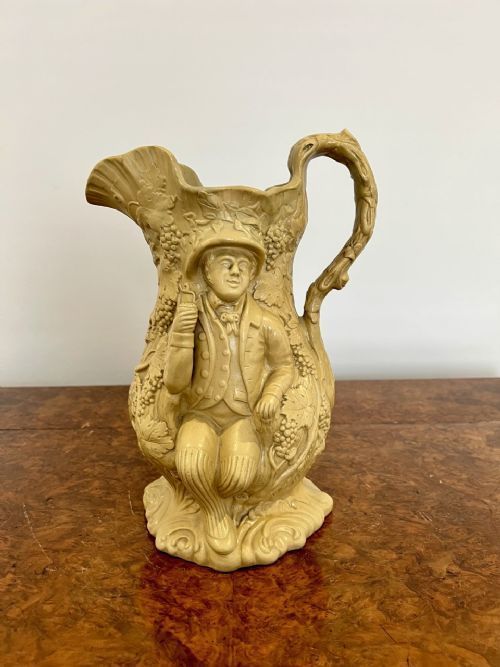
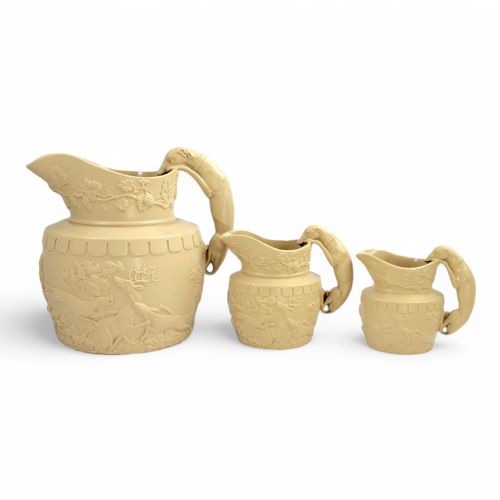
The selections available include salt-glazed examples with cream sprigged decoration and commemorative pieces from Doulton Lambeth. You also find larger vessels intended for communal service, often bearing moulded relief scenes or applied metallic rims.
Many of these containers showcase the heavy, impervious nature of vitrified ceramic body materials. They represent a shift toward durable domestic ware that could withstand daily service while offering distinct aesthetic charm through relief moulding and specialised glazing.
How they were made
Potters utilised dense clay bodies fired at high temperatures to achieve vitrification, rendering the material completely impermeable to water. This intense heat created a hard, durable matrix capable of holding liquids without internal seepage.
Makers applied salt glaze directly to the kiln chamber during firing, producing a characteristic textured surface akin to orange peel. Alternatively, artisans utilised relief moulding techniques to press intricate figural scenes and botanical motifs directly into the damp clay walls before firing.
English Stoneware Water Jug Retail Price Guide 2026
Typical asking prices for english stoneware water jug among the pieces listed under this phrase on Sellingantiques today, from the lower quarter to the upper quarter. They describe what is for sale here now, not the wider market.
Listings feature 19th-century stoneware, earthenware, and parian ware pieces spanning Georgian, Victorian, and Arts and Crafts styles.
What varies in quality
The crispness of the relief moulding distinguishes finer vessels from simpler production pieces, revealing the clarity of the original metal matrices and the skill of the presser. Sharp, deep contours in figural or botanical scenes indicate careful tooling and supervision in the workshop.
The uniformity and depth of the glaze application also divide standard utilitarian containers from exhibition-grade examples. Smooth, consistent salt-glaze textures and well-aligned applied sprigs elevate the piece's visual weight and tactile appeal.
Doulton Lambeth·Charles Meigh·Phillips and Bagster·Copeland Spode·Ridgway
The English Stoneware Water Jug Glossary
- Stoneware
- A heavy, vitreous ceramic body fired at high temperatures until the clay particles sinter and fuse. This process results in a dense, non-porous material that requires no internal glaze to hold water safely.
- Salt-Glaze
- A traditional glazing technique where common salt is thrown into the kiln fires at peak temperature. The sodium vaporises and reacts with the silica in the clay body to form a durable, glassy coating with a characteristic pitted texture.
- Relief Moulded
- A manufacturing method where moist clay is pressed into a carved mould to raise decorative motifs above the vessel wall. This technique allows for repeatable, highly detailed figural and botanical ornamentation.
- Sprigged
- A process of applying separately moulded clay ornaments to the leather-hard surface of a vessel using slip as an adhesive. These raised motifs provide sharp textural contrast against the main body.
- Vitreous
- Describing a ceramic material that has reached a glass-like, non-absorbent state through high-heat firing. It ensures structural strength and prevents liquid absorption.
English Stoneware Water Jug: Frequently Asked Questions
Were these jugs used for everyday water service?
These vessels served practical functions on dining tables and sideboards, holding water, ale, or other domestic beverages. Their heavy ceramic walls helped maintain fluid temperatures during meals.
Over time, many shifted from active utility to decorative display as domestic dining habits evolved through the Victorian period.
What is relief moulding on ceramics?
Relief moulding involves pressing clay into detailed matrices to create raised decorative scenes, such as classical dances or hunting motifs. These applied designs stand out from the smooth background of the jug body.
Finer examples show sharp edges and deep undercut details within the moulded figures.
How do I date a nineteenth-century jug?
Dating relies on stylistic markers such as aesthetic movement patterns, Victorian registration marks, or specific maker stamps found on the underside. Comparing the form and glazing technique to documented pieces from known potteries helps narrow the production window.
Examine the base and handle construction for manufacturing clues typical of Georgian versus late Victorian workshops.