
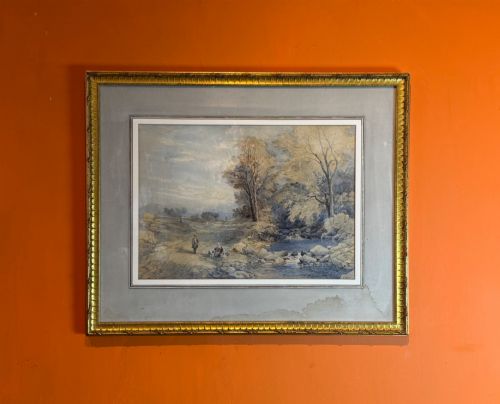


English School Watercolour Landscape
An english school watercolour landscape captures the shifting moods of the countryside through fluid pigment on paper.
English School Watercolour Landscape
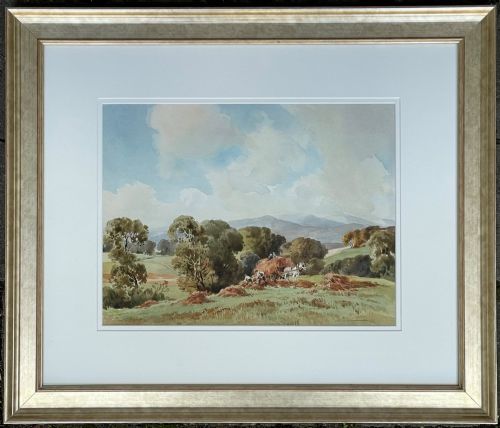
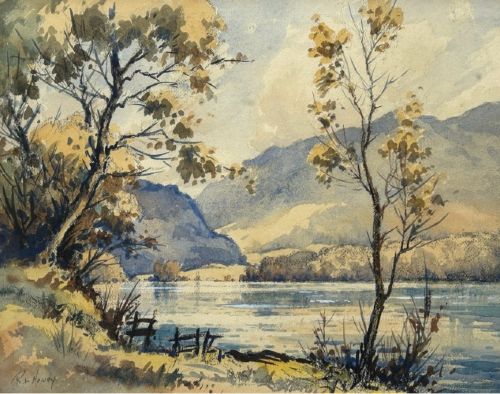
Collectors seeking an english school watercolour landscape encounter works depicting rivers, cottages, and mountains across the eighteenth, nineteenth, and twentieth centuries. These paintings range from anonymous topographical sketches to signed compositions by regional artists working in traditional British styles. The selection frequently includes Victorian river scenes, Edwardian country views, and mid-century topographical studies.
Many pieces display specific regional connections, recording landscapes in Yorkshire, the Lake District, and East Anglia. Smaller unsigned sheets often originate from sketchbooks compiled during the Georgian and Victorian eras, while larger framed watercolours showcase more finished exhibition standards. Buyers find both intimate rural vignettes and expansive pastoral prospects across these periods.
Materials and Technique
Watercolour pigment applied to paper forms the core of these works, frequently augmented with pencil underdrawing, bodycolour, and ink. Artists utilised absorbent rag papers that accepted fluid washes and allowed for delicate layering of translucent colour.
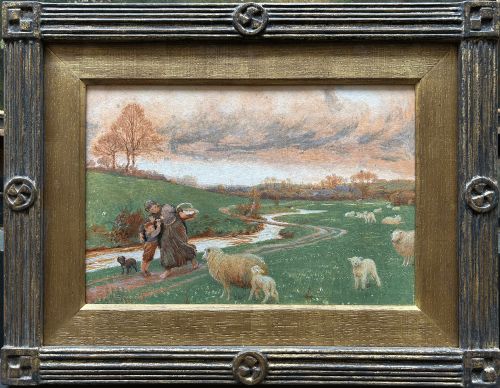
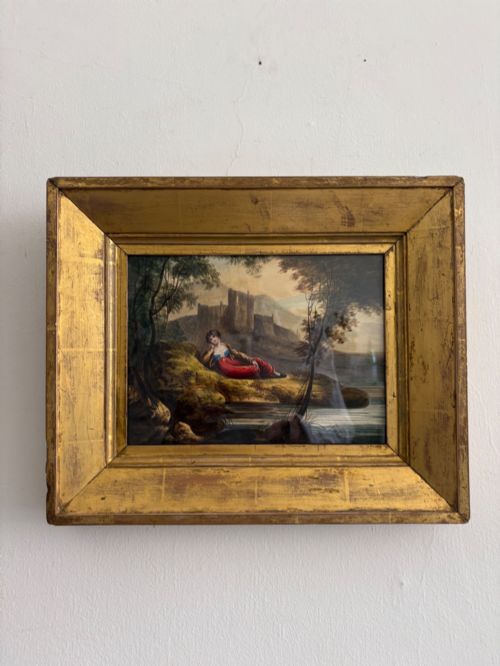
Protection came from framing behind glass within wood or gilt wood surrounds, preserving the water-soluble pigments from atmospheric moisture and handling damage.
Listings feature paper, glass, wood, and gilt wood across Victorian and Edwardian periods.
Evaluating Quality in Watercolours
Mastery of tone and atmosphere distinguishes exceptional sheets from routine topographical records, showing confidence in handling light across water and open skies. Strong compositions employ subtle colour harmonies and secure brushwork rather than rigid, mechanical outlining.
Condition plays a defining role, as prolonged exposure to sunlight causes pigment fading and paper discoloration. Well-preserved sheets retain their original vibrancy and crispness in the delicate wash layers.
Percy Lancaster·Robert Leslie Howey·Thomas Cooper Moore·George Graham·Arthur Tucker·David Cox Jnr·J Laporte·Edward Horace Thompson·Henry Barlow Carter·Frederick Mayor·Percy Brooke·Amos Green·Thomas Bush Hardy·Fred Stead·Robert Winchester Fraser·Angus Rands·Frederick Tucker·Charles Branwhite·Rowland Henry Hill·Cornelius Pearson·James Stephen Gresley·J Tim Macdonald·Tom Dudley·Alfred Rimmer·Fred Lawson
The English School Watercolour Landscape Glossary
- Watercolour
- A painting method in which fine pigment is suspended in a water-based, gum-arabic solution and applied to paper. This medium allows for transparent washes that capture shifting natural light.
- Gilt wood
- Timber framing finished with a thin layer of gold leaf or metallic gilt paint. This traditional finish complements the delicate tones of works on paper.
- Grisaille
- A painting executed entirely in monochrome shades of grey, neutral grey, or brown. Artists used this technique to study tone before applying colour or as a finished monochrome artwork.
English School Watercolour Landscape: Frequently Asked Questions
How do I date an antique watercolour?
Dating relies on examining the type of paper stock, framing methods, and the artist's active period where signatures exist. Early papers often lack modern uniformity, while framing materials change from simple wooden mouldings to elaborate nineteenth-century gilt surrounds.
Subject matter and costume details in figures also offer clues to the era. Comparative study with dated sketchbooks helps narrow down anonymous works.
Where should I hang these watercolours?
These works require placement away from direct sunlight and damp environments to protect the fragile pigments and paper from degradation. Hanging them on interior walls with stable ambient light preserves their delicate colours.
Framing with UV-filtering glass provides an extra layer of conservation for vulnerable nineteenth-century sheets.
Are unsigned watercolours worth collecting?
Unsigned sheets often represent accomplished work by regional practitioners or talented amateurs from the Georgian and Victorian periods. They offer an accessible entry point into collecting historic British art without paying a premium for a known signature.
Quality of execution remains the primary guide to value rather than attribution to a famous hand.
What is the difference between an English School and a regional school?
English School is a broad umbrella term encompassing traditional British painting styles across multiple centuries. Regional schools, such as the Norwich School or Staithes Group, gather artists working within specific geographic areas and shared artistic circles.
Regional pieces often feature local topography and distinctive local palettes influenced by shared sketching grounds.