



English Regency Longcase Clock
An english regency longcase clock stands as a towering piece of precision engineering and cabinetmaking, marking hours with stately weight in any hall.
English Regency Longcase Clock
When searching for an english regency longcase clock, a buyer explores tall timepieces that bridge the Georgian era and the nineteenth century. These items combine functional horology with substantial architectural presence.
The versions most commonly met on this page belong to the Regency and Georgian periods, spanning the early eighteen hundreds. Makers constructed these tall cases primarily from rich timbers to house intricate weight-driven movements.
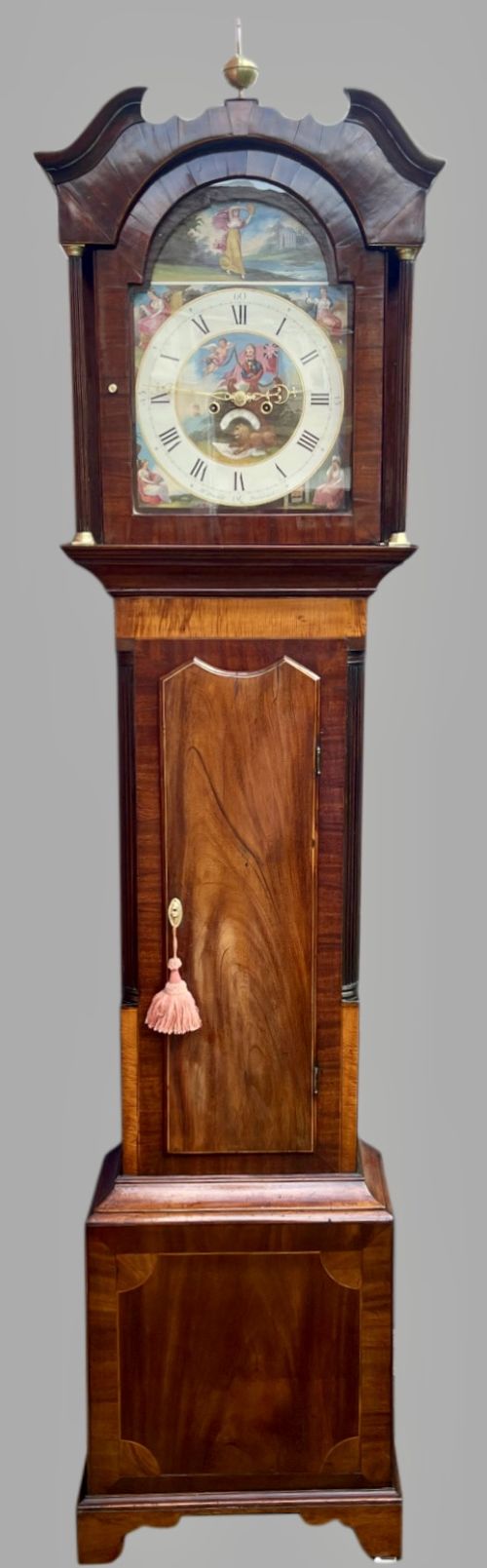
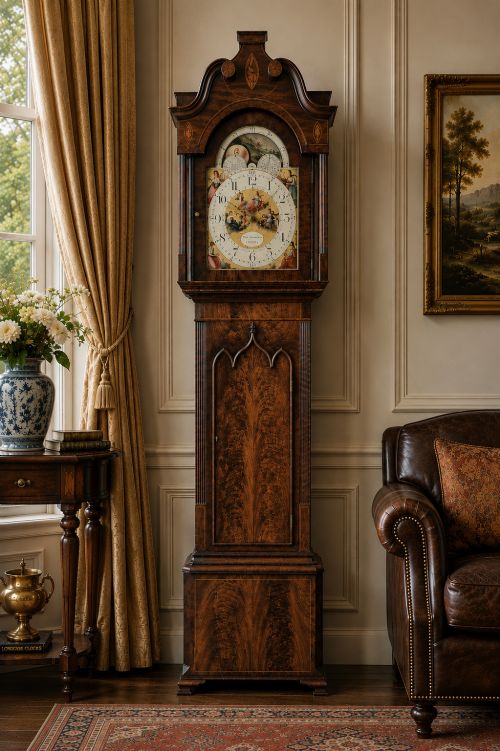
Forms range from simple linear tall cases to elaborate Gothic revival designs and specialised regulators. London makers and regional craftsmen alike produced these pieces, incorporating painted iron dials and moonphase indicators.
Materials and Construction
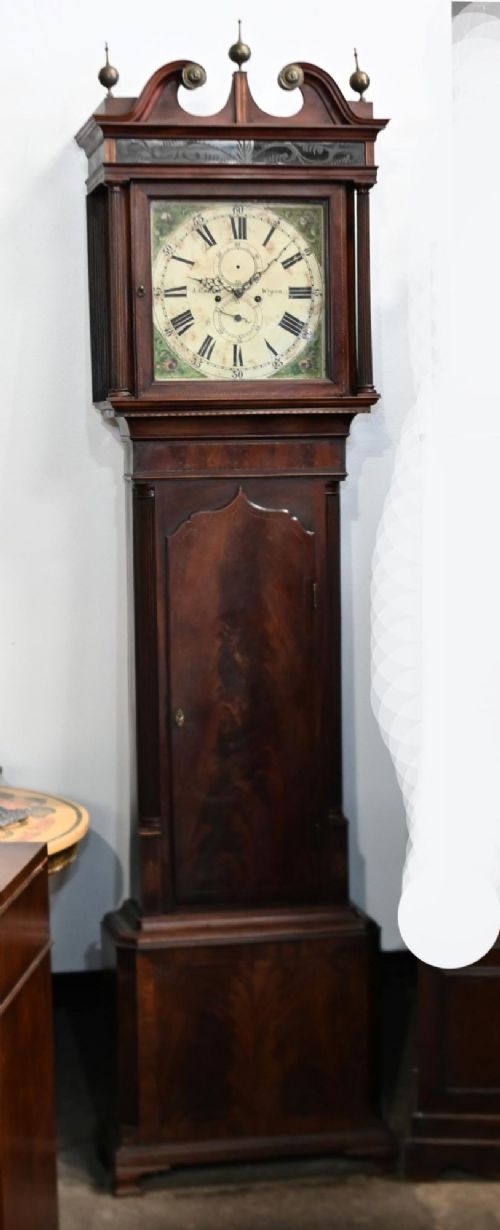
Cabinetmakers utilised dense hardwoods, particularly mahogany and flame mahogany, to build the tall wooden housings. Selected pieces also showcase burr mahogany veneer and decorative inlay work.
Horologists fitted brass movements and dials featuring painted iron details, protected behind glass panels. Iron components provided structural support for the weight-driven mechanisms within the trunk.
English Regency Longcase Clock Retail Price Guide 2026
Typical asking prices for english regency longcase clock among the pieces listed under this phrase on Sellingantiques today, from the lower quarter to the upper quarter. They describe what is for sale here now, not the wider market.
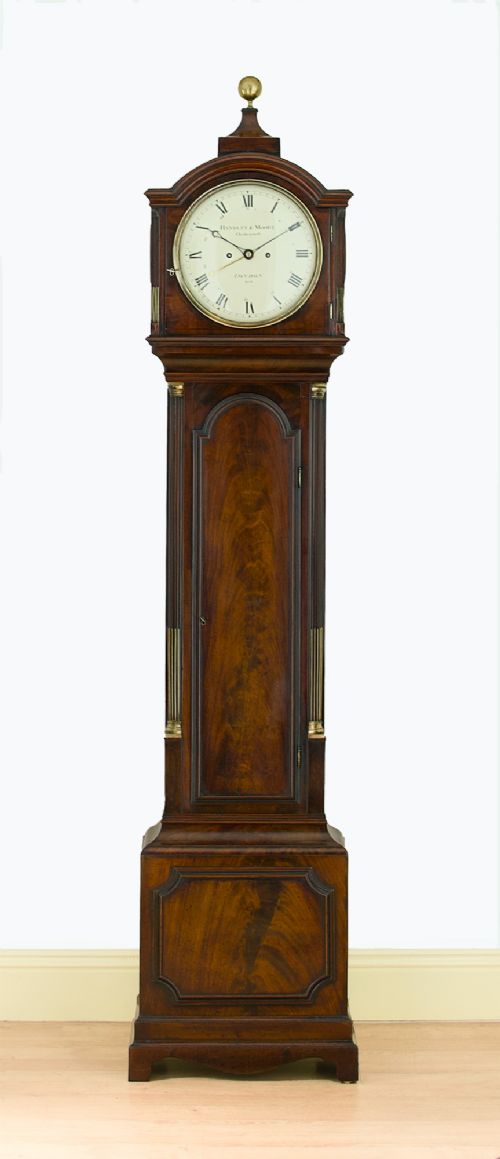
Regional workshops from York and Wigan appear alongside established London makers such as Handley and Moore and James McCabe.
Assessing Quality and Craftsmanship
The distinction between standard examples and the finest items rests in the selection of timber veneers and the sophistication of the internal movement. Flame and burr mahogany require expert handling to create coherent grain patterns across the tall door and base.
Movement complexity further separates pieces, ranging from standard eight-day striking trains to quarter-striking mechanisms and precision regulators. Maker attribution to notable London or regional workshops adds another layer of distinction.
Coats of Wigan·Handley and Moore·Samuel Kellett of Bredbury·William Moon London·Dwerrihouse and Carter·Jno Lane London·Hampston Prince and Cattles of York·James McCabe·Perigal Bond Street
The English Regency Longcase Clock Glossary
- Longcase clock
- A tall pendulum clock enclosed in a wooden case that stands directly on the floor. These items are also frequently termed grandfather clocks.
- Regulator
- A precision pendulum clock designed to keep exceptionally accurate time. Such mechanisms often served as reference standards in workshops and observatories.
- Flame mahogany
- A veneer cut from the branch junction of the mahogany tree, displaying a distinctive flamelike grain pattern. Cabinetmakers used this figure to adorn the primary doors of quality cases.
- Quarter striking
- A mechanism that chimes the time at each quarter hour using multiple gongs or bells. This complication requires sophisticated gear trains within the movement.
- Moonphase
- A dial mechanism tracking the phases of the lunar cycle through a rotating disk. This feature demonstrates the technical ambition of the horologist.
English Regency Longcase Clock: Frequently Asked Questions
How do I wind an eight-day longcase clock?
Winding involves using a specialised key to draw up the heavy weights suspended inside the trunk. Care must be taken not to overwind the movement.
Ensure the weights rise evenly and do not tangle the suspension cords during the process.
Where should I place a longcase clock?
Position the piece against a sturdy interior wall away from direct sunlight and heating vents. Temperature fluctuations can affect the wood and the expansion of the metal pendulum.
A solid floor prevents vibrations from interfering with the accurate beat of the pendulum.
How do I tell a Regency case from a Georgian one?
Regency cases often lean towards classical architectural restraint, occasionally incorporating Gothic revival motifs or brass inlay. Georgian examples tend to display earlier proportions and bracket feet.
Cabinet styles evolved from mid-eighteenth-century standards into the cleaner lines associated with the early nineteenth century.
What is the purpose of a moonphase dial?
The moonphase aperture tracks the lunar cycle over a lunar month using a painted rotating disk behind the dial face. Historically, this helped farmers and mariners monitor tides and night illumination.
Today, it remains a decorative and mechanically complex feature of higher-grade movements.