


English Ormolu Clock
An english ormolu clock brings the warmth of mercury gilt bronze and precise mechanical timekeeping into a room.
English Ormolu Clock
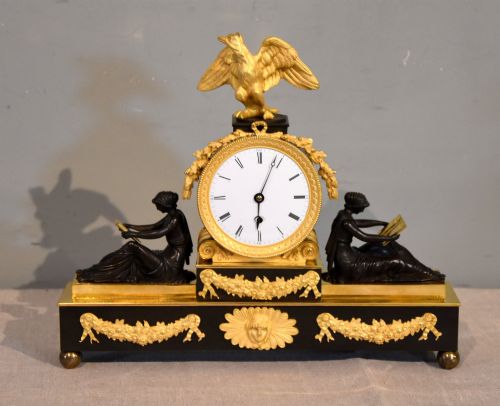
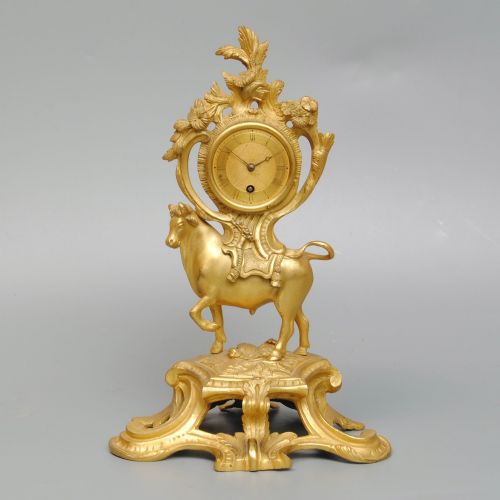
An english ormolu clock combines precision mechanical movements with cast metal cases finished in fine gilding. The pieces seen span from the seventeenth century through the nineteenth century, taking forms such as bracket clocks, table clocks, and mantel clocks.
Regency and nineteenth-century examples dominate the available selection, often featuring architectural marble bases, figural cherubs, and detailed floral motifs. London makers produced the majority of these pieces, pairing substantial fusee movements with elaborate gilt bronze mounts.
How they were made
The construction relies heavily on cast bronze and brass, transformed through fire gilding with mercury to achieve a deep, enduring lustre. Metal cases are frequently mounted onto marble plinths, incorporating enamel dials and glazed bezels to protect the face.
Mechanical integrity comes from fusee movements and chain fusee systems, designed to maintain even power delivery as the mainspring unwinds. Skilled craftspeople united heavy metal casting with intricate clockmaking, incorporating repeating mechanisms and musical complications in the finest examples.
Listings feature pieces spanning the seventeenth century through the late nineteenth century, predominantly housed in gilt bronze, ormolu, and marble.
What varies in quality
The crispness of the bronze chasing separates standard production from superior work, showing in the sharp feathering of leaves, the soft curls of hair on figural cherubs, and the depth of the relief. Heavy gauge metal and dense marble bases indicate a higher tier of manufacture.
Movement sophistication also dictates value, with single or double chain fusee mechanisms representing high standards of London clockmaking. Signed dials and backplates by known makers elevate the piece, reflecting the reputation of the workshop that completed the assembly.
Viner London·Francis Perigal London·John Windmills·John Barwise of London·Payne and Co London·John Bennett Cheapside London·James Murray London·Henry Berkeley Square London·FB Adams London·Adams of Lombard Street·Baetens London·Bently and Beck London·John Peterkin
The English Ormolu Clock Glossary
- Ormolu
- Gilded bronze, where a mixture of gold and mercury is applied to the metal and heated until the mercury vaporises, leaving a rich gold coating behind.
- Fusee
- A conical pulley used in spring-driven clocks to equalise the torque of the mainspring as it runs down, ensuring steady timekeeping.
- Bracket clock
- A portable table clock originally designed to sit on a wall bracket or a chest of drawers, often featuring a handle on top.
- Enamel dial
- A clock face made by fusing powdered glass to a metal plate at high temperatures, typically fired multiple times to achieve a smooth white surface for painted numerals.
English Ormolu Clock: Frequently Asked Questions
How do I wind an english ormolu clock?
Wind the clock using the appropriate key inserted into the winding square on the dial, turning gently until resistance is felt. Care must be taken not to overwind the mainspring.
Ensure the key matches the arbor precisely to avoid damaging the delicate square. Most fusee movements require winding once a week to maintain consistent tension.
Where should I place an english ormolu clock?
Position the clock on a stable, level surface such as a mantelpiece, chest, or dedicated table away from direct sunlight and drafts. A stable base ensures the pendulum or balance wheel beats evenly.
Keep the piece away from extreme temperature fluctuations and damp environments to protect the mercury gilding and internal steel components from degradation.
How do I tell a Regency ormolu clock from a later Victorian piece?
Regency clocks typically exhibit restrained neoclassical lines, crisp fire gilding, and architectural marble or bronze cases. London signatures from this period often appear on the dial or backplate in elegant script.
Victorian pieces, particularly those from the revival periods, tend toward heavier ornamentation, more elaborate figural groupings, and varied casting techniques. Examining the style of the mounts and the signature typography helps clarify the dating.
What is a chain fusee movement?
A chain fusee movement uses a fine steel chain wrapped around a grooved conical drum to regulate the pull of the mainspring. This mechanism delivers even force to the gear train as the spring unwinds.
This system represents a high standard of mechanical horology, distinguishing better quality table and bracket clocks from simpler spring-driven designs.