
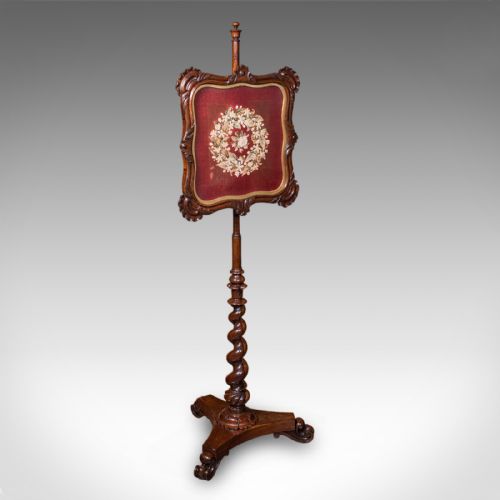


English Needlepoint Screen
An english needlepoint screen brings warmth and texture to a room, functioning as both a decorative panel and a functional shield against hearth heat.
English Needlepoint Screen
An english needlepoint screen primarily takes the form of a pole screen designed for the fireside, alongside larger multi-panel room dividers. The pole screen design places an adjustable embroidered panel on a vertical stand with a tripod base, allowing the shield to slide up and down to block radiant heat from an open fire.
The pieces on this page span several eras including the Regency, Georgian, and Victorian periods, with occasional later examples such as a 1930 metamorphic occasional table combination. Rosewood, walnut, and mahogany provide the structural framework for these upright stands and folding frames.
Beyond the classic pole screen, buyers encounter tall privacy screens and room dividers featuring multiple hinged panels. These larger dividers utilise textile needlepoint and tapestry work to section off spaces within a room while displaying intricate hand-stitched patterns.
Materials and Construction
The structural frames utilise dense hardwoods such as mahogany, rosewood, and walnut, frequently shaped into slender turned poles or carved tripod bases. Giltwood also appears on select decorative stands and frames, adding a gilded finish to the woodwork.
Needlepoint, wool, and textile panels form the visual centrepiece of each screen, worked on canvas using hand-stitched embroidery and tapestry techniques. Brass components, including adjustable thumb screws and mounting brackets, allow the wooden poles and shields to function mechanically.
Glass panels and framed silkwork supplement the standard needlepoint inserts on specific fireside reflectors. These varied inserts demonstrate how makers combined protective glass and reflective elements with soft furnishings.
The archive records pieces spanning the Regency, William IV, and Victorian periods, alongside occasional Georgian items.
Evaluating the Pieces
Quality rests heavily on the fineness of the needlework and the crispness of the timber carving on the stand. Pieces with dense, multicoloured tapestry stitching and deeply carved rosewood or walnut tripod bases sit at the higher end of the range.
Mechanical integrity defines the utility of adjustable pole screens and folding room dividers. Smooth movement in the brass adjustment mechanisms and sturdy hinges across multi-panel screens separate well-maintained examples from those with loose joints.
The preservation of the textile panel dictates overall visual success, where tight canvas tension and rich wool colour remain intact without excessive fading or structural fraying.
The English Needlepoint Screen Glossary
- Pole screen
- A vertical fireside stand holding an adjustable sliding panel designed to block heat from a fireplace. The panel mounts on a central turned shaft supported by a tripod base.
- Needlepoint
- A form of counted thread embroidery stitched onto a stiff open-weave canvas foundation. It provides the durable decorative surface seen on fire screens and room dividers.
- Tripod base
- A three-legged support structure commonly found at the bottom of pole screens to ensure stability on uneven floors. These bases often feature carved cabriole legs or scrolling feet.
- Giltwood
- Timber treated with a thin layer of gold leaf applied over a prepared gesso surface. It appears on decorative frames and poles from the Regency and Georgian periods.
- Cheval screen
- A freestanding floor screen featuring a central panel that swings within a vertical frame. This form allows the viewing angle of the textile to be adjusted.
English Needlepoint Screen: Frequently Asked Questions
What is an english needlepoint screen?
An english needlepoint screen is a historic piece of furniture featuring a hand-stitched textile panel mounted in a wooden frame or stand. These items were originally created to protect faces from the intense heat of open fires or to divide spaces within large rooms.
Today, they function primarily as decorative antiques that introduce traditional craftsmanship and texture into interior spaces. Common formats include adjustable pole screens and folding privacy dividers.
How did people use pole screens?
Pole screens stood near the fireplace to shield individuals from the direct heat radiating from burning coal or wood. Users adjusted the height of the needlepoint panel along a vertical wooden pole to protect their face while seated.
Beyond temperature control, these screens served as decorative accents that showcased fine needlework skills. When not required at the hearth, they functioned as portable room decoration.
How do I style a pole screen?
A pole screen fits well beside a fireplace, in the corner of a living room, or against an empty wall where the textile panel can act as artwork. Because the screen has a vertical profile, it adds height and visual interest to unused corners.
Positioning the piece away from direct, harsh sunlight helps protect the wool and silk threads in the needlepoint panel from fading. Pairing the timber stand with other period furniture creates a cohesive historic display.
How can I tell the period of a screen?
Dating relies on observing the timber species, the turning of the woodwork, and the style of the base and needlework. Regency and George III pieces often feature lighter woods, giltwood accents, and specific neoclassical design motifs.
Victorian and William IV examples tend to use heavier timbers like rosewood and walnut, combined with deeper carving and more elaborate floral tapestry panels. Examining the construction methods underneath provides further clues to the exact era.