




English Country Livestock Art
English country livestock art captures rural animals and farm life through traditional paintings that bring authentic pastoral character into a home.
English Country Livestock Art
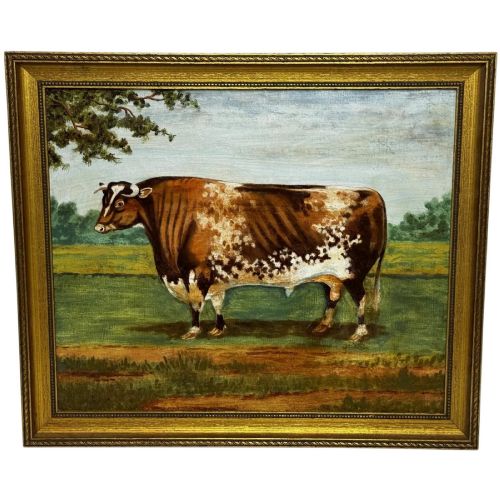
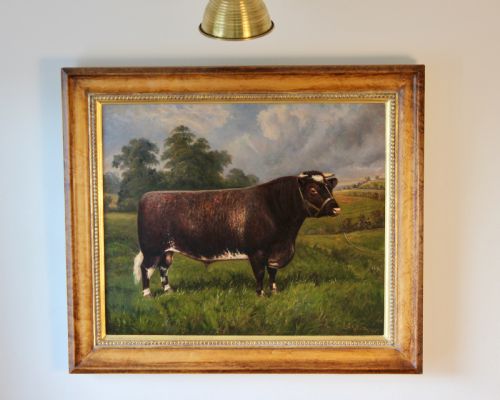
English country livestock art encompasses nineteenth-century and early twentieth-century depictions of farm animals, cattle, sheep, and poultry set within rural landscapes and stables. These works reflect the agricultural focus of the period, ranging from formal portraits of prized shorthorn bulls to bustling farmyard scenes.
Buyers will encounter various stylistic approaches on this page, including Victorian animalier, genre realism, and English folk art. The subjects vary from solitary prize-winning livestock to herds grazing by rivers and poultry gathered in farmyards.
Materials and construction
These works are executed primarily as oil paintings on canvas or watercolours on paper, capturing the texture of animal coats and rural light. The pigments reflect the traditional palettes of the nineteenth and early twentieth centuries.
Many pieces retain their period frames, constructed from wood with gesso, gold leaf, and gilt wood finishes that complement the traditional pastoral subject matter.
Cockerels, chickens, and chicks frequently steal the agricultural spotlight from rather more serious livestock.
Assessing quality and execution
Quality in these pastoral works rests upon the anatomical accuracy of the animals, the depth of the background landscape, and the handling of light and texture. Finer examples display careful observation of livestock conformation and realistic animal behaviour.
The sophistication of the brushwork and the condition of the original canvas, paper, and frame distinguish standard decorative works from accomplished paintings by established nineteenth-century practitioners.
Basil Bradley·Arthur Charles Dodd·W.A. Clark·Edgar Hunt·Henry Cheadle·William Sidney Cooper·William Huggins·A Davis·Thomas Sidney Cooper·Thomas Baker of Leamington
The English Country Livestock Art Glossary
- Animalier
- Art that depicts animals as its primary subject. This genre flourished during the Victorian period with detailed studies of livestock and farm animals.
- Genre Realism
- Painting that depicts everyday life and ordinary people or scenes without idealisation. In this context, it applies to realistic portrayals of farmyard activities and rural settings.
- Folk Art
- Artistic work created in a traditional style by untrained or self-taught artists. These pieces often feature a naive perspective and direct approach to subject matter.
- Gesso
- A plaster-like mixture used as a base for moulding frames before gilding. It provides a smooth surface for the application of gold leaf.
- Watercolour
- A painting method in which the paints are made of pigments suspended in a water-based solution. Works in this medium are typically executed on paper.
English Country Livestock Art: Frequently Asked Questions
What periods do these paintings date from?
The works span the nineteenth century and early twentieth century, encompassing the Victorian and Edwardian eras. Most pieces reflect the agricultural interests of this extended period.
Dating is typically established through the costume, frame construction, signatures, and subject matter characteristic of the nineteenth and early twentieth centuries.
How should I hang and care for these paintings?
Keep these artworks away from direct sunlight, damp walls, and sudden temperature fluctuations to protect the canvas, paper, and gilt wood frames.
Display them on stable interior walls using appropriate picture-hanging hardware that supports the weight of the traditional wooden frames.
How do I tell an oil painting from a watercolour?
Oil paintings use thick pigments on canvas that show visible brush texture and a slight sheen. Watercolours are executed on paper and usually displayed behind protective glass.
Examining the surface under a light reveals the distinct textural differences between canvas weave and paper grain.
What subjects are most common?
Cattle, sheep, horses, and poultry form the primary subjects, often shown in farmyards, stables, or river landscapes. Many pieces focus on specific prize-winning farm animals.
The works range from quiet pastoral scenes to detailed portraits of individual livestock raised for agricultural exhibitions.