
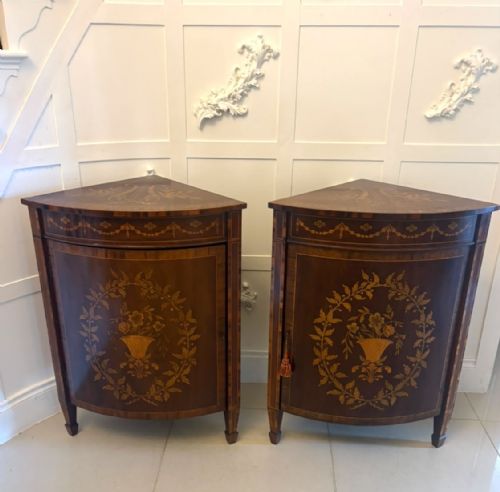


English Corner Cabinet
An english corner cabinet transforms dead vertical room angles into display space while hiding domestic clutter behind panelled or glazed doors.
English Corner Cabinet
An english corner cabinet serves to utilise awkward junctions in a room, turning empty geometry into storage or display.
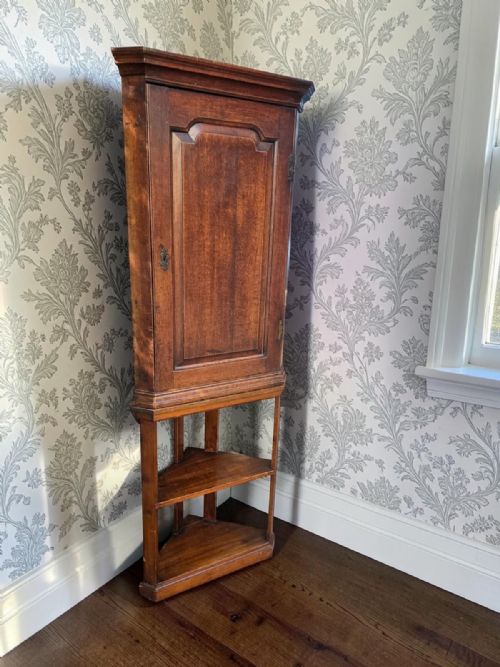
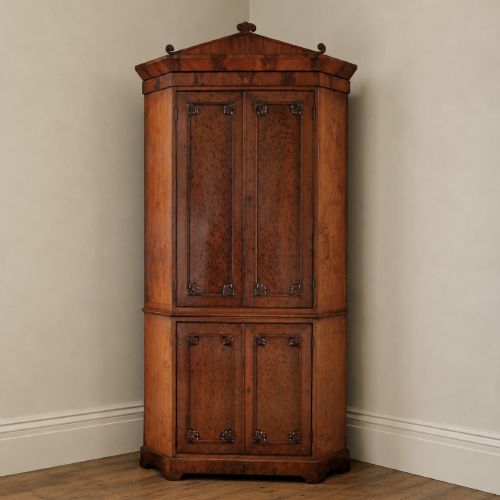
The pieces found here divide primarily into wall-hanging units and taller floor-standing or two-part forms dating from the Georgian period through to the Edwardian era.
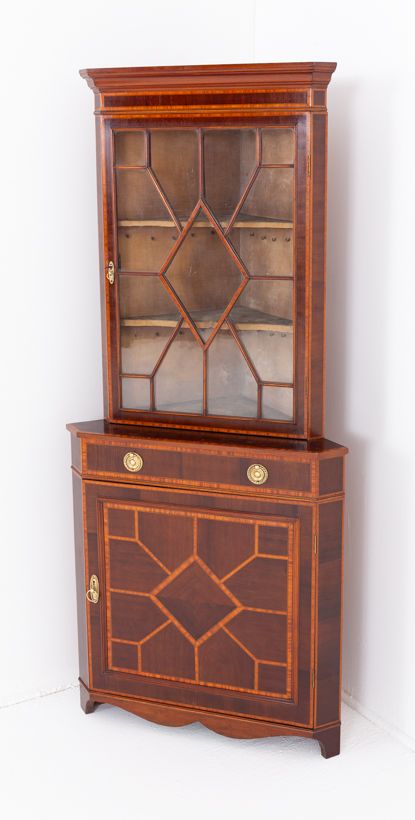
Earlier Georgian examples often utilise robust oak or figured mahogany with simple panelled doors, whereas later Edwardian and revival pieces introduce satinwood and marquetry.
Materials and Construction
Cabinet makers relied on solid oak and dense mahogany, frequently enhanced by flame mahogany veneers or contrasting crossbanding in fruitwood and satinwood.
Glass doors employ wooden glazing bars, often configured in geometric or astragal patterns to showcase porcelain and glassware.
Brass hinges, key escutcheons, and working locks provide functional security alongside decorative contrast.
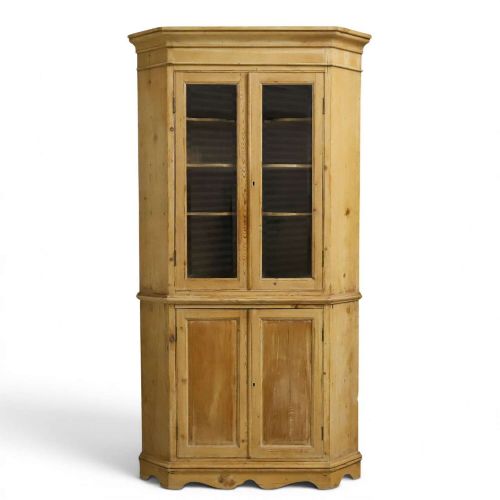
Chemists and apothecary shops utilised modified pine versions for narrow bottle storage.
Craftsmanship and Proportion
Quality rests upon the selection of timber, visible in the grain matching of flame mahogany or the tight growth rings of early oak.
Fine joinery shows in the dovetail construction of internal drawers and the tight fit of panelled doors that counter seasonal wood movement.
Subtlety of internal shelving, original brass hardware, and crispness of inlaid stringing distinguish superior examples from utilitarian workshop output.
The English Corner Cabinet Glossary
- Astragal
- A moulding profile used to divide glass panes in cabinet doors. These thin wooden bars create decorative geometric lattices.
- Crossbanding
- A strip of veneer laid perpendicular to the surrounding grain along the edge of a panel. This technique frames the primary wood.
- Bow front
- A convex curved cabinet front popular during the Georgian period. It softens the stark geometry typical of corner furniture.
- Marquetry
- Inlaid patterns formed from different coloured woods fitted into a veneer ground. This decorative work often decorates Edwardian surfaces.
English Corner Cabinet: Frequently Asked Questions
How do I hang a wall cabinet?
Wall-hanging examples require secure anchorage into solid masonry or substantial internal timber studs due to the combined weight of dense hardwood and stored contents.
Original brass mounting brackets or internal screw points distributed through the backboards provide the primary support.
What is a two-part corner cabinet?
A two-part form consists of an upper display section resting upon a separate lower cupboard base. This construction aided transport into domestic interiors.
Floor-standing variations of this scale offer substantial storage capacity without dominating floor space.
How do I date an oak corner cupboard?
Early 18th-century pieces display hand-cut joinery, pegged tenons, and dense native oak boards without modern machine intervention.
Later Victorian and Edwardian interpretations utilise standardised fixings, machine-cut mouldings, and imported secondary softwoods.
Can these cabinets hold heavy books?
Hanging cupboards suit lighter display items such as porcelain, ceramics, and glassware rather than heavy libraries.
Standing models with robust internal shelving handle heavier loads safely within their structural limits.