
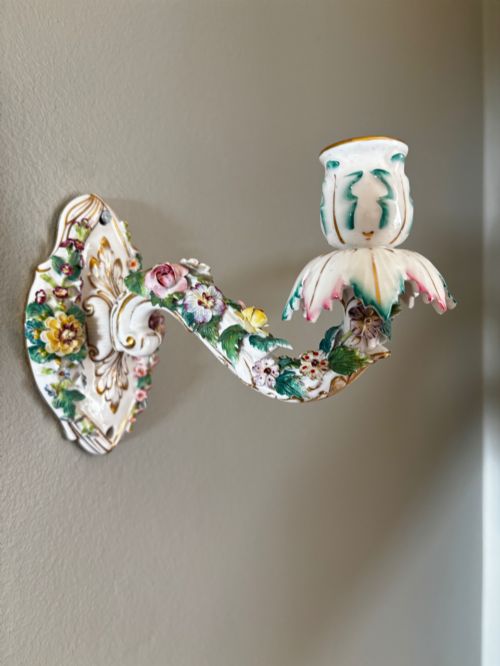


Encrusted Floral Porcelain Candlesticks
These encrusted floral porcelain candlesticks bring Victorian tables alive with dense, colourful blossom work and gilt flourishes.
Encrusted Floral Porcelain Candlesticks
When you search for encrusted floral porcelain candlesticks, you find ornate lighting pieces formed from hard-paste porcelain and decorated with applied ceramic flowers. The selection on this page centres on nineteenth century German works, particularly pieces originating from Meissen, Sitzendorf, Dresden and Minton.
Forms range from single candle wall sconces and simple candlesticks to large pairs of multi-arm candelabra. Many examples incorporate figural elements alongside the floral motifs, reflecting the exuberant Rococo Revival style of the period.
Most items date from the late nineteenth century, specifically the eighteen eighties, eighteen nineties, and around nineteen hundred, alongside occasional earlier nineteenth century pieces. Buyers encounter both single items and matched pairs designed to light a formal mantelpiece or dining table.
How they were made
Potters built these pieces using hard-paste porcelain, shaping the main body by hand or mould before applying delicate ceramic petals and leaves individually to the surface. This meticulous encrusting technique required immense patience, as each tiny flower had to be formed and attached securely prior to firing.
Makers finished the pieces with detailed enamel painting and rich gilding, using gold leaf or liquid gilding to highlight the moulded scrolls and candle sockets. Transparent glaze seals the porcelain body and locks the vibrant enamel colours in place during the kiln firing.
Listings span the nineteenth century up to nineteen hundred, featuring hard-paste porcelain, enamel, gold leaf, and glaze.
What varies in quality
The distinction between ordinary and exceptional pieces lies in the density and crispness of the floral encrustation. Superior examples retain every delicate petal and leaf without heavy restoration, displaying sharp moulding beneath the enamel and gold leaf.
Figural modelling also determines the grade of a piece, with finer works showing expressive faces, well-defined hands, and complex multi-arm structures. The application of the gilding and the precision of the hand-painted enamel work reveal the skill of the original workshop.
Meissen·Sitzendorf·Minton
The Encrusted Floral Porcelain Candlesticks Glossary
- Hard-paste porcelain
- A durable ceramic material composed of kaolin and petuntse, fired at very high temperatures. This substance forms the strong, vitrified body necessary for intricate candleholders.
- Enamel
- Opaque glass-based colour applied to the glazed porcelain surface before a final low-temperature firing. Enamels provide the bright, lasting hues seen on the petals.
- Gilt
- A thin layer of gold or gold leaf applied to the porcelain surface to accent raised details. Gilding catches the candlelight and adds richness to the design.
- Rococo Revival
- A nineteenth century design movement borrowing the curving asymmetry and shell motifs of the eighteenth century. This style dictates the sweeping, scroll-heavy forms of these candleholders.
- Candelabra
- A branched lighting fixture holding multiple candles on a single base. These larger pieces often match the height and style of paired candlesticks.
Encrusted Floral Porcelain Candlesticks: Frequently Asked Questions
What periods do these pieces date from?
The items listed on this page originate primarily from the nineteenth century, with specific examples dated across the eighteen eighties, eighteen nineties, and around nineteen hundred. A few pieces extend back into the earlier part of the nineteenth century.
These dates reflect the height of the Rococo Revival movement in European porcelain manufacturing, particularly within German workshops.
How do single candlesticks differ from candelabra?
Single candlesticks hold one candle on a vertical shaft, whereas candelabra feature branched arms designed to support multiple candles simultaneously. Candelabra often provide a more imposing decorative presence on a sideboard or table.
Both forms share the characteristic applied floral encrustation and gilt detailing typical of the period.
What materials make up these candleholders?
The primary material is hard-paste porcelain, coated in a smooth glaze and decorated with coloured enamel paints. Gold leaf and liquid gilding highlight the moulded details.
Applied ceramic petals and leaves create the dense floral encrustation that covers the porcelain body.
Where were these porcelain pieces made?
The majority of the pieces originate from established European porcelain factories, notably German establishments such as Meissen, Sitzendorf, and Dresden. British firms like Minton also produced comparable figural and floral work during the nineteenth century.
These workshops employed skilled modlers and painters to execute the complex floral encrustations.