


Enameled Ruby Glass
These enameled ruby glass pieces are rich decorative objects that bring deep colour and Victorian character to any room.
Enameled Ruby Glass
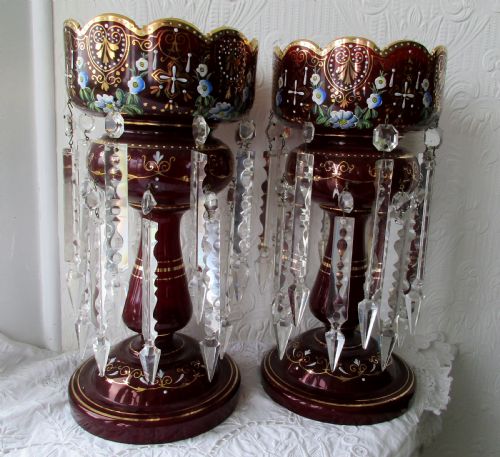
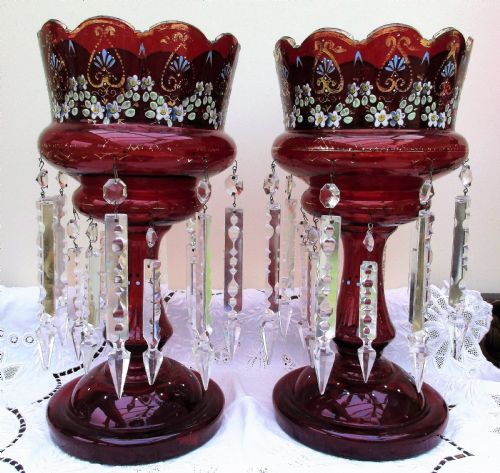
When you search for enameled ruby glass, you encounter pieces designed primarily for display rather than utility. Mantel lustres and vases dominate the selection, often appearing in pairs that anchor either end of a mantelpiece.
The objects stem predominantly from the nineteenth century, with Victorian and Bohemian examples forming the core of what is available. These items range from large, commanding mantel lustres hung with spear prisms to smaller decorative vases and perfume bottles.
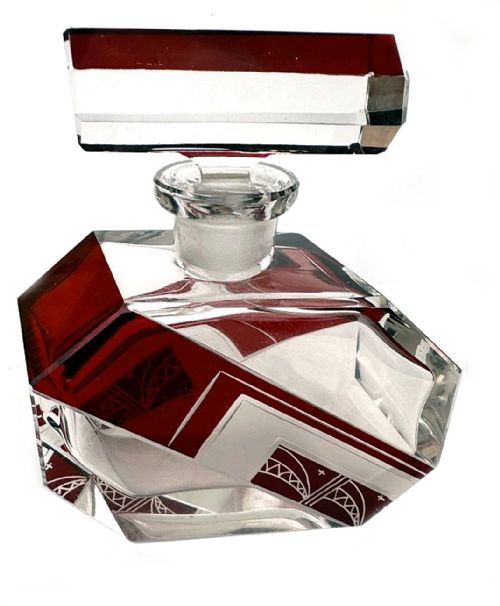
The style spans classical Victorian ornamentation and occasional Art Deco forms such as the Karl Palda perfume bottle. Collectors also encounter Mary Gregory pieces featuring white enamel silhouette figures, alongside rich cranberry glass and crystal overlay work.
How they were made
Makers produced these items using rich ruby and cranberry glass as a base material, frequently applying crystal overlay to create depth. Artisans then shaped the hot glass into vases, jars, and lustres through blowing and cutting techniques.
Decoration relied on skilled hand painting with enamel and gold leaf. Workers applied opaque white enamel to render figures, floral motifs, and foliage directly onto the deep red glass surface, often accentuating the details with gilding.
Listings feature nineteenth-century Victorian and Bohemian glassware, including mantel lustres, perfume bottles, and Mary Gregory vases.
What varies in quality
The standard of enameled ruby glass depends heavily on the crispness of the glass cutting and the hand control evident in the enamel work. Superior examples display finely rendered white enamel figures with clean lines, whereas simpler pieces show coarser brushwork.
Scale and completeness dictate the character of each item, particularly with mantel lustres where the presence and matching nature of hanging prisms matter greatly. The depth of the ruby colour and the richness of the gilding also separate standard production wares from the finest workshop pieces.
Karl Palda
The Enameled Ruby Glass Glossary
- Mantel lustres
- Large decorative ornaments designed to sit on a mantelpiece, featuring a central vase body fitted with a ring of hanging crystal prisms. These prisms catch the light and create a glittering display.
- Cranberry glass
- A transparent pinkish red glass produced by adding gold chloride to the molten batch. It provides a lighter, brighter alternative to deep ruby glass.
- Crystal overlay
- A technique where a layer of clear crystal glass is fused over a coloured glass base, then selectively cut away to reveal the ruby glass underneath. This creates a striking contrast in texture and tone.
- Mary Gregory
- A style of decorative glass featuring white enamel silhouettes of children, birds, or foliage. The technique was named after an American decorator, though most pieces of this type originated in Bohemia and England.
Enameled Ruby Glass: Frequently Asked Questions
What are mantel lustres used for?
Mantel lustres served as decorative shelf ornaments in Victorian parlours, designed to catch the flickering light of candles or gas lamps.
They were rarely used for holding flowers, functioning instead as high-status decorative objects that anchored the mantelpiece arrangement.
How do I tell ruby glass from cranberry glass?
Ruby glass exhibits a deep, intense red hue that can appear almost opaque in thick sections. Cranberry glass tends to be lighter and brighter, showing a distinct pinkish red tone when held to the light.
Both materials were used extensively in the nineteenth century, often appearing alongside gilt and enamel decoration.
Are Mary Gregory pieces English?
Despite the American name associated with the enamel decorating style, most pieces bearing white enamel figures originated in European glasshouses, particularly in Bohemia and England.
These items date predominantly to the Victorian era and include small vases, jars, and jugs.
How do I care for enameled glass?
These decorative pieces require gentle handling, particularly around delicate hanging prisms and applied surface gilding. Dust them softly with a dry cloth and avoid harsh cleaning agents that might damage the enamel.
Keep them out of direct, intense sunlight to protect the integrity of the coloured glass and gold leaf.