






Empire Tallboy Drawers
Empire tallboy drawers bring striking vertical presence and classical proportion to a room, offering ample storage within stately French and Swedish designs.
Empire Tallboy Drawers
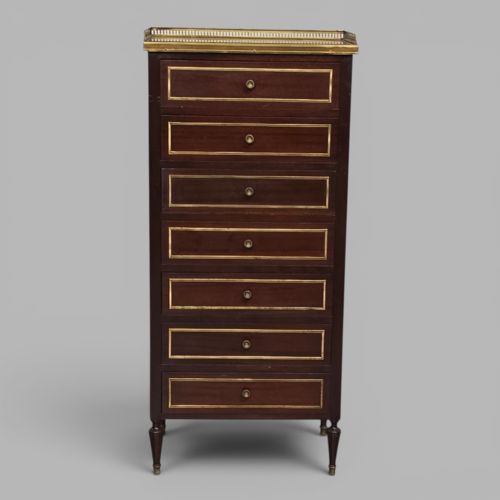
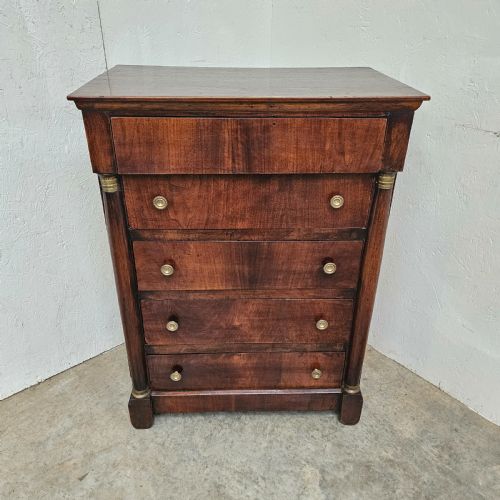
Empire tallboy drawers comprise stately vertical chests of drawers, semainiers, and secretaire cabinets spanning the nineteenth century alongside later revival periods. Buyers seeking empire tallboy drawers encounter substantial pieces originating from French workshops and Swedish interiors.
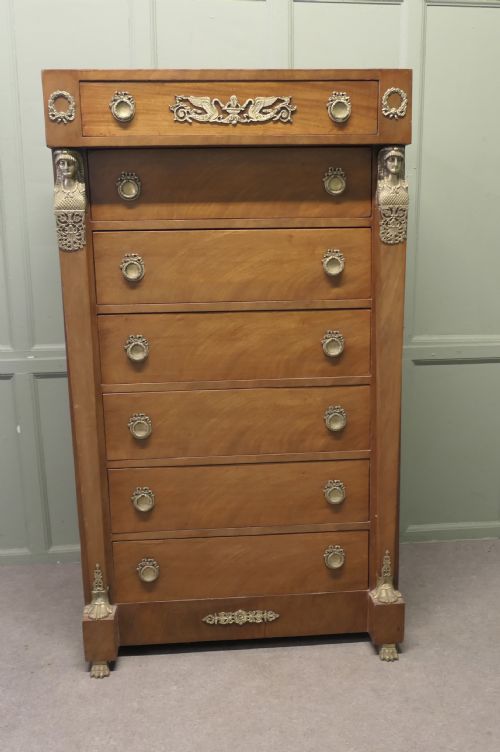
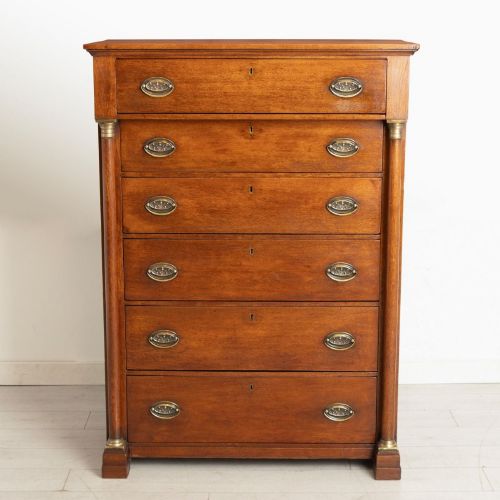
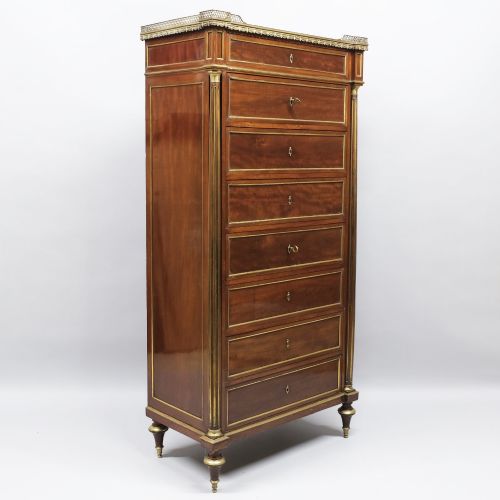
The selections on this page emphasise tall formats, often featuring five or six primary drawers designed to maximise storage capacity without dominating floor space. These pieces frequently incorporate secretaire writing compartments or marble tops atop timber carcases.
What varies in quality
Quality rests in the precision of the veneer selection, where bookmatched figuring and consistent grain alignment elevate the visual impact of the timber carcase. The crispness of the cast ormolu and gilt bronze mounts similarly separates standard production from finer outputs.
Structural integrity of the deep drawer frames and the smooth operation of internal secretaire compartments indicate superior craftsmanship. The integration of heavier elements, such as fitted marble slabs and heavy brass hardware, reflects the original tier of commissioning.
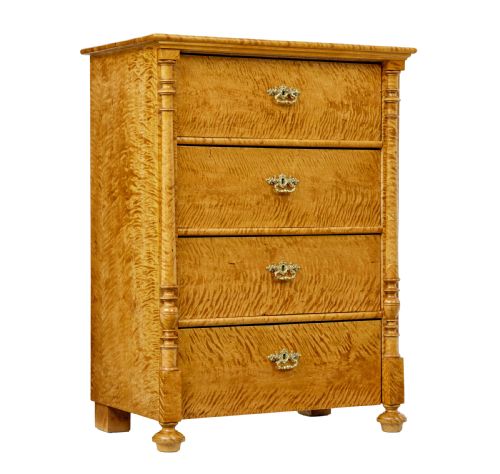
Listings feature nineteen-century pieces alongside 1920 revival items, constructed from mahogany, walnut, birch, cherry, and oak.
The Empire Tallboy Drawers Glossary
- Semainier
- A tall seven-drawer chest traditionally designed with one drawer for each day of the week. These narrow pieces provide significant vertical storage.
- Ormolu
- Gilt bronze ornamentation applied to furniture mounts and hardware. It offers a bright metallic contrast against dark timbers like mahogany and walnut.
- Secretaire
- A cabinet incorporating a pull-down writing flap revealing small interior drawers and pigeonholes. These multifunctional units combine desk space with general drawer storage.
- Biedermeier
- A Central European style prioritising clean lines, minimal ornamentation, and warm domestic timbers. It developed alongside the broader Empire aesthetic.
- Bookmatched
- A veneering technique where adjacent slices of timber are mirrored to create symmetrical patterns across drawer fronts. This method highlights natural grain figures.
- Marquetry
- Inlaid wood veneers forming decorative patterns or pictorial scenes. It appears on select cabinet surfaces to add ornate detail.
Empire Tallboy Drawers: Frequently Asked Questions
What is an empire tallboy?
An empire tallboy is a tall, vertical chest of drawers influenced by the classical proportions of the nineteenth-century Empire style. These pieces provide substantial storage capacity while maintaining a narrow floor footprint.
They frequently appear as French semainiers or Swedish birch cabinets adorned with brass or ormolu mounts.
How do I use a tall chest in a bedroom?
A tall chest provides vertical storage for clothing and linens without requiring wide wall space. They fit neatly into corners or between windows where standard low chests cannot go.
The top surface also offers a convenient display area for lamps or decorative objects.
What woods are common on these pieces?
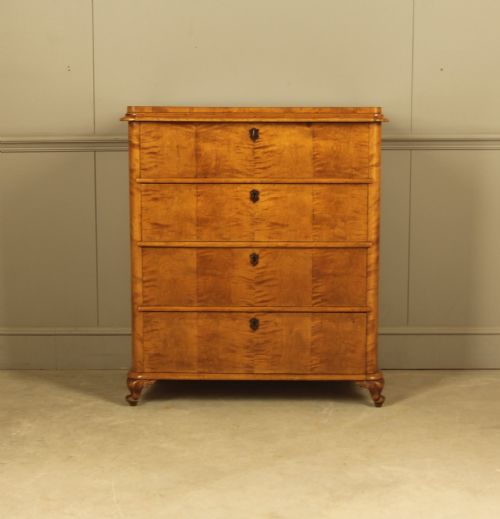
Mahogany and walnut dominate French designs, often accented with bookmatched grain patterns and gilt metal mounts. Swedish pieces frequently utilise birch, flame birch, and tiger birch for a lighter aesthetic.
Pine and oak commonly form the internal carcase structures beneath these fine exterior veneers.
How do I identify a semainier?
A semainier is characterised by its tall, slender profile containing multiple stacked drawers, traditionally numbering seven. They were designed in France to hold a week's worth of personal garments.
Many examples feature marble tops and locking mechanisms securing the entire stack via a single side key.
Are these pieces purely French?
While many examples originate from French workshops following the Empire and Neo-Classical styles, a significant portion comes from Sweden. Swedish Biedermeier and Empire Revival pieces offer distinctive blond birch timbers and restrained neoclassical lines.
Dutch examples featuring marquetry inlay also appear within this furniture category.