


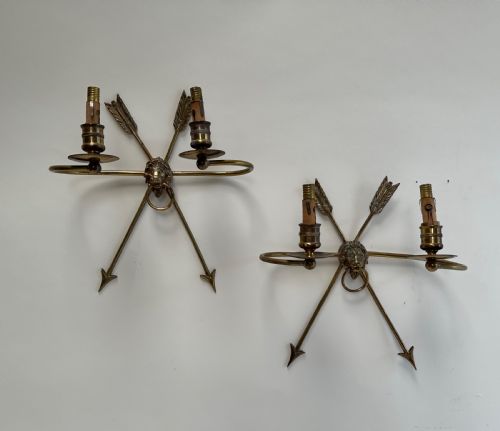
Empire Style Wall Appliques
Empire style wall appliques bring classical symmetry and gleaming metalwork to a room, offering functional illumination rooted in nineteenth-century design.
Empire Style Wall Appliques
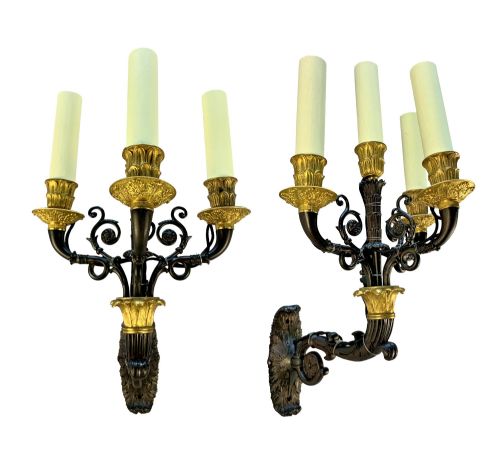
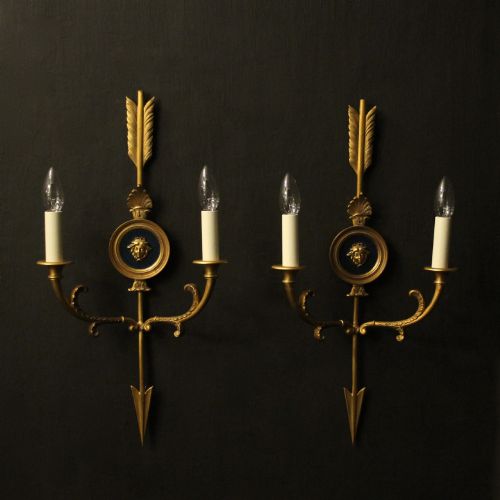
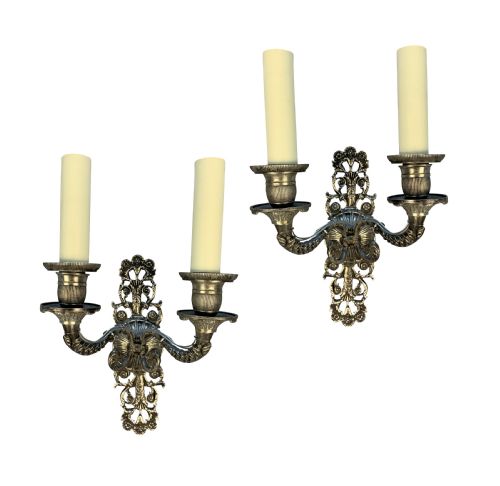
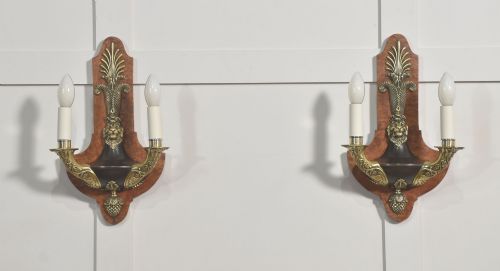
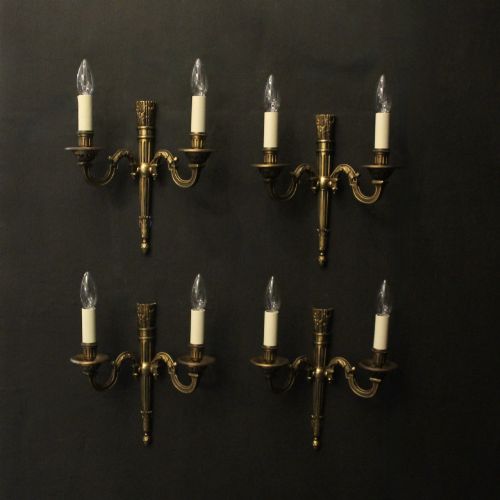
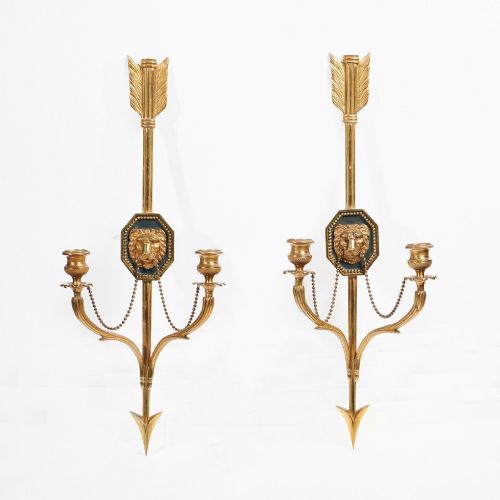
Empire style wall appliques are decorative lighting fixtures designed to mount directly onto vertical surfaces, providing both ambient and directed illumination. When searching for empire style wall appliques, buyers encounter pieces that draw heavily on neoclassical motifs, classical architecture, and ancient Roman or Greek iconography.
The selections available here predominantly originate from French workshops, alongside English and Italian interpretations, spanning the nineteenth century through the early decades of the twentieth century. Most examples appear as matched pairs, featuring multi-branch configurations designed to balance light evenly across a drawing room, hallway, or boudoir.
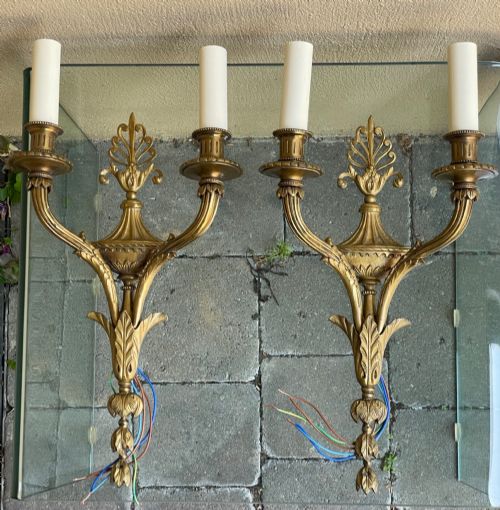
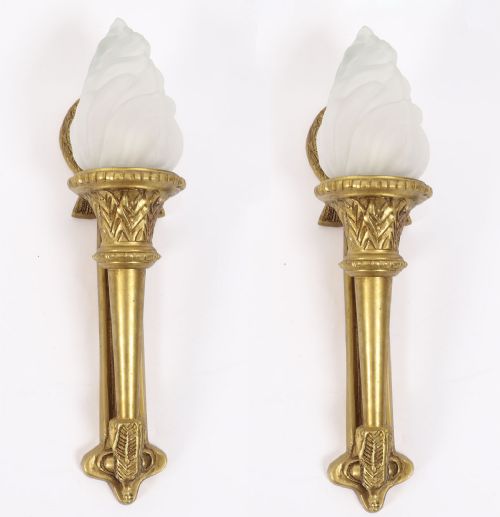
The forms range from twin-arm sconces to larger four-branch wall lights, frequently incorporating architectural elements such as flaming torches, urns, and draped garlands. These fixtures serve as both practical light sources and sculptural wall ornaments that define the character of a period interior.
How they were made
The construction of these wall appliques relies primarily on metal casting techniques using brass, bronze, and copper alloys. Artisans poured molten metal into detailed moulds before chasing the cooled surfaces by hand to sharpen the leaf motifs, fluting, and figural details.
Surface decoration frequently involved fire gilding, also known as ormolu, which bonded a mercury and gold amalgam to the bronze base through heat, producing a durable and luminous golden finish. Patinated bronze elements were often contrasted against this bright gilding, while occasional examples integrated secondary materials such as burr walnut, ebonised wood, or glass components.
Several pairs disguise their illumination entirely as flaming torches, letting electricity pretend it learned how to burn from ancient Rome.
What varies in quality
Quality in these lighting fixtures is determined by the crispness of the metal casting and the depth of the subsequent hand-chasing. Superior examples exhibit sharply defined acanthus leaves, clean drapery folds, and precise geometric borders that retain their definition despite the smoothing effects of cleaning over the decades.
The richness and integrity of the original surface finishes further distinguish finer pieces, particularly where fire gilding or ormolu remains deep and even across complex contours. Heavier gauge metalwork and robust mechanical joints ensure that multi-branch frames support the weight of their arms securely without sagging or twisting away from the wall mounting plate.
The Empire Style Wall Appliques Glossary
- Ormolu
- Gilded bronze produced by applying a mercury-gold amalgam to a bronze object and heating it until the mercury vaporised, leaving a rich gold coating. This technique creates a distinctive, deep lustre characteristic of fine period metalwork.
- Applique
- A decorative wall-mounted lighting fixture designed to hold candles or electric bulbs. The term is frequently used interchangeably with wall sconce.
- Patinated bronze
- Bronze that has been treated chemically or allowed to age naturally to produce a dark, protective surface layer. This dark tone provides visual contrast against gilded highlights.
- Neoclassical
- An artistic movement drawing inspiration from the classical art and culture of ancient Greece and Rome. It emphasises symmetry, proportion, and classical architectural motifs.
- Torchere
- A decorative form modelled after a flaming torch, often incorporated into the design of wall lights to symbolise illumination. These fixtures frequently feature stylized flames issuing from a central urn or bracket.
Empire Style Wall Appliques: Frequently Asked Questions
How do I wire old wall lights?
Rewiring period wall appliques requires running modern insulated cable through the existing hollow arms and backplates, a task best performed by a qualified electrician to ensure safety compliance. Many original fixtures accommodate modern candle tubes and small SES lamp holders discreetly within the drip pans.
Care is taken to preserve the original mounting brackets and structural integrity of the metalwork without altering visible exterior surfaces during the conversion process.
How do I clean gilded bronze?
Gilded bronze and ormolu require gentle dusting with a soft, dry brush to remove surface particles without abrading the delicate metallic layer. Moisture and harsh chemical cleaners should be avoided entirely to prevent stripping the historic finish.
Professional conservation advice is recommended if deeper cleaning becomes necessary to address accumulated tarnish or grime.
What is the difference between Empire and Regency styles?
French Empire style emerged under Napoleon, heavily referencing Roman imperial grandeur through heavy ormolu mounts, military trophies, and classical laurel wreaths. English Regency style developed concurrently, sharing classical roots but often incorporating lighter proportions, ebonised details, and distinctively native cabinet-making traditions.
Both styles utilise similar bronze casting methods and share a vocabulary of ancient architectural motifs.