






Empire Style Foyer Table
An empire style foyer table brings architectural grandeur to an entrance hall, offering a striking focal point with classical proportions and rich timber.
Empire Style Foyer Table
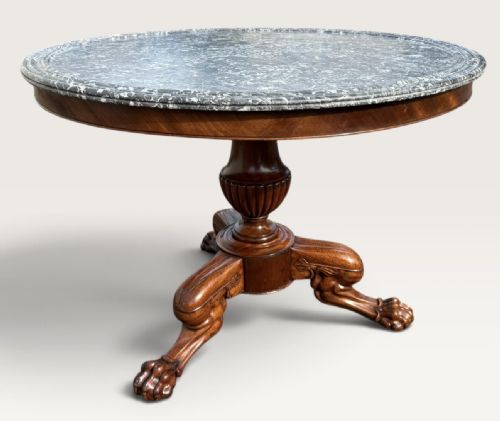
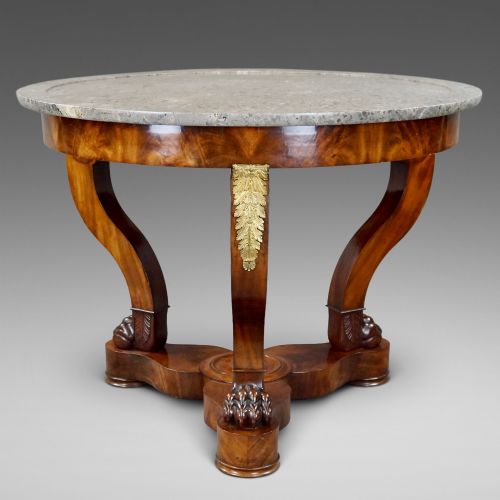
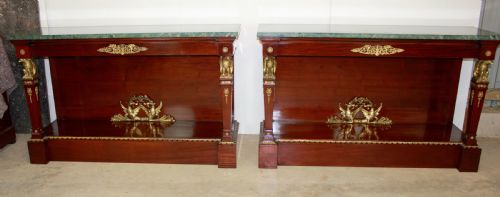
An empire style foyer table predominantly appears as a round gueridon or a console table designed to anchor an entrance hall. These pieces draw upon French Empire, Swedish Empire, and Empire Revival idioms to create a formal presence.
The selection centres heavily on nineteenth-century originals alongside later revivals from nineteen hundred to nineteen twenty. Buyers encounter round centre tables and console tables designed with heavy geometric silhouettes.
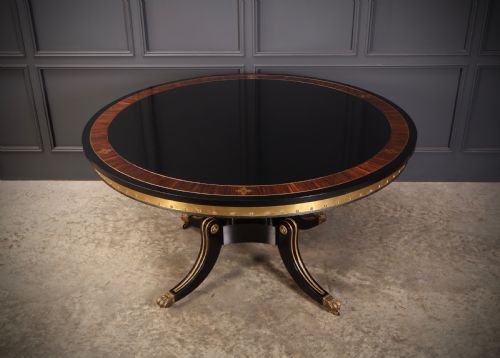
Mahogany and walnut form the structural core of these examples, frequently enhanced by contrasting ebonised wood. The proportions remain grand, suited to spacious hallways and reception rooms.
Construction and Materials
Cabinet makers built these tables using solid timbers and wood veneers over sturdy construction bases. Mahogany and walnut provide the primary carcase materials, often finished with ebonised surfaces.
Heavy marble slabs form the traditional tops, resting directly upon the wooden frames. Metal mounts in brass, ormolu, and gilt bronze punctuate the woodwork along friezes and column supports.
Intricate decorative details include marquetry inlay, brass inlays, and cast mounts taking the form of rams heads or swans. Parcel silvered and painted finishes appear on select revival pieces.
Empire Style Foyer Table Retail Price Guide 2026
Typical asking prices for empire style foyer table among the pieces listed under this phrase on Sellingantiques today, from the lower quarter to the upper quarter. They describe what is for sale here now, not the wider market.
Listings feature pieces spanning the nineteenth century alongside revival items from nineteen hundred, nineteen twenty, eighteen sixty, eighteen eighty, and eighteen ninety.
Distinctions in Quality
The grade of the marble top significantly influences the character of the table, ranging from standard white stone to rich porphyry variants. Finer examples integrate heavy, solid marble slabs that fit precisely within the wooden gallery.
The execution of cast metal mounts defines the distinction between standard production and superior work. Crisp chasing on brass, ormolu, and gilt bronze elements indicates careful workshop attention.
Timber selection and veneer matching reveal the cabinet maker's skill. Figured mahogany and walnut displays lively grain patterns across large surfaces without interruption.
The Empire Style Foyer Table Glossary
- Gueridon
- A small round table supported by a single central pillar or three legs. This form serves as a primary shape for nineteenth-century entrance tables.
- Ormolu
- Gilded bronze applied as decorative mounts on furniture. It adds a bright metallic contrast to dark woods.
- Ebonised wood
- Timber treated to imitate ebony through staining or painting. This dark finish provides sharp visual contrast against brass inlays and marble tops.
- Marquetry
- Decorative patterns formed by fitting together small pieces of wood veneer. It creates complex geometric designs on table tops and friezes.
- Porphyry
- A hard igneous rock with crystal inclusions used for decorative table surfaces. It offers a distinctive purple-red hue.
Empire Style Foyer Table: Frequently Asked Questions
Where should an empire style foyer table go?
These tables find their natural home in entrance halls and large reception rooms where their circular or console shapes command attention. They serve as a surface for lamps, vases, or decorative objects.
Because many examples feature delicate marble tops and gilt mounts, positioning them away from heavy family traffic prevents accidental knocks.
How do I care for the marble top?
Marble requires gentle cleaning with warm water and a soft cloth to preserve the polished surface. Acidic substances like citrus juice or wine can etch the stone.
Using coasters and mats protects the mineral top from moisture rings and scratches over years of daily use.
Are these tables solid mahogany?
Most nineteenth-century examples combine solid timber frames with rich wood veneers applied to stable secondary woods. This construction method prevents warping on wide table surfaces.
High-grade pieces utilise thick mahogany or walnut veneers that display deep natural grain patterns across the top.
How do I distinguish nineteenth-century originals from revivals?
Original pieces from the early nineteenth century exhibit period construction techniques, hand-cut joinery, and natural wear patterns on the timber. Revival pieces from nineteen hundred often show different internal secondary woods and machine precision.
Examining the casting quality of the brass or ormolu mounts also helps determine the exact period of manufacture.