


Empire Portico Clock
An empire portico clock brings architectural columns, gleaming metalwork, and precise French horology straight to your mantelpiece.
Empire Portico Clock
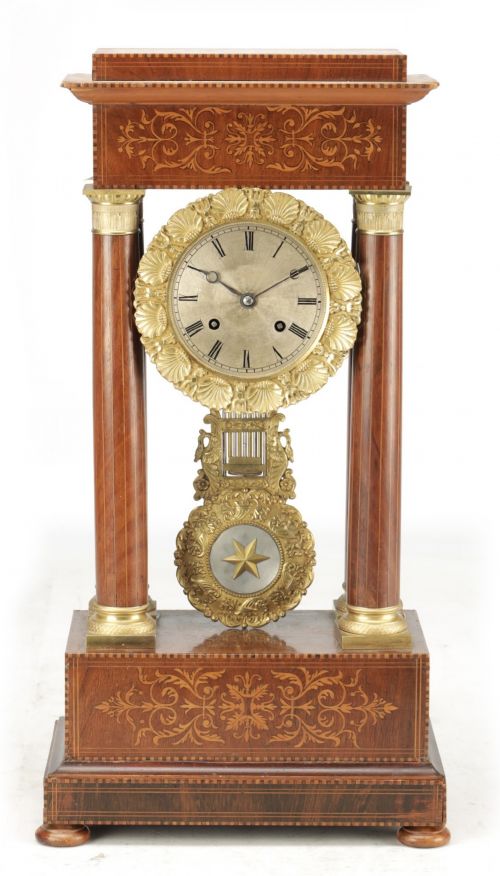
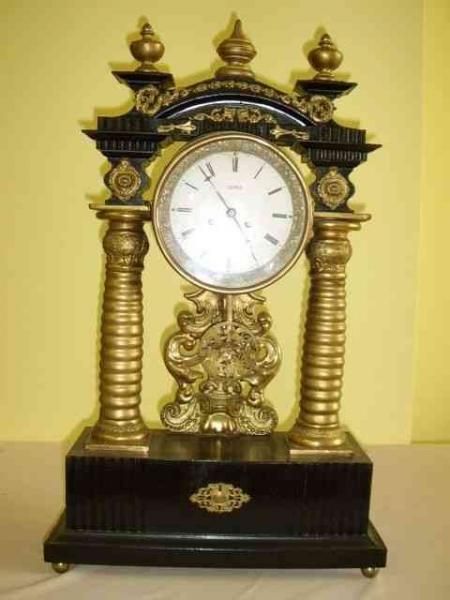
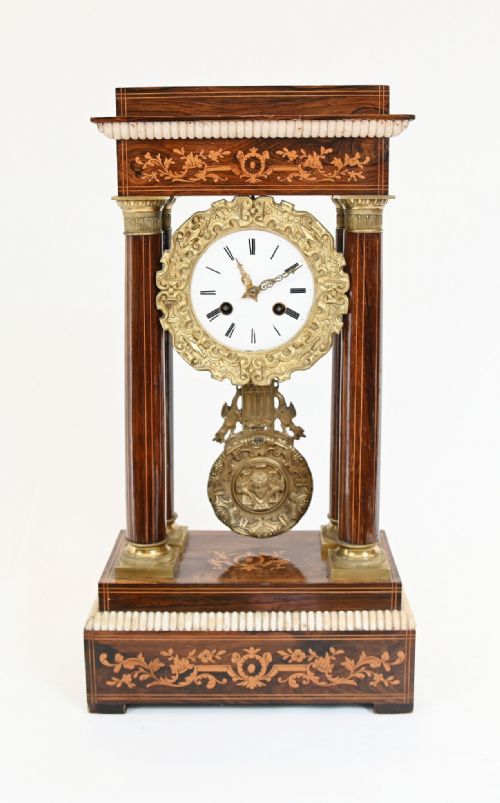
An empire portico clock is an architectural timepiece supported by slender columns arranged over a distinct base and top lintel. These pieces draw heavily on classical design, taking inspiration from ancient architectural forms translated into domestic clocks.
Buyers will encounter French examples spanning the nineteenth century alongside earlier models from the late eighteenth century. The form typically houses the dial centrally between two or four pillars, often accompanied by a pendulum swinging visibly within the open archway.
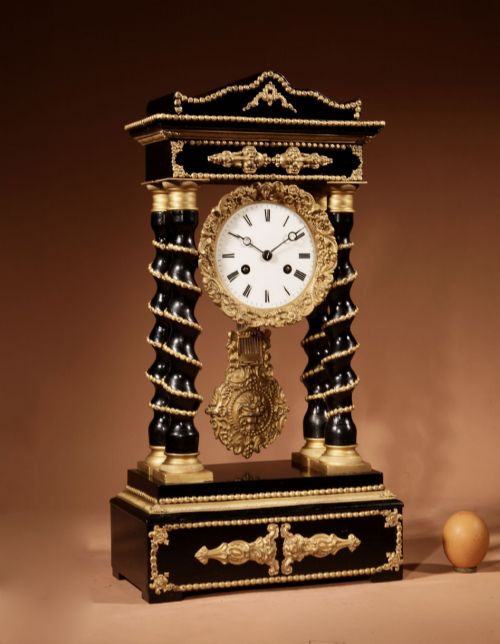
Variations on this page range from classical marble and ormolu designs to polished rosewood, mahogany, and ebonised wood versions. Certain pieces incorporate glass domes or form part of a clock garniture set with matching side pieces.
How They Were Made
Makers constructed the architectural framework using dense timbers such as rosewood, mahogany, and ebonised wood, frequently enhanced with contrasting inlay or satinwood. Alternatively, bodies were sculpted from white marble, siena marble, or alabaster to form the solid base, pillars, and pediment.
Gilt bronze, ormolu, and patinated bronze provided the decorative mounts, capitals, bezels, and pendulum bobs that bring metallic brilliance to the timber and stone structures. Enamel dials, often featuring delicate numerals, sit behind glass within brass bezels to complete the movement housing.
What Varies in Quality
The refinement of the cast bronze and ormolu mounts dictates the visual hierarchy, with crisper chasing and deeper gilding separating superior examples from simpler productions. The choice of primary material also sets the tone, where finely figured rosewood or heavy carved marble elevates the piece above standard ebonised alternatives.
Breguet·Baltazart
The Empire Portico Clock Glossary
- Portico clock
- A mantel clock designed with architectural columns supporting a top entablature, framing a central suspended pendulum. This style reflects classical building designs adapted for domestic interiors.
- Ormolu
- Gilded bronze created by applying a mixture of gold and mercury to a bronze base, then firing to leave a rich gold layer. This technique produces the bright metallic finish seen on French classical clocks.
- Clock garniture
- A set comprising a central clock accompanied by matching decorative side pieces, such as candelabra or urns. These matched suites were designed to create a unified display across a mantelpiece.
- Mystery clock
- A timepiece where the mechanism driving the hands is concealed or appears inexplicable, often utilising transparent glass dials. These inventive designs showcase high-level horological skill.
- Knife edge suspension
- A specialised pendulum suspension system using thin steel edges instead of a traditional spring. This reduces friction to improve the accuracy of the timekeeping.
Empire Portico Clock: Frequently Asked Questions
Where should I place an empire portico clock?
These clocks suit prominent locations such as a drawing room mantelpiece or a sturdy sideboard where their architectural lines can be fully appreciated. Because many versions incorporate glass domes or delicate suspended pendulums, they require a stable surface away from heavy household traffic.
Positioning the clock out of direct sunlight protects sensitive materials like enamel dials and rosewood veneers from fading. Ensuring the surface is completely level also helps the pendulum swing evenly and keeps the movement running accurately.
How do I wind an antique portico clock?
Winding requires using the appropriate key inserted into the winding holes on the enamel dial, turning gently until resistance is felt. Care must be taken not to overwind the spring, which can damage the internal mechanism.
If the clock includes a striking train or musical mechanism, both sides of the movement may need attention depending on the specific design. Consulting the individual movement type helps determine the correct winding frequency and care routine.
How do I tell Charles X clocks apart from later Victorian pieces?
Charles X pieces, dating from the early nineteenth century, typically lean towards refined ormolu, cut crystal, and exotic woods like rosewood with crisp Neoclassical proportions. They often reflect a direct continuation of French Empire aesthetics with balanced, restrained classical detailing.
Later Victorian interpretations made around 1880 frequently introduce ebonised finishes, heavier architectural forms, or alternative stone bodies like onyx. Examining the dial typography, wood selection, and casting style helps clarify the period of production.
What is a clock garniture set?
A clock garniture consists of a central clock paired with matching decorative side objects, such as matching urns or candelabra. These sets were manufactured to be displayed together as an integrated decorative ensemble on a mantelpiece.
Materials used for the clock, such as white marble, ormolu, or bronze, are mirrored exactly in the accompanying side pieces. This creates visual symmetry and a cohesive decorative statement within a room.