




Empire Period Candlesticks
Empire period candlesticks bring monumental neoclassical weight and gilt brilliance to a table, pairing dark patinated bronze with shimmering ormolu.
Empire Period Candlesticks
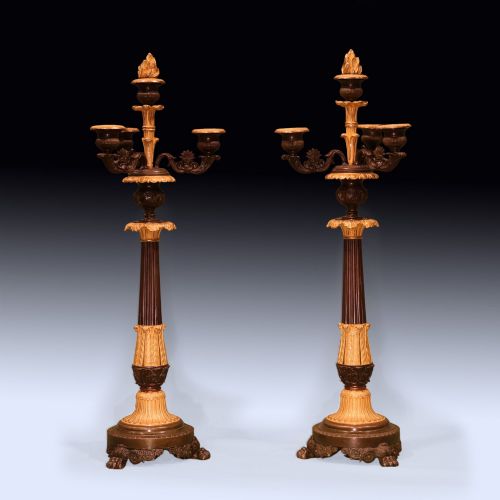
Empire period candlesticks comprise nineteenth-century lighting pieces spanning the Regency, French Empire, Charles X, and French Restauration styles. These items appear as single sticks, pairs, or larger multi-light candelabra adapted occasionally into table lamps.
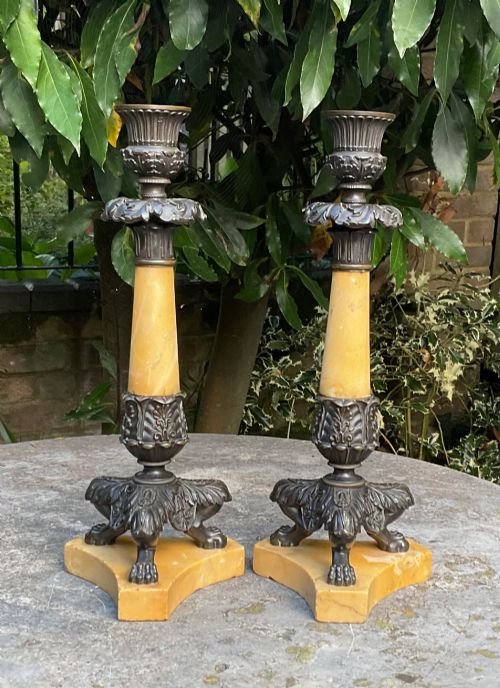
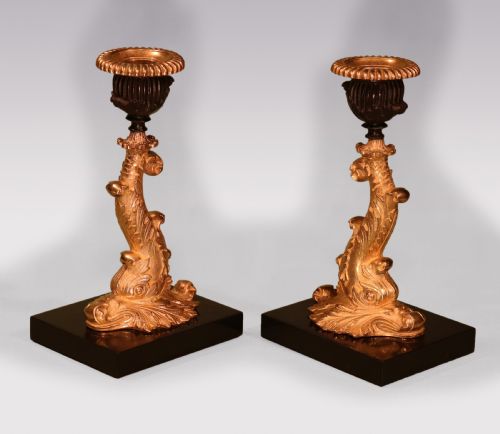
The forms draw heavily on classical motifs, presenting architectural columns, griffin supports, dolphin figures, and classical Athenienne shapes. Buyers encounter materials such as patinated bronze paired with bright ormolu, mounted frequently on marble or slate plinths.
Origins trace principally to British Regency workshops and continental French ateliers operating during the early nineteenth century. Surviving examples demonstrate the formal symmetry and martial or mythological iconography favoured during the Napoleonic era and subsequent Bourbon restoration.
What varies in quality
Crispness in the chasing of the ormolu and bronze separates superior examples from simpler production pieces. Deep, sharply defined casting retains its edge and reads clearly across a room.
The choice of base materials influences overall presence, with dense sienna marble plinths and heavy patinated bronze showing greater substance than lesser alloy counterparts.
Listings feature nineteenth-century materials including ormolu, patinated bronze, sienna marble, slate, and cut glass across Regency and French styles.
The Empire Period Candlesticks Glossary
- Ormolu
- Gilt bronze produced by applying a mercury and gold amalgam to a bronze base before firing. This technique creates a rich, matte gold surface characteristic of nineteenth-century luxury goods.
- Patinated bronze
- Bronze treated with chemical solutions to achieve a controlled dark brown or black surface finish. It provides a stark contrast against bright gilt metal mounts.
- Candelabra
- A branched candlestick holding multiple candles on separate arms. These lighting pieces often feature removable upper sections to convert between single and multi-light configurations.
- Athenienne
- A classical tripod stand or basin form adapted during the neoclassical revival to serve as a support for lighting. The profile references ancient Greek incense burners and washing stands.
Empire Period Candlesticks: Frequently Asked Questions
How do I clean ormolu?
Dust gilt bronze gently with a soft dry brush to remove surface particles.
Avoid abrasive cleaners or chemical polishes that strip the historic gold layer from the metal.
Are these wired for electricity?
Many survive in original un-electrified form while others have undergone conversion into table lamps over time.
Buyers find both configurations depending on whether the pieces retain their original candle sockets or received later wiring.
What is the difference between Regency and Empire styles?
Regency design reflects British interpretations of classical motifs patronised during the prince regent's rule.
French Empire work shares the same classical roots but deploys heavier martial symbolism and bolder ormolu contrasts.
Can I use standard candles?
Historical sockets often require specific taper sizes or candle adapters to secure modern wax inserts safely.
Measure the nozzle diameter before purchasing candles to ensure a stable fit during use.