





Empire Pendule De Cheminee
An empire pendule de cheminee brings architectural bronze and gilded presence to a mantelpiece, offering striking movement alongside classical French styling.
Empire Pendule De Cheminee
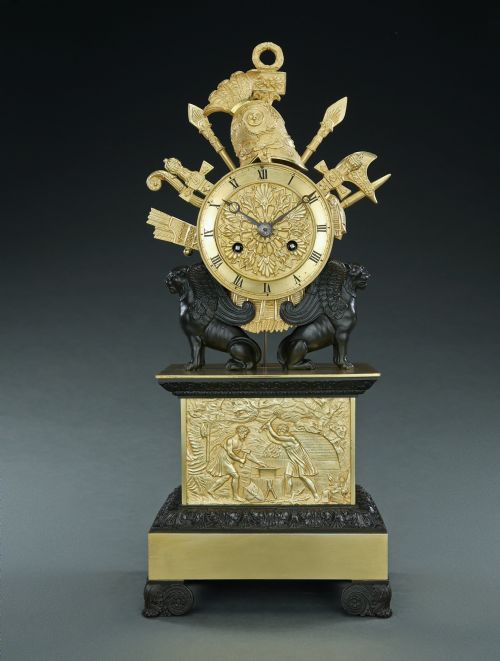
When you search for an empire pendule de cheminee, you encounter sophisticated mantel clocks rooted in nineteenth-century French and British design. These timepieces take the form of substantial mantel clocks, often driven by eight-day striking movements.
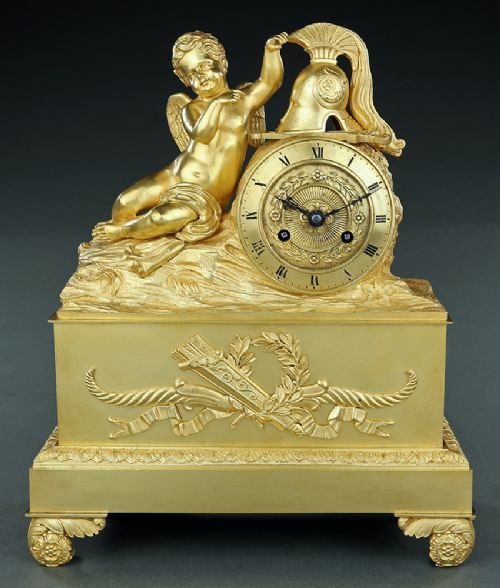
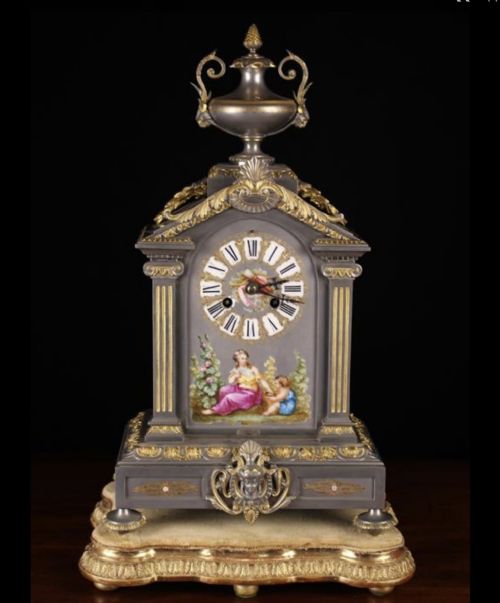
The selection here draws primarily from the Victorian era and the nineteenth century, alongside Regency examples. These clocks frequently incorporate classical figures, allegorical themes, or architectural marble housings.
You will find variations ranging from French Empire style compositions to Louis XVI revival and Rococo revival pieces. Each version reflects the period taste for combining decorative metalwork with functional horology.
How they were made
Makers constructed these clocks using a combination of cast metals, patinated bronze, ormolu, and gilt bronze, often mounted upon bases of specimen marble. Enamel dials provide the face for the movement, protected beneath glass.
Techniques relied on intricate metal casting and mercury or electro-chemical gilding to achieve the contrasting polished and matte golden surfaces. Silk suspension movements appear in earlier pieces, while later examples utilise more standard pendulum setups.
Empire Pendule De Cheminee Retail Price Guide 2026
Typical asking prices for empire pendule de cheminee among the pieces listed under this phrase on Sellingantiques today, from the lower quarter to the upper quarter. They describe what is for sale here now, not the wider market.
The inventory includes movements signed by French makers alongside sculptural figures depicting Diana the Hunter and classical cupids.
What varies in quality
The selection of materials also dictates standing, with heavy specimen marble bodies and signed movements by known makers separating standard production from superior workshop output.
Japy Freres·Samuel Marti·Charpentier Paris
The Empire Pendule De Cheminee Glossary
- Ormolu
- Gilded bronze, where a gold amalgam is applied to a bronze base through heat or chemical processes. This technique creates the characteristic bright metallic finish seen on French mantel clocks.
- Silk suspension
- A method of hanging the pendulum from a small loop of silk thread rather than a metal spring. This feature tends to appear in earlier nineteenth-century clocks.
- Patinated bronze
- Bronze that has been chemically treated to produce a dark, aged surface tone. It provides a visual contrast against the brighter gilded elements.
- Specimen marble
- Multi-coloured decorative marble assembled from various mineral samples. It adds weight and visual richness to clock bases.
- Enamel dial
- A metal clock face coated with fused glass powder and fired in a kiln. Numerals are typically painted onto this smooth white surface.
Empire Pendule De Cheminee: Frequently Asked Questions
How do I wind an empire pendule de cheminee?
Most of these clocks utilise an eight-day movement requiring a key to tension the mainsprings via the dial holes. Care must be taken not to overwind the springs.
Moving the hands should be done clockwise, stopping briefly at each hour to allow the striking train to complete its cycle.
Where should I place a heavy marble clock?
Due to the substantial weight of marble and bronze clock bodies, place the piece on a sturdy, level surface like a heavy mantelpiece or console table. A stable base ensures the pendulum swings evenly.
Avoid locations exposed to direct sunlight or damp conditions, which can degrade the marble polish and damage the internal brass movement.
What is the difference between Empire and Rococo styles?
Empire style clocks draw heavily on classical antiquity, featuring military trophies, architectural forms, and figures derived from Greek and Roman mythology. They favour symmetry and strict geometric lines.
In contrast, Rococo revival pieces embrace asymmetry, naturalistic scrolls, and C-scroll motifs inspired by Louis XV aesthetics, often with softer, more exuberant ornamentation.
How do I identify a silk suspension movement?
You inspect the upper suspension block behind the dial where the pendulum hangs by opening the rear access door. A silk suspension uses a woven ribbon of thread instead of a flat steel spring.
This detail generally points to an earlier nineteenth-century date of manufacture for the clock.