

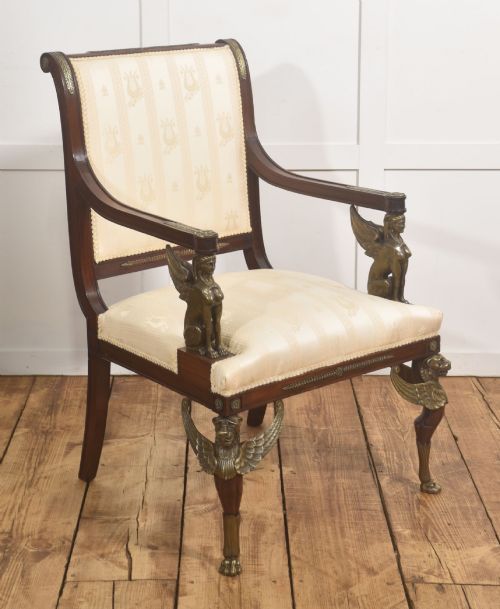
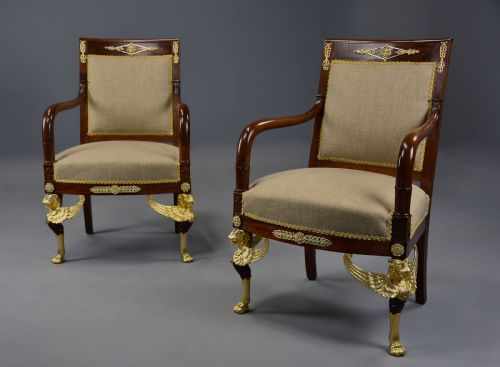

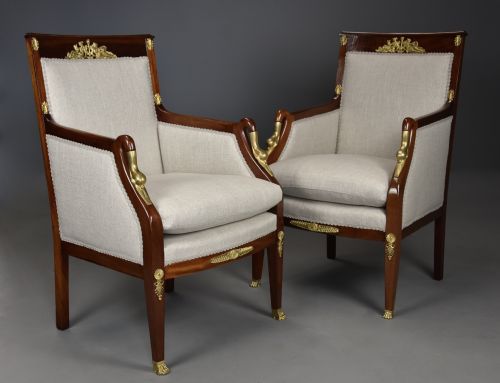
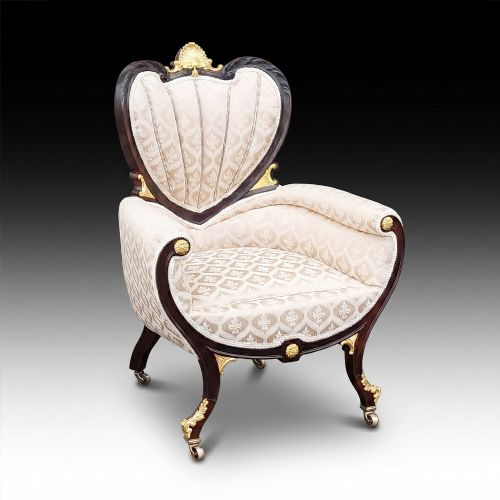
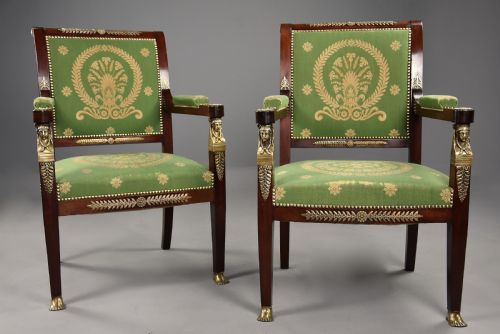


Empire Mahogany Fauteuil
An empire mahogany fauteuil brings classical proportion and substantial presence to a room, offering both formal authority and deep seat comfort.
Empire Mahogany Fauteuil
An empire mahogany fauteuil is an open armchair rooted in neoclassical design, distinguished by architectural lines and dark timber frames. These chairs appear across the nineteenth and early twentieth centuries, spanning original Empire periods through later French and Italian revivals.
Buyers encounter single chairs, balanced pairs, and occasionally larger salon suites or library armchairs. The form frequently includes desk chairs and open armchairs designed for formal reception rooms or studies.
Origins stretch from early nineteenth century French workshops to later continental revivals in the grand regency and neoclassical styles. Mahogany remains the constant structural medium, often paired with contrasting metal mounts.
Assessing Quality and Execution
The precision of the carved decoration separates standard production from finer examples. Crisp lines in the timber and finely chased metal mounts indicate superior craftsmanship.
Proportion and scale dictate the visual weight of the chair within a room. Balanced arm supports and rauted legs demonstrate a careful adherence to classical canons.
The integration of ormolu or gilt bronze mounts reveals the tier of the piece. Heavy, well-cast metalwork fastened securely to the mahogany frame marks the upper range of manufacture.
Empire Mahogany Fauteuil Retail Price Guide 2026
Typical asking prices for empire mahogany fauteuil among the pieces listed under this phrase on Sellingantiques today, from the lower quarter to the upper quarter. They describe what is for sale here now, not the wider market.
Some chairs are specifically designated as desk chairs, proving that nineteenth-century bureaucrats also appreciated classical French style while pushing paperwork.
The Empire Mahogany Fauteuil Glossary
- Ormolu
- Gilt bronze mounted ornamentation applied to furniture frames. This technique involves coating cast bronze in gold amalgam to create a bright metallic contrast against dark mahogany.
- Directoire
- A transitional stylistic period bridging Louis XVI and the French Empire. It favours restrained neoclassical lines and pared-down classical ornamentation.
- Consulate
- A historical design period preceding the full French Empire style. Pieces from this era display early iterations of military-inspired neoclassical motifs.
Empire Mahogany Fauteuil: Frequently Asked Questions
Where should I place an empire mahogany fauteuil?
These armchairs suit studies, libraries, and formal drawing rooms where their architectural presence can anchor the layout. They function well as reading chairs or paired flanking a fireplace.
Because of their substantial wooden frames and decorative mounts, they command visual attention. Position them away from cramped corners to let the carved details and ormolu mounts catch the light.
How do I care for the mahogany and upholstery?
Dust the mahogany frame regularly with a soft, dry cloth to protect the polished surface. Avoid commercial polish containing silicone, which builds up over time.
Protect upholstery fabrics from direct sunlight to prevent fading. Professional cleaning is recommended for antique velvet, leather, or silk linen coverings.
Are these chairs comfortable for daily sitting?
Empire fauteuils were designed for formal posture rather than lounging, offering upright support through rigid padded backs and wide open arms. Their proportions suit sitting upright at a desk or in conversation.
Seat comfort depends on the internal webbing and padding condition. Many period examples retain supportive sprung or stuffed foundations suitable for regular use.
How do I distinguish original period pieces from later revivals?
Examine the timber shrinkage, joinery methods, and hand-cut fixings on the underside of the frame. Nineteenth-century pieces display wear patterns consistent with age and traditional hand-craftsmanship.
Revival pieces from the late nineteenth or early twentieth centuries often employ machine-assisted joinery and different secondary woods while faithfully copying the earlier French neoclassical vocabulary.