




Edwardian Walnut Nest Tables
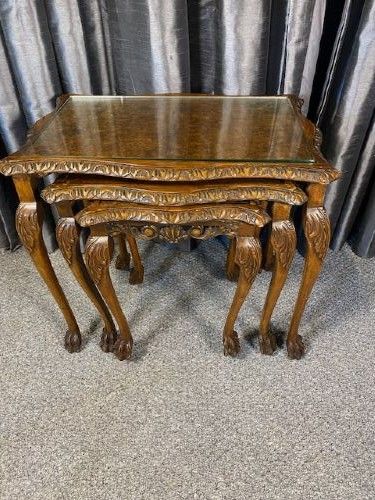
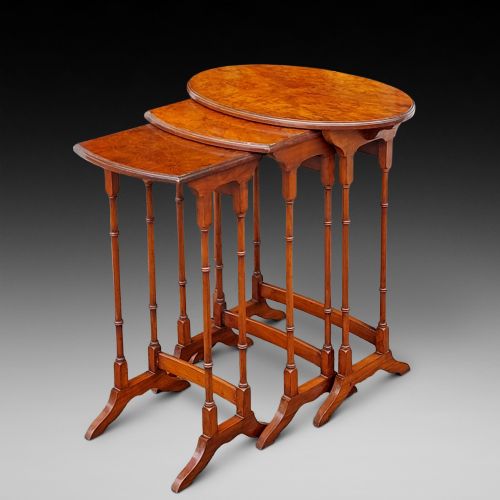
Edwardian walnut nest tables are clever sets of graduating occasional surfaces designed to stack neatly away when floor space matters.
Edwardian Walnut Nest Tables
When you search for edwardian walnut nest tables, you encounter sets of three or four occasional surfaces designed to slide beneath one another. These nesting tables span periods from the late nineteenth century through to nineteen thirty, drawing on Edwardian, Victorian, and revival styles.
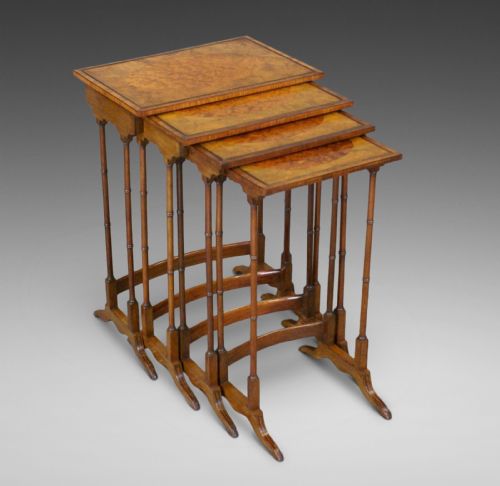
The form appears as both three-table trios and quartetto sets of four tables that descend in height to fit snugly together. Walnut and burr walnut dominate the timber choices, frequently enhanced by parquetry inlay or paired with oak, mahogany, teak, and glass.
Most examples you meet on this page originate from the Edwardian era or the early decades of the twentieth century. They serve living spaces by providing movable surfaces that vanish into a single compact stack when floor space is needed.
How they were made
Cabinet makers utilised solid walnut and decorative burr walnut veneers applied to secondary timbers like oak and mahogany. Parquetry inlay added geometric surface patterns to the tops of select tables, requiring precise hand-fitting of wood segments.
Construction relied on traditional joinery to ensure each table in the nest scaled down smoothly without binding against the others. Brass fittings occasionally appear on specific revival forms to accent the woodwork.
A set of four tables means four separate pieces of furniture occupying the footprint of a solitary stool.
What varies in quality
Quality rests primarily in the choice of timber figure, particularly the richness of the burr walnut veneer selected for the primary surfaces. Finer sets display meticulous parquetry inlay and balanced proportions across all graduating sizes in the nest.
Sturdiness in the frame construction and clean movement as the smaller tables slide in and out separate standard production from superior cabinet work. The integrity of the polish and the preservation of the original wood surfaces dictate overall desirability.
The Edwardian Walnut Nest Tables Glossary
- Quartetto
- A set of four graduating occasional tables designed to nest together. This term frequently describes Edwardian nesting tables.
- Parquetry
- A geometric mosaic of wood pieces used for decorative ornamentation on table tops. It often incorporates contrasting timber tones.
- Burr walnut
- A prized wood figuring caused by tree growth anomalies that creates swirling, organic patterns. It forms the decorative top surfaces on better tables.
- Nesting tables
- A group of several tables made in graduated sizes so they fit one beneath another. They provide flexible surface space in compact rooms.
Edwardian Walnut Nest Tables: Frequently Asked Questions
What is a quartetto nest?
A quartetto nest consists of four tables built in graduating sizes to slide neatly under the largest one. This format gives you multiple surfaces that occupy the floor space of just one small table.
Cabinet makers of the Edwardian period favoured this design for entertaining, as the nesting tables could be distributed around a room for tea and collected again afterwards.
Were these tables made after the Edwardian era?
While the style originates in the Edwardian period, the form continued through the nineteen tens, twenties, and thirties. Makers kept producing these nesting sets using traditional walnut and revival styles well into the twentieth century.
Comparing construction details and timber preparation helps distinguish pieces made around nineteen hundred from those made three decades later.
How were nesting tables used originally?
These tables served as versatile furniture for drawing rooms and parlours where guests required places for cups or books. They remained stacked together against a wall until visitors arrived.
Once needed, the smaller tables were pulled out individually and placed beside seating areas before being returned to the column stack.