



Edwardian Toast Holder
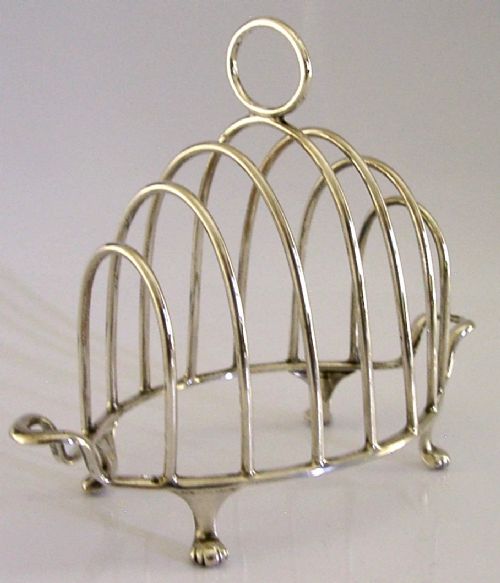
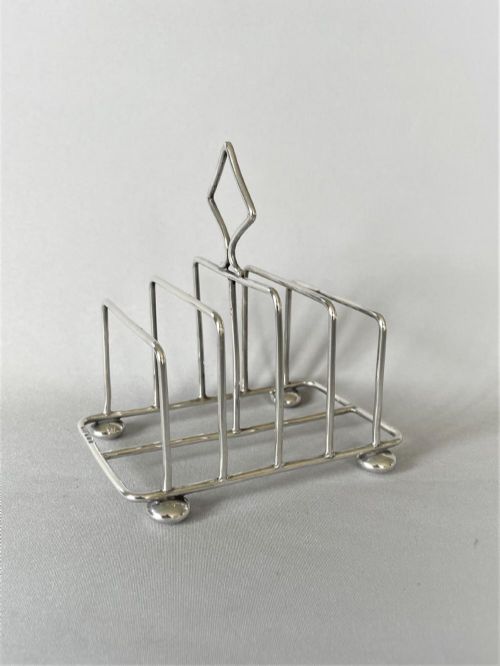
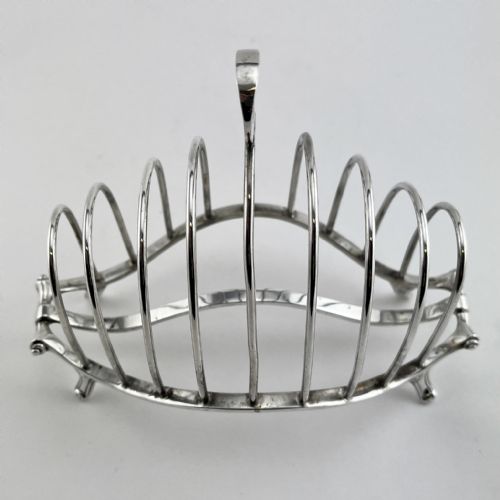
These pieces are Edwardian toast holders, small silver and plated tableware items designed to keep crisp breakfast slices upright and dry.
Edwardian Toast Holder
An edwardian toast holder is a form of tabletop silver built with vertical metal dividers to hold slices of hot toast apart so they do not steam themselves soft. The examples on this page span the periods recorded in our stock, stretching from Georgian and Victorian items through to Edwardian, George V, and later twentieth-century work.
Most items meeting the edwardian toast holder description take the form of open racks with arched or looped dividers welded to a small base fitted with ball feet and a central lifting ring. While the core design remains consistent, makers adapted the silhouette across different decades, producing variations from simple wirework frames to heavier modernist and aesthetic interpretations.
How they were made
Makers fashioned these pieces primarily from solid sterling silver or silver plate over base metal, utilising techniques such as wire bending, soldering, and electroplating. The structural dividers are shaped individually and soldered firmly to the base plate to withstand daily breakfast table use without loosening.
Surface finishes range from polished sterling silver bearing assay office hallmarks to electroplated nickel silver layers applied over a base metal core. Handles and feet are frequently cast separately and attached by hand, ensuring each rack has a balanced weight and a stable footing.
What varies in quality
Quality in an edwardian toast holder rests on the gauge of the metal used for the dividers and the precision of the solder joints where the bars meet the base. Heavier wire resists bending when loaded with hot toast, whereas thin gauge metal feels flexible and prone to distortion.
The crispness of the design work and the preservation of the original silver plating or hallmark stamping distinguish superior examples from ordinary production pieces. Finer items display clean symmetry in the arch loops and securely fitted handle rings that show no signs of clumsy repair.
Mappin and Webb·Roberts and Belk·Christopher Dresser for Hukin and Heath
The Edwardian Toast Holder Glossary
- Silver plate
- A thin layer of pure silver fused or electroplated onto a base metal core such as copper or nickel silver to give the appearance of solid silver.
- Sterling silver
- A silver alloy containing ninety-two point five percent pure silver by mass and seven point five percent other metals, usually copper, ensuring structural durability.
- Electroplated nickel silver
- A copper-nickel-zinc alloy coated with an electrolytic layer of silver, commonly abbreviated as EPNS in British silver manufacture.
- Hallmark
- A series of official marks stamped onto precious metal items in Britain to indicate the standard of purity, the assay office, and the date letter.
- Base metal
- Any non-precious metal or alloy, such as brass, copper, or nickel, used as the underlying foundation for plated tableware items.
Edwardian Toast Holder: Frequently Asked Questions
What is an edwardian toast holder used for?
These items were placed on the breakfast table to hold slices of freshly made toast upright. Keeping the slices separated allowed steam to escape so the toast remained crisp rather than becoming soggy.
They also functioned as serving pieces, allowing diners to help themselves easily from a communal rack passed around the table.
How do I clean a silver toast holder?
Clean solid silver or silver-plated pieces using a soft cloth and a specialised silver cream designed to lift tarnish without abrasive scratching. Avoid harsh chemical dips, which can strip away thin plating layers and damage underlying base metals.
Rinse the item thoroughly in warm water and dry it immediately with a lint-free cloth to prevent water spots from forming on the polished surface.
Can I use an antique toast holder daily?
These pieces are robust enough for daily use provided they are handled with reasonable care during washing and storing. The sturdy soldered joints on solid silver and plated examples are built to support the weight of standard bread slices.
Hand wash the rack rather than placing it in an automatic dishwasher, as harsh detergents and high heat will damage silver plate and older soldered connections.
How do I tell different periods apart?
Dating relies primarily on official hallmarks stamped onto sterling silver pieces, which indicate the exact assay year and maker. Stylistic cues also help, as Victorian and Edwardian examples often feature ornate wirework, while later 1920s and 1930s pieces adopt cleaner geometric lines.
Silver-plated items without hallmarks require stylistic comparison with documented designs from specific manufacturing periods to narrow down their date of origin.