

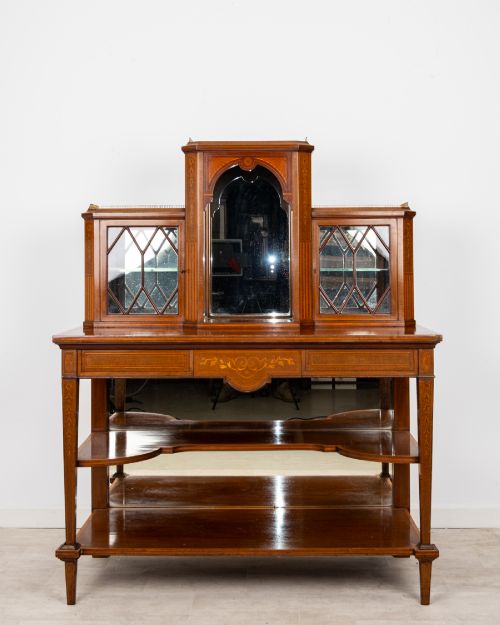
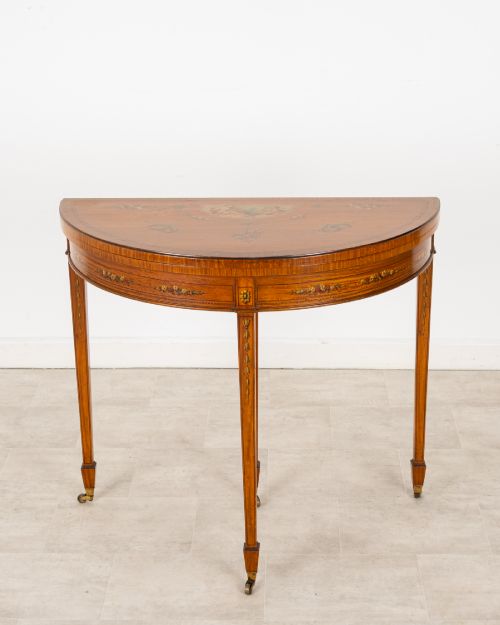


Edwardian Satinwood Console Table
An Edwardian satinwood console table brings light grain and neoclassical grace to a hall or drawing room, prized for its curved demi-lune form.
Edwardian Satinwood Console Table
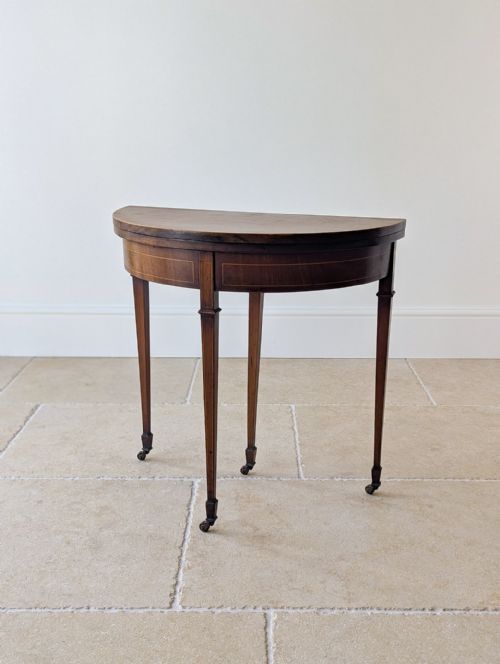
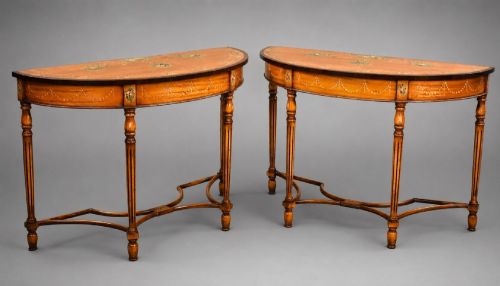
An edwardian satinwood console table appears frequently as a demi-lune or half-moon table designed to stand flat against a wall. The pieces listed span the Edwardian period alongside nineteenth century examples and nineteenth century revivals of eighteenth century Sheraton and George III designs.
Makers and workshops produced console tables, side tables, and card tables that often utilised folding tops or Games table configurations. Formats range from simple painted surfaces to elaborately inlaid marquetry and banded timbers intended for principal reception rooms.
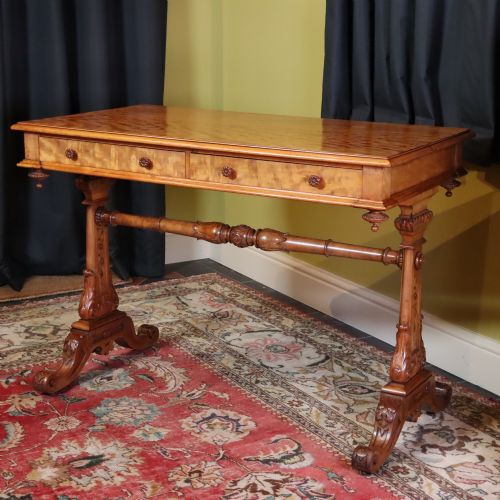
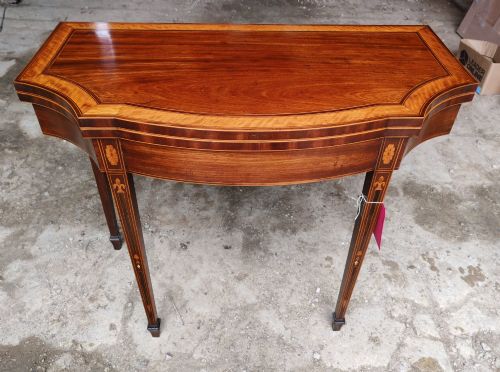
The evidence shows forms overlapping between console tables, side tables, and pier tables, occasionally sharing proportions with washstands and writing desks. Buyers encounter variations in top shape, including serpentine and bow-front profiles alongside standard semi-circular designs.
How they were made
Cabinet makers constructed carcass frames from mahogany or timber, applying fine veneers of satinwood and rosewood across visible surfaces. Crossbanding in boxwood and contrasting darker timbers framed the primary grain patterns.
Inlay techniques combined boxwood stringing with complex marquetry and painted decoration depicting classical urns, swags, and floral motifs. Brass fittings and hinges completed folding top mechanisms on card and games tables.
Listings feature satinwood combined with mahogany, rosewood, and boxwood across various table forms.
What varies in quality
The refinement of the painted decoration and the precision of the marquetry inlay set the standard for finer pieces. Hand-painted details and intricate floral swags indicate workshops of higher ambition.
Timber selection distinguishes ordinary carcases from superior examples, particularly where figured satinwood meets contrasting mahogany or purpleheart banding. The crispness of the carving on tapered legs and the tightness of veneer joints reveal workshop competence.
Edwards and Roberts·Maples of London
The Edwardian Satinwood Console Table Glossary
- Demi-lune
- Having a half-moon shape with a flat back edge designed to stand against a wall. This profile defines the majority of console tables.
- Satinwood
- A dense, lustrous timber with a natural golden sheen utilised extensively for veneering. It accepts painted decoration and inlay with exceptional clarity.
- Marquetry
- The art of forming decorative patterns using fitted pieces of veneer of different woods. It creates pictorial motifs across tabletops.
- Crossbanding
- A border of veneer laid with the grain running perpendicular to the main surface. It frames panels of satinwood or mahogany.
- Sheraton Revival
- A late nineteenth and early twentieth century design movement replicating the light neoclassical style of the eighteenth century. Makers utilised painted satinwood and classical proportions.
Edwardian Satinwood Console Table: Frequently Asked Questions
Where should a console table go?
A console table fits naturally against a hallway wall or beneath a mirror in a principal reception room. Its shallow depth ensures it occupies minimal floor space while providing a display surface.
Traditional demi-lune shapes align flush with the wall, making them suitable for narrow corridors and entrance spaces where bulkier furniture impedes movement.
How do I spot Sheraton Revival?
Sheraton Revival pieces date from the late nineteenth and early twentieth centuries, copying the lighter proportions and neoclassical motifs of the Georgian era. Look for painted satinwood, tapering legs, and delicate floral swags.
Construction details and secondary woods help distinguish these later interpretations from genuine eighteenth-century originals despite similar stylistic vocabulary.
What is satinwood?
Satinwood is a dense, yellow-hued timber prized for its reflective, satiny grain pattern. Cabinet makers used it primarily as a veneer over sturdier woods like mahogany.
Its pale surface provided an ideal canvas for hand-painted decoration, marquetry, and contrasting stringing in dark woods.
Are these tables sturdy?
Console tables were built primarily for display rather than heavy load-bearing use. Many feature slender tapering legs designed for visual lightness.
Fold-over card tables incorporate hinged tops and support gates that require careful handling when opened for games or writing.