

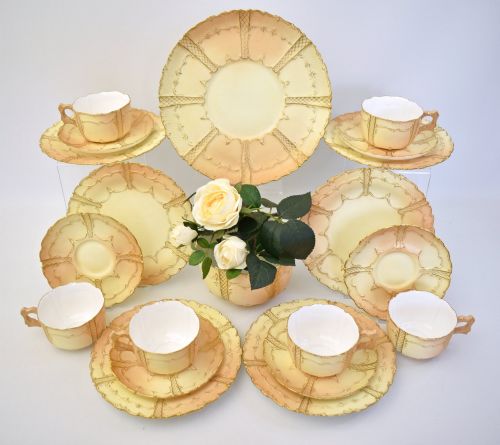
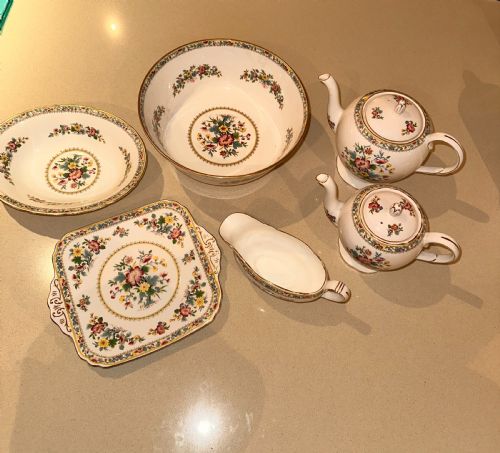


Edwardian Porcelain Tea Service
An edwardian porcelain tea service brings domestic history to the table, combining delicate ceramic forms with enduring hand-painted decoration.
Edwardian Porcelain Tea Service
When you search for an edwardian porcelain tea service, you encounter complete sets designed for formal afternoon hospitality. The pieces on this page span the Edwardian era alongside adjacent late Victorian, 1900, 1910 and 1920 periods.
The selections range from intimate afternoon sets to larger tea and coffee services, dinnerware and breakfast sets. Forms include dedicated sugar bowls alongside comprehensive multi-piece settings.
Origins reflect traditional English manufacture, with notable examples produced by factories such as Coalport, Royal Crown Derby, Wileman Foley Shelley, Copeland Spode, Royal Albert Crown China and Gladstone potteries, plus occasional continental pieces.
How they were made
Makers utilised fine porcelain and bone china as the primary ceramic bodies for these services, shaped into delicate cups, saucers and pots. The material provides a thin, translucent wall combined with structural resilience.
Surface decoration relies on hand-painted details, cobalt enamel, and applied gold leaf, gilding or gold gilt. Many patterns incorporate traditional motifs applied by skilled hands before firing.
Edwardian Porcelain Tea Service Retail Price Guide 2026
Typical asking prices for edwardian porcelain tea service among the pieces listed under this phrase on Sellingantiques today, from the lower quarter to the upper quarter. They describe what is for sale here now, not the wider market.
Object types recorded across the inventory include tea sets, coffee services, dinnerware, breakfast sets and sugar bowls.
What varies in quality
Quality rests in the precision of the hand-painted brushwork and the crispness of the gilt accents applied across the porcelain body. Services featuring intricate hand-applied patterns display greater artistry than standard transfer prints.
The completeness and integrity of the set define its standing, as larger surviving groupings with matching components demand attention. The weight, thinness and translucency of the bone china also indicate the maker's technical skill.
Royal Crown Derby·Coalport·Wileman Foley Shelley·Copeland Spode·Royal Albert Crown China·Gladstone potteries
The Edwardian Porcelain Tea Service Glossary
- Bone china
- A type of porcelain incorporating bone ash, known for its high strength, chip resistance and milky translucency. It allows for thinner vessel walls than standard ceramic paste.
- Gilding
- The application of gold leaf or powdered gold paint to the rims, handles and surface motifs of tea wares. This adds a reflective metallic border to the ceramic body.
- Cobalt enamel
- A deep blue metallic oxide pigment used for underglaze or overglaze hand-painting. It produces a rich, durable colour resistant to fading.
- Bat Wing
- A specific decorative pottery pattern style characterised by segmented panel designs resembling wings. It appears on period Coalport tea sets.
- Imari
- A decorative style featuring rich cobalt blue and iron red highlights, often enriched with gold. It originates from Japanese export traditions and was adopted by English potteries.
Edwardian Porcelain Tea Service: Frequently Asked Questions
How do I use an Edwardian tea service?
These services were designed for formal afternoon hospitality, featuring cups, saucers and pots intended for serving tea to guests. Many owners reserve them for special occasions rather than daily dining.
Hand washing is essential to preserve the delicate porcelain bodies, hand-painted details and fragile gold leaf gilding over time.
How do I date an Edwardian tea set?
Dating relies on maker marks stamped or painted on the underside of the ceramic base, combined with stylistic clues such as handle shape and pattern design. Period markers often reference specific reigns or decades.
Comparing the decorative motifs, such as trailing daisies or Imari patterns, helps place the service within the broader 19th and early 20th century timeline.
What is the difference between porcelain and bone china?
Porcelain is a dense ceramic fired at high temperatures from specific clay minerals, while bone china incorporates animal bone ash into the mixture. This addition creates a lighter, whiter and more translucent material.
Both materials were utilised by Edwardian makers to produce thin, refined tea wares suited for polite society.