
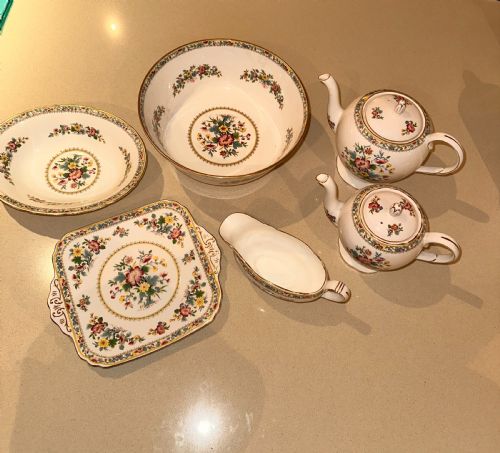


Edwardian China Tea Service
An edwardian china tea service brings patterned bone china and gilt elegance to the table, offering a traditional centrepiece for afternoon gatherings.
Edwardian China Tea Service
An edwardian china tea service comprises matched or coordinated porcelain vessels intended for the formal serving of tea, often including cups, saucers, and plates alongside larger pots.
The selections encountered here span traditional English forms and related periods, reflecting the styles of the early twentieth century alongside adjacent Victorian and later designs.
Makers represented in this category range from established factories producing cobalt enamel motifs to hand-painted sets finished with delicate gilding.
How they were made
Production relies primarily on fine bone china and porcelain, shaped into delicate cups and vessels that receive hand-painted details.
Decoration incorporates gold leaf and gilding alongside cobalt enamel to create contrasting borders and central motifs.
Listings span periods from the nineteenth century through the nineteen-thirties, featuring bone china, porcelain, and gold leaf materials.
What varies in quality
Distinctions in quality rest upon the crispness of the hand-painted execution and the precision of the gilding applied across each piece.
The preservation of delicate gold leaf and enamel details through decades of use marks the difference between standard production wares and finer surviving examples.
Royal Crown Derby·Coalport·Royal Albert Crown China·Wileman Foley Shelley·Copeland Spode·Gladstone potteries
The Edwardian China Tea Service Glossary
- Bone China
- A type of porcelain incorporating bone ash, yielding a durable body with a high degree of translucency. This material forms the base of many fine English tea wares.
- Gilding
- The application of gold leaf or gold paint to the rims, handles, and surface patterns of ceramic items. It provides a bright metallic contrast to the white ceramic body.
- Cobalt Enamel
- A deep blue vitreous pigment fused to the surface of the pottery during firing. It appears frequently in traditional underglaze and overglaze decorative schemes.
- Porcelain
- A ceramic material made by heating raw materials, generally including clay in the form of kaolin, in a kiln. It is valued for its smooth texture and strength.
Edwardian China Tea Service: Frequently Asked Questions
What pieces comprise a service?
A standard service typically includes cups, saucers, and side plates, alongside larger serving components such as teapots, milk jugs, and sugar bowls.
Individual sets vary in size, with some configurations expanding to include twenty or more matching elements for guests.
How do I care for gilt china?
Wash these pieces gently by hand using warm water and a mild detergent rather than placing them in an automated dishwasher. Avoid abrasive sponges that might wear away the delicate gold leaf and enamel over time.
Store the items with soft dividers between stacked plates to prevent surface scratching on the glazed ceramic bodies.
Can I use these for daily tea?
While these ceramics remain functional, their age and hand-painted decorations suggest careful handling during occasional use rather than heavy everyday service.
Hand-painted bone china benefits from gentle treatment to preserve the integrity of the early twentieth-century glaze and gilding.
How are different periods identified?
Makers often stamped or painted specific backstamps on the underside of the porcelain, which correspond to known manufacturing dates and registration numbers.
Stylistic cues such as the weight of the ceramic, the intensity of the cobalt enamel, and the style of the floral patterns also indicate whether a set originates from the Victorian era or later decades.