
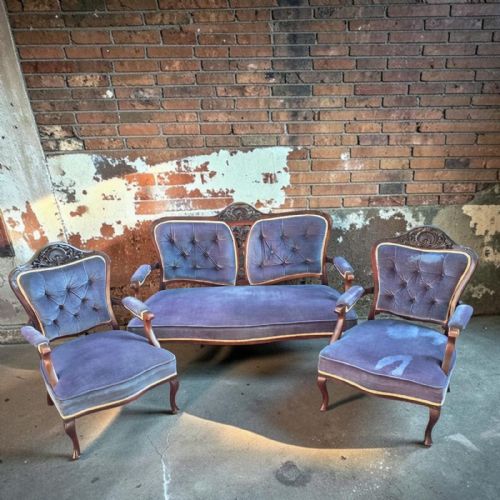
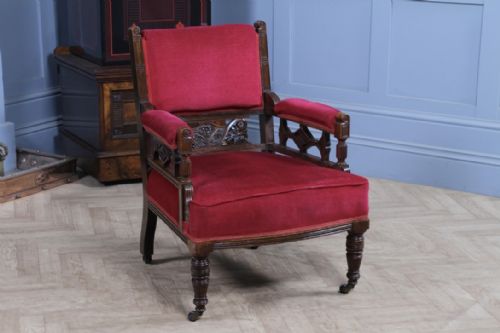


Edwardian Parlour Armchair
An edwardian parlour armchair provides formal, upholstered seating rooted in domestic reception rooms, combining polished timbers with period textiles for a refined interior.
Edwardian Parlour Armchair
An edwardian parlour armchair bridges late nineteenth-century revival aesthetics and early twentieth-century domestic comfort, appearing frequently alongside matching settees or within larger salon suites. These chairs serve as reception furniture, designed to furnish formal entertaining spaces rather than heavy daily use.
The version most likely to meet a buyer on this page is constructed from mahogany, often enhanced by satinwood inlay or marquetry, and dates from around nineteen hundred. Pieces from the broader Victorian period also populate the selection, showing similar upholstered forms and carved wooden frames.
Makers ranged from individual cabinetmakers to prominent firms like James Shoolbred, producing single armchairs, pairs, and multi-piece suites for the home. Forms vary from low salon armchairs and corner chairs to open arm chairs and musician's seats.
Materials and construction
Frames rely primarily on solid mahogany and walnut, selected for their strength and stability when carved into cabriole legs or open arm designs. Satinwood provides contrast through decorative inlay and marquetry panels set into the woodwork.
Upholstery involves traditional fabric and velvet coverings, sometimes finished with button-back detailing over internal padding and brass castors or fittings on the feet. Showwood timber frames display hand-carved details or smooth polished surfaces depending on the stylistic influence.
Listings feature mahogany, walnut, rosewood, and satinwood, spanning the Victorian and Edwardian periods.
Assessing quality in period seating
The standard of timber selection and the precision of cabinetwork set the better examples apart from standard production. Crispness in carved details and clean execution of satinwood inlay demonstrate superior craftsmanship.
Integrity of the underlying frame construction and the preservation of original showwood surfaces determine the desirability of an upholstered piece. Matching suites and paired armchairs maintain greater cohesion than assembled groups.
James Shoolbred·Jenks & Wood
The Edwardian Parlour Armchair Glossary
- Marquetry
- Decorative veneer work forming pictorial or geometric patterns using various coloured woods. This technique adorns the backrests and rails of finer parlour furniture.
- Cabriole leg
- A furniture leg curving outward at the knee and tapering inward toward the foot, often ending in a pad or scroll. It derives from classical forms popular in revival styles.
- Salon suite
- A coordinated set of seating comprising a settee and multiple matching armchairs or side chairs. These suites furnished formal reception rooms during the Victorian and Edwardian periods.
- Showwood
- Polished timber left exposed on an upholstered chair or settee frame to display the grain and carving. It defines the visible structural aesthetic of parlour seating.
- Satinwood
- A yellowish-glowing timber utilised for contrasting inlay and stringing on darker woods like mahogany. It adds brightness to Edwardian cabinet pieces.
Edwardian Parlour Armchair: Frequently Asked Questions
What is an edwardian parlour armchair?
An edwardian parlour armchair is a decorative wooden seat designed for formal reception rooms, featuring upholstered cushions and polished timber frames.
These chairs date from the early twentieth century and often incorporate inlaid satinwood or carved mahogany details.
How do I spot an Edwardian chair?
Edwardian chairs typically display lighter mahogany or walnut timbers, slender cabriole legs, and delicate satinwood inlay or marquetry.
They lean toward refined elegance rather than the heavier proportions associated with earlier Victorian seating.
Were these chairs sold in pairs?
Makers frequently produced parlour armchairs in matched pairs or as part of larger salon suites that included settees and side chairs.
Pairs were intended to sit symmetrically within formal reception spaces.
How do I care for antique upholstery?
Protect the fabric from direct sunlight to prevent fading and vacuum the upholstery gently using a soft brush attachment.
Feed the exposed wooden frame periodically with appropriate furniture wax to maintain the polished finish.