

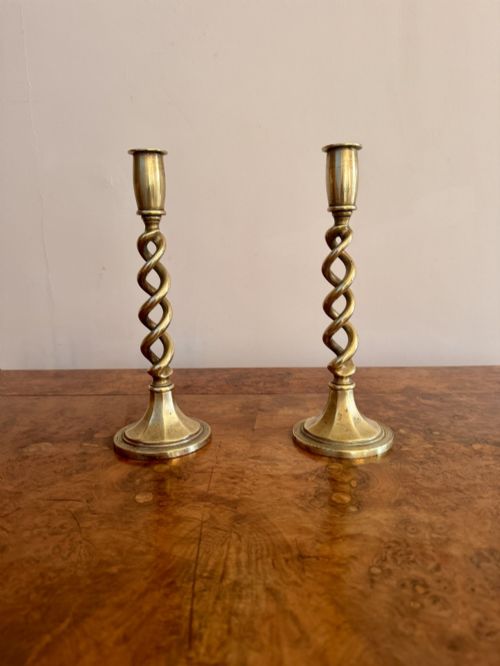


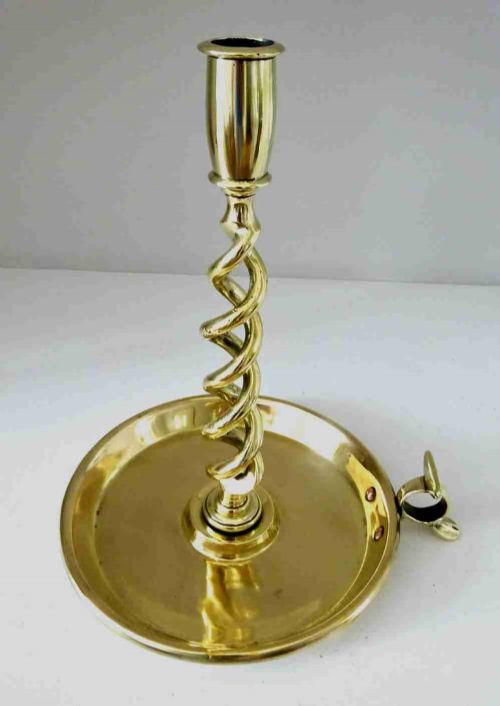


Edwardian Open Twist Candlesticks
Edwardian open twist candlesticks bring tactile warmth to a room through turned oak and gleaming brass.
Edwardian Open Twist Candlesticks
When you search for Edwardian open twist candlesticks, you are looking at turned shaft lighting fixtures designed for domestic use during the early twentieth century. The examples you are most likely to meet on this page span the Victorian, Edwardian, and later nineteenth century periods, appearing in brass, oak, and glass.
Makers utilised familiar forms such as candlesticks and table lamps, frequently employing a barley twist or double helix motif. The materials range from solid brass to combinations of oak and brass tops, reflecting the domestic tastes of the period.
How they were made
The construction of these pieces relies on turning timber and casting or working metal. Oak is shaped into distinct barley twist columns, while brass is formed into shafts, fittings, and bases.
Makers combined these materials securely, pairing oak shafts with brass tops and fitted bases to ensure stability. Glass also appears among the listings, adding another textural element to the traditional turned silhouette.
Edwardian Open Twist Candlesticks Retail Price Guide 2026
Typical asking prices for edwardian open twist candlesticks among the pieces listed under this phrase on Sellingantiques today, from the lower quarter to the upper quarter. They describe what is for sale here now, not the wider market.
Current listings feature pieces spanning the Victorian, Edwardian, and nineteenth-century periods in brass, oak, and glass.
What varies in quality
Quality in these pieces rests upon the precision of the twist and the substance of the materials. A well-executed open twist displays crispness along the spiral, whether rendered in brass or oak.
The integration of mixed materials also defines the better examples. Fitted bases and solid metal tops demonstrate careful proportion and secure assembly.
The Edwardian Open Twist Candlesticks Glossary
- Barley twist
- A turned column resembling a stalk of barley, featuring a continuous spiral. This decorative form appears frequently in wooden and metal candlesticks.
- Double helix
- A decorative twist composed of two intertwined spirals running parallel up the shaft. It creates a pronounced sense of movement in brass and wooden pieces.
- Fitted base
- A weighted or specially shaped lower section designed to support a tall candlestick securely. It prevents the piece from tipping during use.
Edwardian Open Twist Candlesticks: Frequently Asked Questions
What are edwardian open twist candlesticks?
These pieces are turned lighting items featuring helical or barley twist shafts made from brass, oak, or glass.
They date primarily from the late nineteenth century and the Edwardian era, serving both functional and decorative roles.
How were these candlesticks used?
They were placed on tables, sideboards, and desks to provide illumination in domestic rooms before widespread electric lighting.
Over time, many of these turned shafts were adapted to hold electrical fittings for table lamps.
How do I live with oak and brass candlesticks?
Place them on stable surfaces where their turned wood and polished metal can catch the light. They suit both traditional interiors and rooms with mixed period furnishings.
Keep them away from direct heat sources to protect the wooden shafts and fitted bases.
How do I tell periods apart?
Victorian and nineteenth-century pieces often feature heavier brass casting, while Edwardian examples introduce refined double helix designs and combined oak elements.
Stylistic revivals, such as Jacobean Revival, also influence the turning styles seen in the oak items.