






Open Spiral Candlesticks
Open spiral candlesticks bring movement to a table through twisting stems of brass, oak, and fruitwood.
Open Spiral Candlesticks
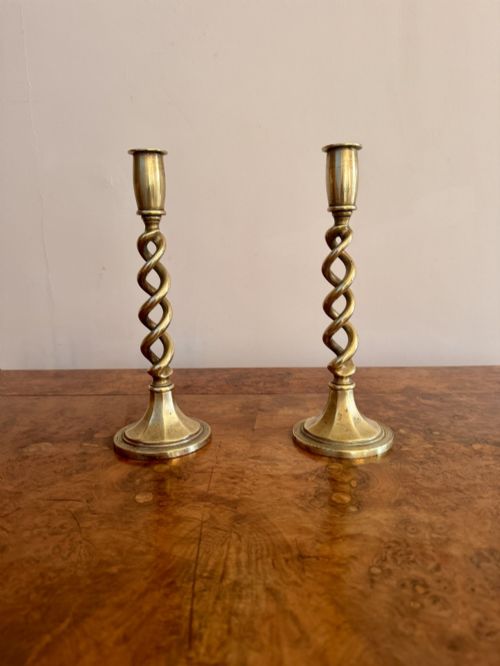
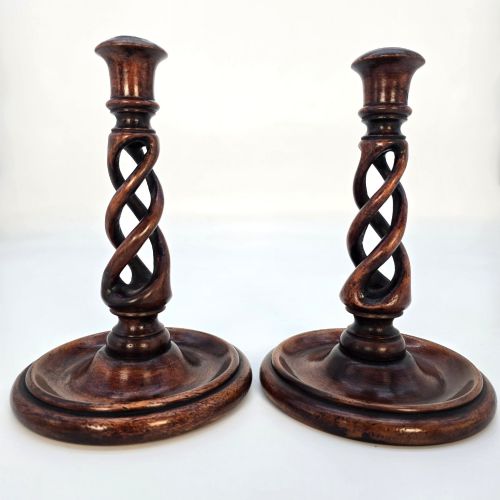
Open spiral candlesticks are turned table lights featuring a corkscrew shaft that leaves air visible through the centre of the twist. When collectors search for open spiral candlesticks, they encounter items produced across the eighteenth, nineteenth, and early twentieth centuries in materials such as brass, oak, and fruitwood.
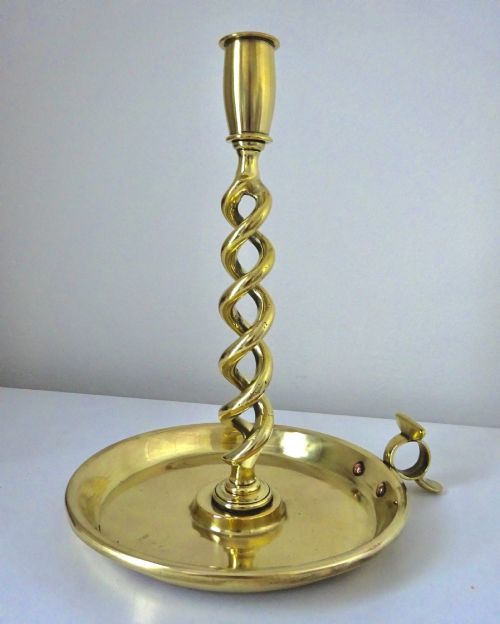
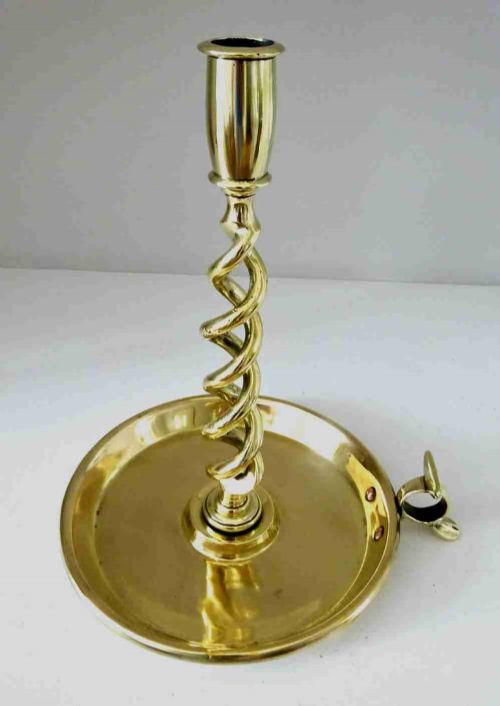
The most common examples on this page date from the Victorian and Edwardian eras, frequently standing tall on weighted bases or fitted trays. Surviving forms include pairs of table candlesticks, single examples mounted with brass top sockets, and pieces adapted into table lamps.
Earlier instances appear in fruitwood or oak under Georgian and Jacobean Revival influences. These wooden forms contrast with the bright metalwork of the later nineteenth century, yet share the same characteristic spiralling silhouette.
Materials and construction
Brass examples are cast and turned, often utilising multi-component construction where the twisted stem screws into a fitted base or integral tray. The metal takes on a polished or mellowed surface depending on its age and subsequent care.
Wooden pieces in oak and fruitwood rely on lathe turning to cut the deep open twist down the length of the shaft. Grain direction and timber selection dictate the strength of these slender columns, occasionally paired with cast brass drip pans or nozzle tops.
Open Spiral Candlesticks Retail Price Guide 2026
Typical asking prices for open spiral candlesticks among the pieces listed under this phrase on Sellingantiques today, from the lower quarter to the upper quarter. They describe what is for sale here now, not the wider market.
Listings span three centuries, running from eighteenth-century fruitwood specimens through Victorian brass creations to Edwardian oak examples.
Assessing quality and proportion
Quality rests in the crispness of the turning and the harmony of the proportions between base, stem, and nozzle. Sharply defined twists with consistent spacing show a higher degree of maker skill than thicker, softer rotations.
Weight and stability distinguish better examples, particularly in tall brass pairs where balance is essential. Fitted trays and heavy circular bases add both structural integrity and functional utility to the design.
The Open Spiral Candlesticks Glossary
- Barley twist
- A cylindrical column carved or cast into a helical screw shape resembling a stalk of barley. This profile defines the majority of the wooden and metal pieces seen here.
- Fruitwood
- Dense timber derived from orchard trees such as apple or pear, utilised by turners for its fine grain. It yields a warm tone on eighteenth-century examples.
- Jacobean Revival
- A nineteenth-century style drawing inspiration from seventeenth-century British furniture and woodwork. It accounts for the darker oak interpretations of the twist.
- Nozzle
- The upper socket cup designed to hold the base of a taper or candle steady. In mixed-material pieces, this component is frequently cast in brass.
Open Spiral Candlesticks: Frequently Asked Questions
Are these candlesticks sold in pairs?
Many examples survive as matched pairs, suited for mantelpieces or sideboard ends, though single items also appear.
Buyers find both configurations represented across the brass and wooden stock on this page.
How do I date brass versus wood?
Brass pieces on this page span the Victorian and Edwardian periods, identified by manufacturing techniques and surface finish. Wooden examples trace back to the eighteenth century through timber patination and turning styles.
Examining the base construction and metal composition helps confirm the era of manufacture.
Can these hold modern candles?
Most historic sockets accommodate standard taper candles, though minor variations in diameter occur due to hand-finishing. Adaptations into table lamps also exist among the taller Victorian items.
Checking nozzle dimensions ensures compatibility with contemporary candle sizes.
How should I clean brass twists?
Gentle dusting preserves the aged patina that collectors value on historic metalwork. Aggressive polishing removes the character accumulated over decades.
A soft cloth is sufficient for routine maintenance of both brass and timber surfaces.