


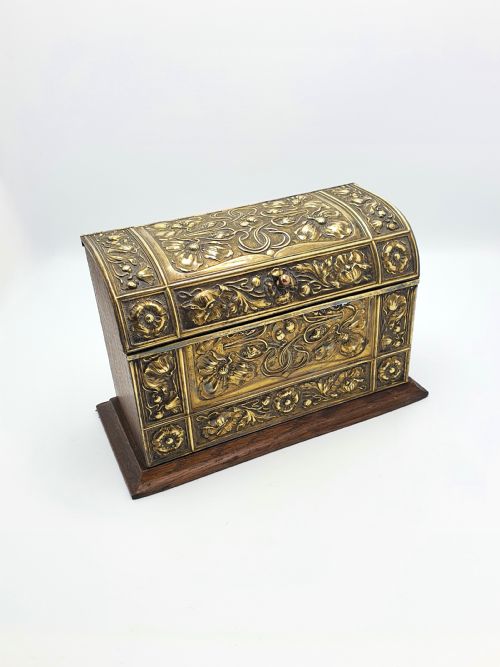


Edwardian Oak Letter Box
These edwardian oak letter box examples are practical desk accessories built from sturdy timber to organise domestic post.
Edwardian Oak Letter Box
An edwardian oak letter box provides a dedicated desktop or wall-mounted receptacle for incoming and outgoing post, frequently combining compartments with inkwells, calendars, or document storage. The selection spans compact domestic post boxes and larger country house or hotel stationery cabinets made from solid timber.
Most items belong to the Edwardian period or the broader late nineteenth century, often sharing stylistic overlaps with Arts and Crafts or Art Nouveau movements. Forms range from fall-front desks tidies and drop-front cabinets to wall-hung receptacles mounted with brass fittings.
Buyers also encounter related desk furniture such as stationery boxes, inkstands, and filing cabinets that serve similar organisational purposes in domestic or office interiors. These pieces reflect the heavy correspondence culture of the period through specialised slots and internal dividers.
How they were made
Cabinetmakers constructed these pieces primarily using oak, often selected for its figured grain in golden or darker tones, combined with brass mounts, hinges, and slot plates. Internal fitments occasionally incorporate glass ink bottles, paper labels, and fabric linings.
Construction techniques rely on durable joinery suited to daily desktop use, including dovetailed box construction and panelled fall fronts. Metalwork is typically secured with small brass screws, highlighting structural hardware as a decorative element.
Some country house boxes include adjustable date mechanisms, proving that Victorians needed reminding what day it was just as much as we do.
What varies in quality
Distinctions in quality rest upon the weight of the timber, the subtlety of any carved or applied stylistic detailing, and the integrity of the original brass hardware. Pieces with integrated calendars, matching ink bottles, or complex internal stationery partitions command greater interest than plain boxes.
The refinement of the joinery and the presence of designated Arts and Crafts or Art Nouveau design elements elevate certain examples above standard utilitarian desk accessories. Condition of the original finish and completeness of internal fittings also define the standing of individual boxes.
Amberg filing cabinet
The Edwardian Oak Letter Box Glossary
- Fall front
- A hinged panel that drops forward to reveal internal compartments and writing surfaces. This mechanism allows easy access to stacked stationery and correspondence.
- Stationery cabinet
- A desktop box designed to hold writing paper, envelopes, and related desk accessories. These often feature tiered interior slots and doors.
- Arts and Crafts
- A design movement emphasising handcraftsmanship, simple forms, and honest use of materials. Pieces in this style often display subtle metalwork and plain oak surfaces.
- Art Nouveau
- A style characterised by flowing, organic lines and stylized natural motifs. It appears in the decorative brass mounts and hinges on select boxes.
- Inkstand
- A tray or stand incorporating inkwells and pen rests, occasionally combined with an integral letter box. These formed the centrepiece of a Victorian or Edwardian writing desk.
Edwardian Oak Letter Box: Frequently Asked Questions
How were these letter boxes used?
These boxes served as secure receptacles for household or office mail, keeping incoming correspondence tidy before collection or sorting. Many included specialised slots labelled for letters, pins, or stamps.
Larger versions functioned as comprehensive stationery cabinets, housing writing paper and envelopes alongside inkwells and date adjustments. They sat upon library desks or hung on hallway walls in country houses and hotels.
Are these boxes suitable for daily modern use?
Most pieces remain sturdy enough for everyday desktop organisation, accommodating modern letters, cards, and small stationery items. The internal partitions work well for sorting daily household paperwork.
Care should be taken with antique hinges, glass ink bottles, and original locks, which may require gentle handling during regular use.
How do I tell an Edwardian box from a Victorian one?
Victorian examples tend to feature heavier proportions, darker timber finishes, and occasionally elaborate Gothic or heavily carved revival details. They often prioritize formal symmetry and dense ornamentation.
Edwardian and later pieces frequently show lighter golden oak tones, cleaner lines, and influences from the Arts and Crafts or Art Nouveau movements, reflecting a shift toward simpler domestic interiors.
What materials are typical for these pieces?
Solid oak forms the primary structural material across nearly all examples, appearing in both dark tones and lighter golden hues. Brass is the standard metal used for hinges, lock escutcheons, carrying handles, and mail slot plates.
Secondary materials include glass for internal ink bottles, paper for calendar or date adjustments, and occasional fabric linings within the document compartments.