




Edwardian Marquise Diamond Ring
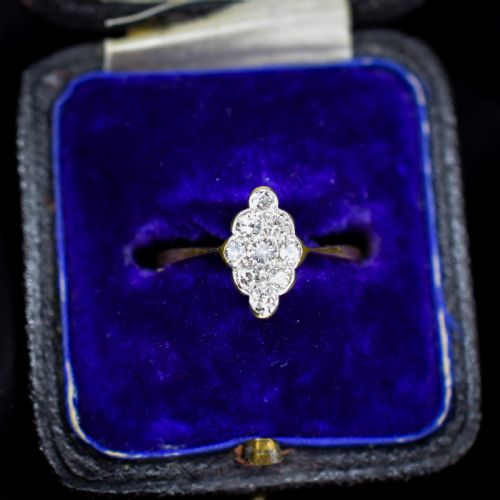
An edwardian marquise diamond ring brings a sharp, elongated silhouette to the hand, combining early twentieth-century grace with bright cluster work.
Edwardian Marquise Diamond Ring
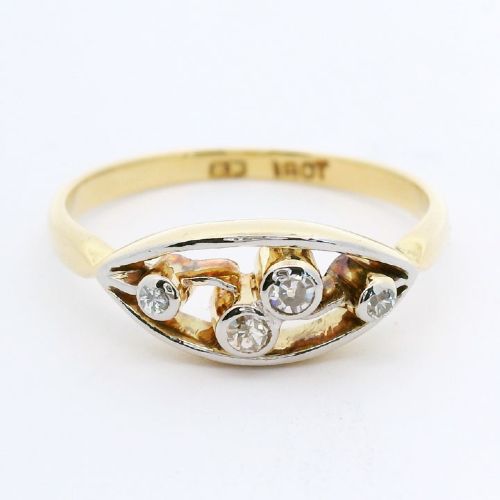
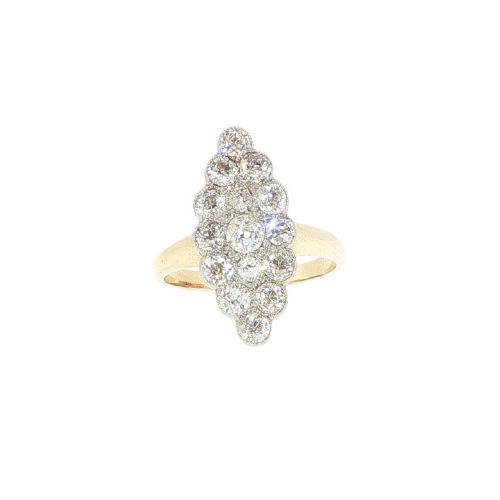
The edwardian marquise diamond ring is defined by its pointed, boat-shaped outline, often called a navette, which stretches lengthwise along the finger. Most examples meet here through Edwardian and Art Deco periods, drawing on foundational Victorian styles.
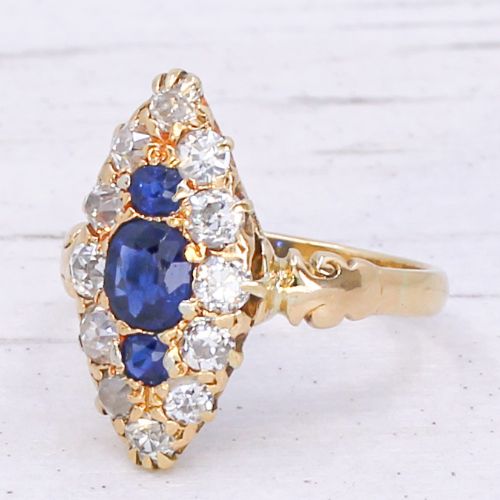
Makers shaped these elongated faces to hold clusters of old cut diamonds, frequently accented with calibré-cut sapphires, rubies, or emeralds. The silhouette sits flat or gently raised, designed to maximise finger coverage and catch candlelight.
While the core inventory centres on gold and platinum settings from the early decades of the twentieth century, occasional variations introduce coloured stones or alternate metal combinations.
Materials and construction
Goldsmiths combined yellow gold shanks with platinum-topped heads to provide a bright, durable white surface for claw-set diamonds without losing the warmth of gold underneath. This dual-metal technique characterises the period's finer workshops.
Early makers occasionally hid tiny geometric pierced vents beneath the stones so light could wash through the tapered ends of the ship.
Distinctions in quality
The precision of the piercing and the crispness of the millegrain beadwork separate standard production from finer goldsmithing. Superior pieces maintain symmetry across the pointed ends and keep the bezel edges sharp and even.
The calibre of the central diamonds and the matching saturation of companion stones like sapphires or emeralds determine the visual weight of the cluster. Well-matched old cut stones distribute light evenly across the elongated face.
The Edwardian Marquise Diamond Ring Glossary
- Marquise
- A boat-shaped or pointed oval gemstone cut with curved sides and pointed ends. It creates a distinctive elongated silhouette on the hand.
- Navette
- French for little ship, this term describes the pointed, boat-shaped form of a ring face or cluster. It is used interchangeably with marquise in period descriptions.
- Old cut
- A diamond cut by hand before modern machinery, characterised by a smaller table, higher crown, and open culet. These stones catch ambient light with a softer, broader flash.
- Millegrain
- A decorative border of tiny metal beads along the edge of a setting. It was widely used in Edwardian jewellery to frame stones and soften metal lines.
- Platinum
- A dense, strong white metal favoured in the Edwardian era for fine settings. It allowed jewellers to use minimal metal while securing delicate stones.
Edwardian Marquise Diamond Ring: Frequently Asked Questions
How do I wear a marquise ring daily?
Because the pointed ends extend beyond the finger, take care to avoid catching the tips on coarse fabrics or hard surfaces.
Pair it with low-profile bands if stacking, or let it sit alone as a focal piece on the hand.
Are these rings genuinely Edwardian?
The selection spans late Victorian, Edwardian, and early Art Deco periods, sharing similar boat-shaped geometries and old cut stones.
Examining hallmarks and construction methods helps determine the precise decade of manufacture.
What is the difference between marquise and navette?
In historical jewellery terms, both words describe the same pointed, elongated boat shape.
Marquise often refers specifically to the gemstone cut, while navette describes the overall mounting and cluster form.
Can an edwardian ring be resized?
Most gold and platinum bands can be adjusted by a skilled jeweller, though intricate shoulders require careful handling.
Consult a specialist who understands antique settings to preserve the original shank integrity and hallmark.