
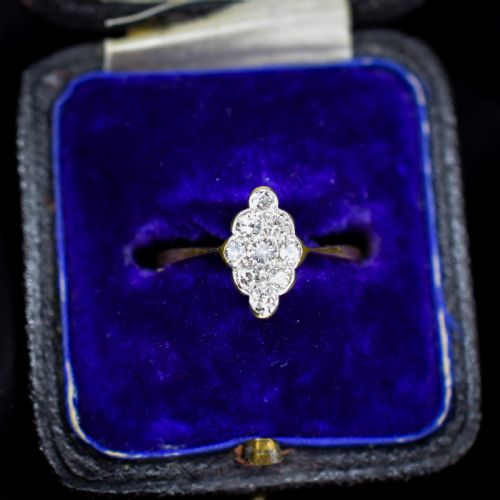
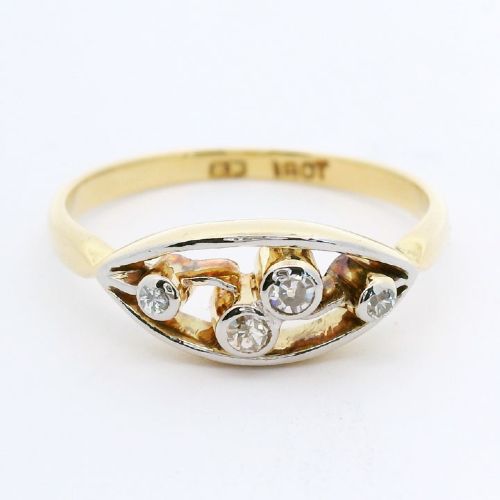
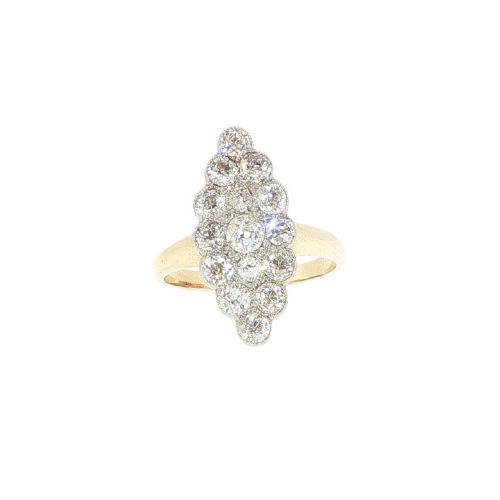


Platinum Diamond Navette Ring
A platinum diamond navette ring offers an elongated boat shape set with sparkling stones, prized for its flattering finger coverage.
Platinum Diamond Navette Ring
A platinum diamond navette ring is an elongated cluster jewel designed to sit lengthwise along the finger, catching the light across multiple stones.
You will most commonly encounter Edwardian and Art Deco versions on this page, spanning periods from 1900 through to 1940.
Many examples combine platinum settings with 18ct yellow gold or white gold shanks, while occasionally incorporating blue sapphires, rubies, or emeralds.
How they were made
Maker workshops utilised platinum to create fine, sturdy metal work that could hold old cut, transitional, and rose cut diamonds securely without bulky settings.
Gold in 18ct yellow or white was frequently combined with platinum tops during the Edwardian era and the 1920s to support complex cluster formations.
The listings here span the Victorian, Edwardian, and Art Deco periods, uniting platinum with diamonds, sapphires, rubies, and 18ct gold.
What varies in quality
The sophistication of the piercing and openwork metal underneath dictates the overall refinement of a navette ring, separating standard production from finer workshop output.
The selection and matching of old cut or transitional cut diamonds determine the visual harmony across the elongated face of the cluster.
The Platinum Diamond Navette Ring Glossary
- Navette
- A boat-shaped gemstone setting that tapers to points at both ends. It is also frequently described in listings as a marquise or panel ring.
- Platinum
- A dense, durable white metal favoured in the Edwardian and Art Deco periods for delicate millegrain edges and secure gemstone settings.
- Transitional cut
- A diamond facet style used primarily between the old European cut and the modern brilliant, bridging traditional hand-cutting and standardised geometry.
Platinum Diamond Navette Ring: Frequently Asked Questions
What is a navette ring?
A navette ring is a piece featuring an elongated, boat-shaped cluster of stones that stretches along the length of the finger. The term translates from French as little ship.
These rings are designed to provide maximum finger coverage and visual impact through a combination of diamonds and precious metals.
How do I date a platinum navette ring?
Dating relies on stylistic clues such as the presence of delicate Edwardian millegrain work or geometric Art Deco lines. Jewel construction methods and metal combinations also point toward specific decades between 1900 and 1940.
Examining the diamond cuts, such as old mine or transitional cuts, helps narrow down the era of manufacture.
Can I wear a navette ring daily?
Platinum provides a strong and durable setting for daily wear, though the elongated shape requires some care against sharp knocks. Regular checks by a jeweller ensure the tiny claw settings remain secure.
Removing the ring during heavy manual tasks helps preserve the intricate metalwork and delicate gemstone arrangements.
What is the difference between navette and marquise?
Navette and marquise both refer to the same elongated, pointed boat shape in antique jewellery. Navette is more commonly used for multi-stone cluster designs, while marquise often describes a single large gemstone.
Listings across the Edwardian and Art Deco periods use both terms interchangeably for these rings.