
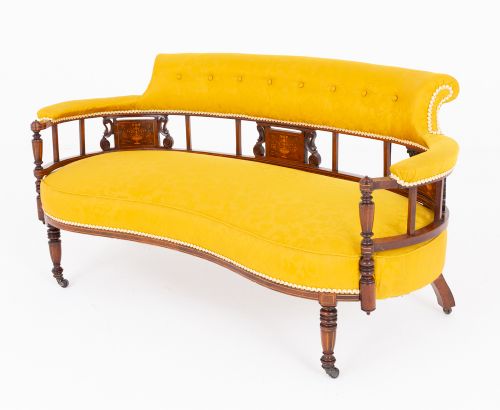


Edwardian Marquetry Settee
An edwardian marquetry settee brings inlaid wood and curved lines to a room, offering both a comfortable seat and a striking decorative centrepiece.
Edwardian Marquetry Settee
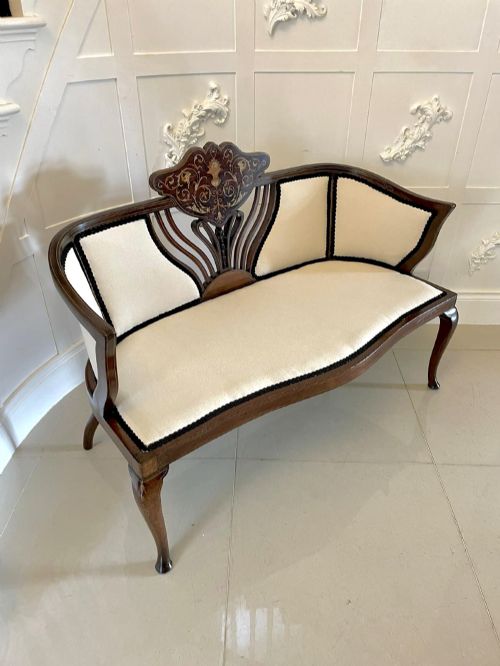
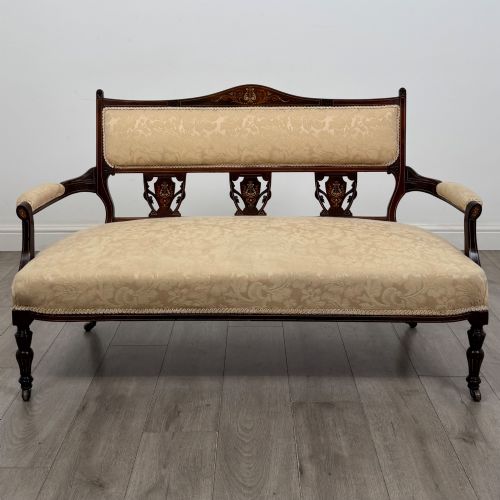
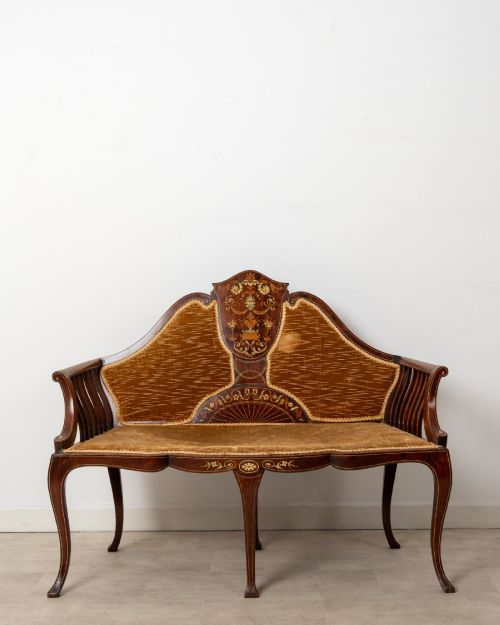
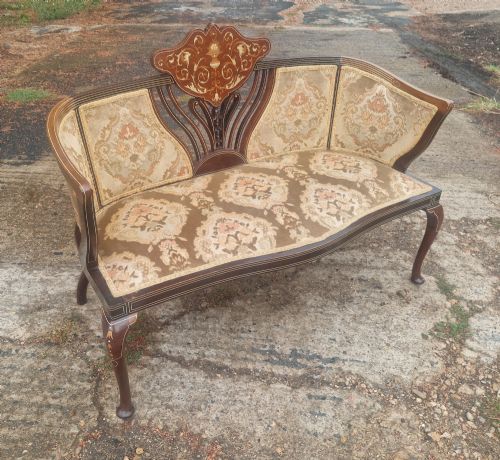
An edwardian marquetry settee represents a refined seating form primarily produced around the turn of the twentieth century. Buyers seeking this phrase encounter pieces spanning from late Victorian decades through the Edwardian period, often styled as salon settees, two-seater sofas, or window seats. These items function as ornamental furniture designed for reception rooms and parlours rather than heavy daily lounging.
The inventory demonstrates a clear preference for lighter timbers and detailed surface decoration over the heavy, dark styles of earlier decades. Mahogany and rosewood form the main structural frames, whilst satinwood, boxwood, and bone provide contrasting tones for intricate pictorial or geometric inlays. Alongside standalone sofas, one occasionally finds related parlour suites and matching salon chairs sharing the same decorative vocabulary.
Materials and Construction Techniques
Cabinetmakers constructed these frames predominantly from solid mahogany and rosewood, applying fine veneers to curved crest rails and splats. The defining characteristic involves marquetry work, where contrasting woods such as satinwood and boxwood are carefully cut and fitted into recessed channels within the primary timber. Artisans secured these intricate patterns by hand before finishing the surfaces with traditional polishes to highlight the natural grain.
Upholstery forms an integral part of the construction, utilising sprung seats covered in fabrics like damask, velvet, or specialised upholstery ready for restoration. The integration of textile panels with wooden frames requires precise joinery to ensure stability, particularly on slender legs and open arm supports.
Edwardian Marquetry Settee Retail Price Guide 2026
Typical asking prices for edwardian marquetry settee among the pieces listed under this phrase on Sellingantiques today, from the lower quarter to the upper quarter. They describe what is for sale here now, not the wider market.
Current listings demonstrate a prevalence of mahogany frames decorated with satinwood inlay across pieces dating from the late Victorian era up to nineteen-ten.
Distinctions in Quality and Execution
The refinement of the marquetry design largely determines the distinction between standard production and exceptional examples. Finer pieces display crisp, multi-wood pictorial inlays featuring precise shading and tight joints, whereas simpler items rely on basic geometric stringing. The choice of primary timber also influences the standing of a piece, with richly figured rosewood and select mahogany achieving greater visual depth than plain secondary woods.
Structural integrity and original proportion separate superior examples from lesser ones. A well-balanced frame retains clean lines without excessive reinforcement, while the execution of curved arms and backrests reflects the maker's skill in handling delicate forms.
James Shoolbred
The Edwardian Marquetry Settee Glossary
- Marquetry
- Decorative veneer work assembled in geometric patterns or pictorial scenes using various coloured woods. This technique requires meticulous hand-cutting and fitting of thin wood sections into a prepared surface.
- Satinwood
- A lustrous, hard timber native to Ceylon and India with a yellowish-gold sheen. It serves as a principal contrasting material for fine inlay work.
- Salon Settee
- A light, decorative two-seat sofa intended for formal reception rooms. These pieces prioritize elegant proportions and ornamental detail over heavy cushioning.
- Stringing
- Thin lines of contrasting wood inlay used to outline panels and borders on furniture. This linear decoration accentuates the structural contours of the frame.
- Sheraton Revival
- A late nineteenth and early twentieth century design movement inspired by the lighter neoclassical furniture of the eighteenth century. Pieces in this style typically feature symmetrical forms and delicate inlay.
Edwardian Marquetry Settee: Frequently Asked Questions
What is an edwardian marquetry settee?
An edwardian marquetry settee is a decorative two-seat wooden sofa featuring detailed inlaid patterns made from contrasting timbers. These pieces date principally from the late nineteenth and early twentieth centuries.
They were designed primarily for formal reception rooms and parlours, combining practical seating with intricate surface ornamentation that showcased fine cabinetmaking skills.
How were these settees originally used?
These settees served as elegant seating in drawing rooms, salons, and bed chambers where entertaining took place. They were positioned against walls or beneath windows rather than used for heavy daily relaxation.
Their open frames and light construction made them easy to move about the room to suit the social arrangements of the household.
How do I care for inlaid wood?
Inlaid wooden surfaces require gentle dusting with a soft, dry cloth and protection from direct sunlight and extreme temperature fluctuations. Excessive heat can cause veneers to dry out and lift from the core timber.
Applying traditional wax polish occasionally helps nourish the wood and maintain the lustre of the marquetry without building up heavy residues.
How do I tell Victorian from Edwardian styles?
Victorian furniture tends to feature darker timbers, heavier proportions, and more robust carving. Edwardian pieces generally display lighter woods like satinwood and mahogany with more slender, graceful profiles.
Sheraton Revival influences in the Edwardian era introduced brighter inlay work and a return to neoclassical symmetry, creating a distinct visual lightness compared to earlier Victorian designs.