
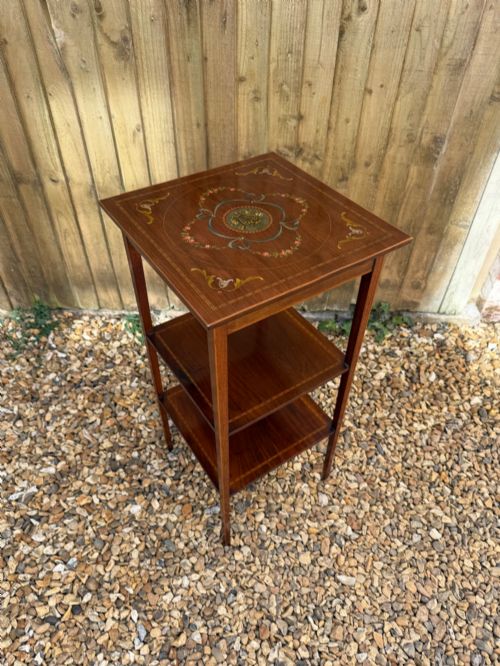
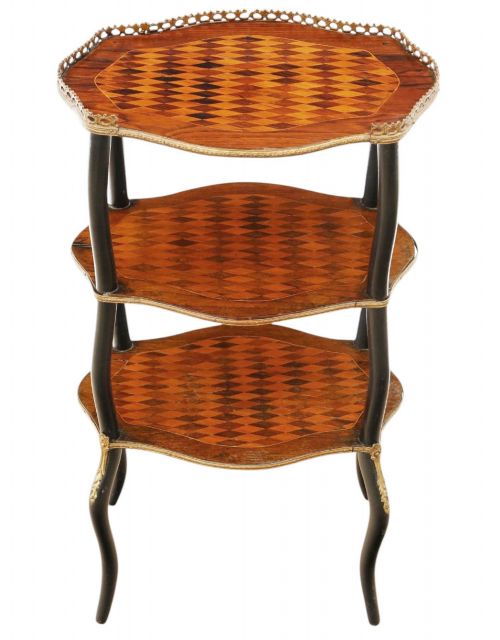


Edwardian Inlaid Whatnot Stand
An edwardian inlaid whatnot stand offers tiered display space, bringing characteristic period marquetry and slender proportions to a room.
Edwardian Inlaid Whatnot Stand
The edwardian inlaid whatnot stand is a tiered display piece designed for holding decorative objects, books, or music sheets in a drawing room or parlour. These items combine open shelving with decorative woodwork, functioning as both practical storage and focal points.
You are most likely to encounter corner variants or standing three and four-tier pieces across the current selection. Materials span walnut, burr walnut, and mahogany, frequently embellished with boxwood inlay, marquetry, and parquetry.
The objects date across the nineteenth and early twentieth centuries, encompassing Victorian, Edwardian, and Sheraton Revival styles. Forms range from simple display shelves to combination pieces featuring canterburys, music cabinets, and small drawers.
Construction and materials
Makers utilised dense cabinet timbers like mahogany and walnut, often selecting burr walnut veneers for their figured grain patterns on shelves and cupboard doors. Ebonised wood occasionally provides contrast against lighter veneers.
Decoration relies on precision inlay work, incorporating boxwood and marquetry to form floral, classical, or geometric motifs across the tiers. Brass mounts and handles appear on select pieces, adding metallic detail to the timber framework.
Tiered configurations span from three-shelf display units to four-tier standing formats and specialised corner designs.
Judging quality in these stands
Quality rests in the crispness of the marquetry and the choice of timber veneers, where highly figured burr walnut and clean boxwood stringing elevate a piece. The structural integrity of the upright supports and tier joints determines stability.
Subtlety in design distinguishes finer examples, particularly those incorporating integrated drawers, music compartments, or complex curved corners. Ormolu mounts and well-executed parquetry point to higher workshop standards.
The Edwardian Inlaid Whatnot Stand Glossary
- Whatnot
- A piece of furniture consisting of a set of open shelves for displaying small objects. They became popular in the nineteenth century for drawing rooms.
- Etagere
- A piece of furniture with a set of open shelves for displaying ornaments. The term is often used interchangeably with whatnot in French and English cabinet making.
- Marquetry
- Decorative veneer work forming pictures or patterns by using thin slices of wood, shell, or ivory. This technique defines the surface decoration on many tiered stands.
- Canterbury
- A low stand with partitions for holding sheet music or loose papers. Some examples combine this function with whatnot shelving above.
- Parquetry
- A geometric mosaic of wood pieces used for floors and furniture surfaces. It provides a structured contrast to flowing floral marquetry.
Edwardian Inlaid Whatnot Stand: Frequently Asked Questions
What is an edwardian inlaid whatnot stand used for?
These pieces serve as multi-tiered display stands for ornaments, china, or small books within reception rooms. Their open structure allows decorative items to be viewed from multiple angles.
Some variations incorporate lower cabinets, drawers, or partitions for sheet music, adding enclosed storage to the open shelving.
How do I tell Victorian from Edwardian stands?
Victorian examples often employ darker timbers like burr walnut and heavy mahogany with robust corner supports and rich grain patterns. They frequently date from the mid to late nineteenth century.
Edwardian and Sheraton Revival pieces tend to feature lighter satinwood or mahogany with more delicate, refined stringing and neoclassical motifs dating towards the turn of the century.
Where should I place a corner whatnot?
Corner variants fit neatly into unused room angles, making efficient use of space while drawing the eye upward through their graduated tiers. They work well in smaller parlours or sitting rooms.
Ensure the wall angles match the ninety-degree or specific splay of the stand so the rear uprights sit flush against the skirting and wall.
Are these stands structurally stable?
Most standing and corner tiers are surprisingly sturdy when placed on level flooring, supported by solid upright columns or slender legs. However, their height means they should not bear excessive weight on upper shelves.
Using wall fixings is occasionally advisable for taller four-tier models if placed in busy hallways or homes with pets and children.
What maintenance do inlaid wooden stands need?
Routine dusting with a soft, dry cloth protects the polished timber and delicate boxwood stringing from abrasive particles. Avoid placing them in direct sunlight to prevent veneer fading.
Occasional application of appropriate furniture wax nourishes the wood and maintains the satin sheen without building up heavy residues.