
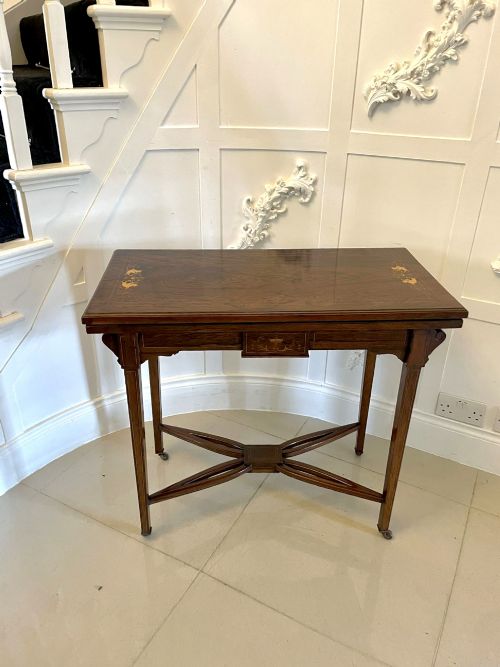
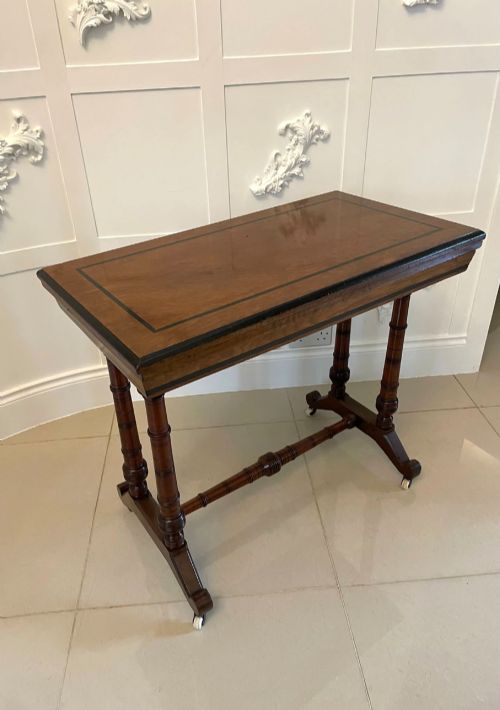
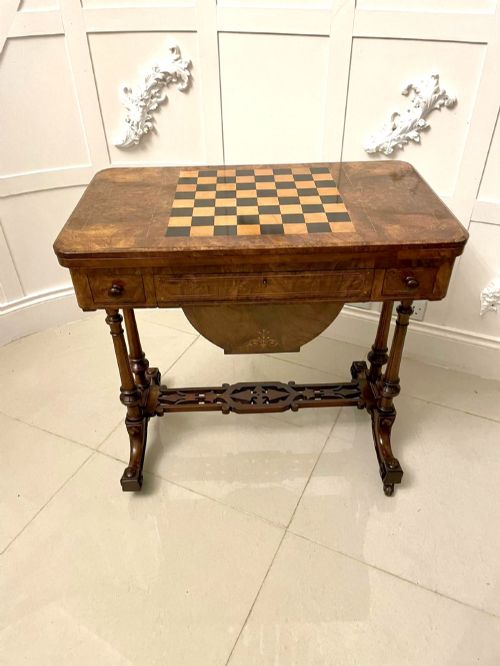
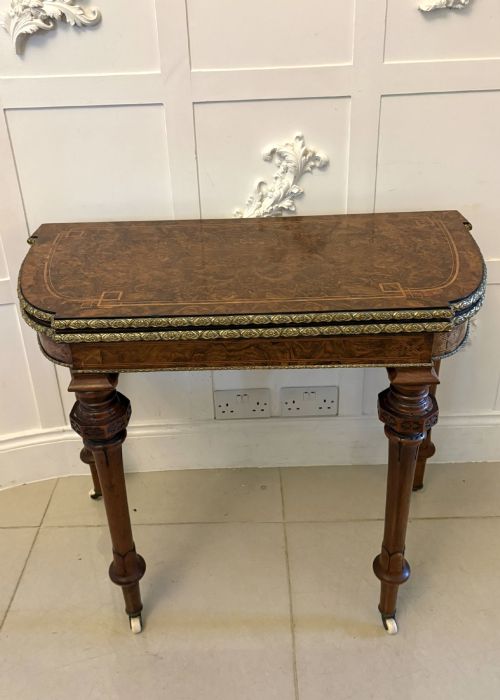

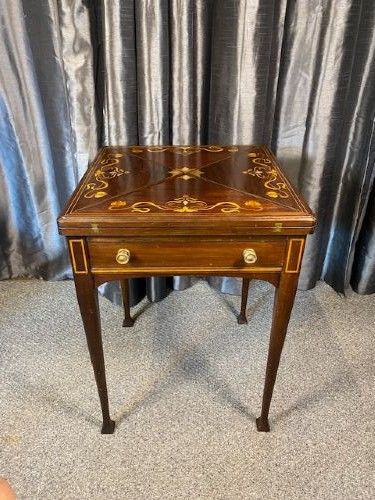
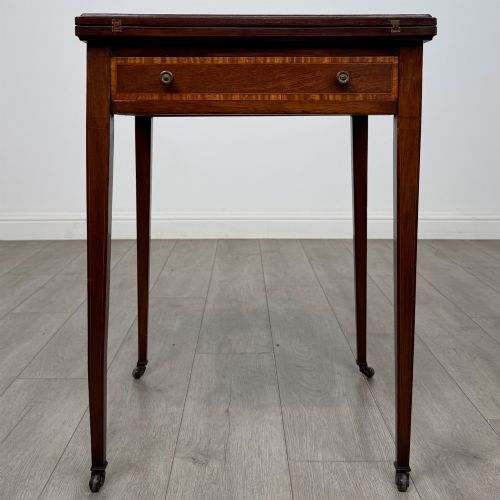
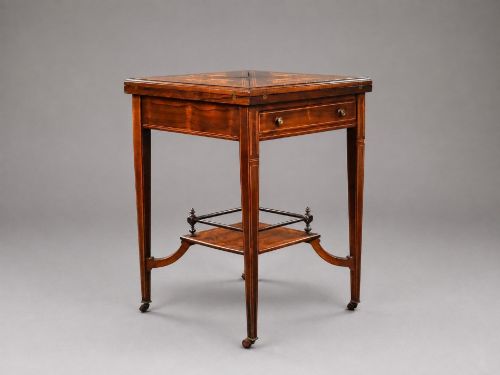
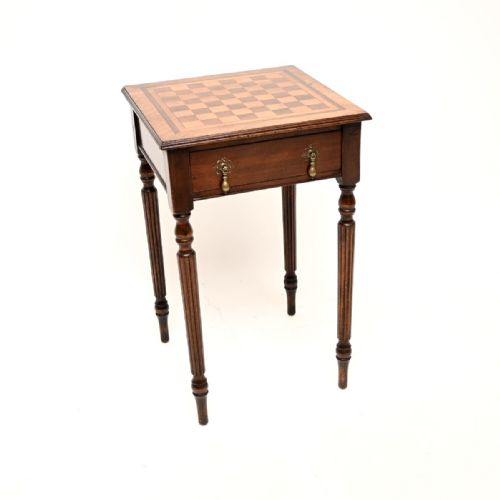
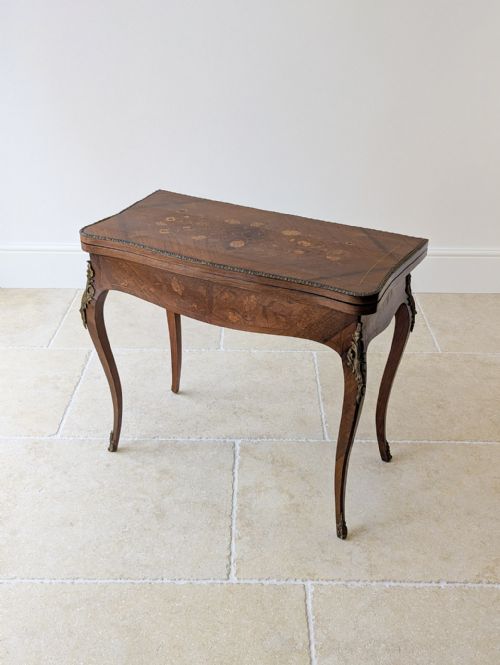

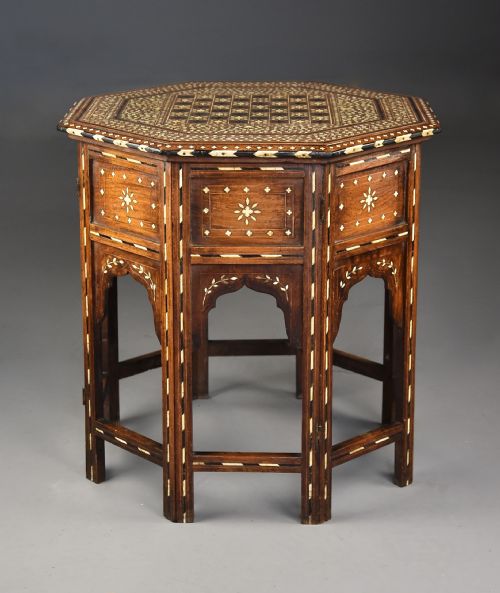
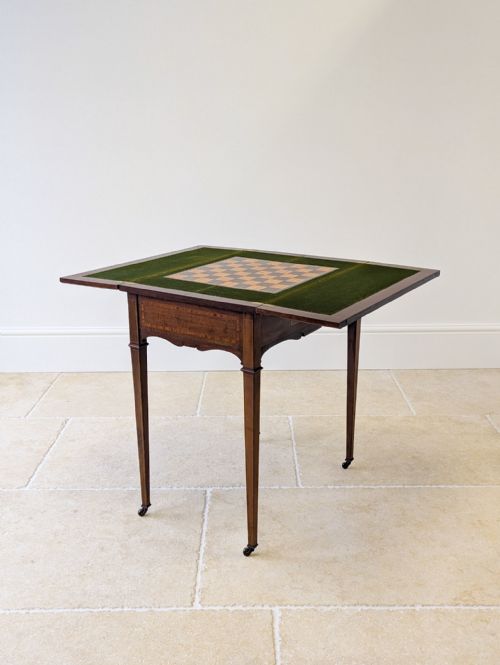
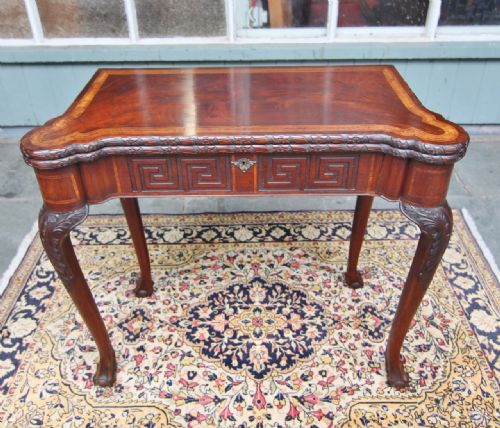
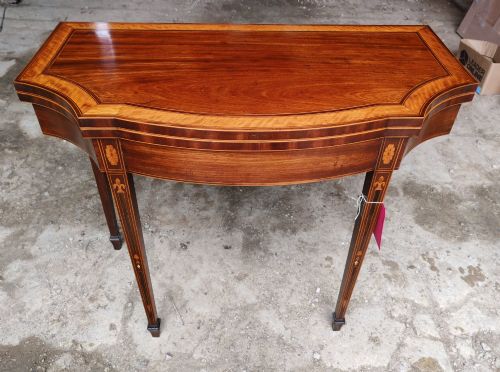
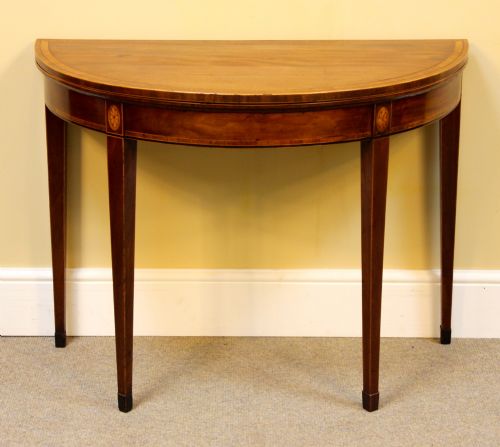
Edwardian Inlaid Gaming Table
An Edwardian inlaid gaming table combines practical ingenuity with refined surface decoration, offering a versatile surface for cards and board pursuits.
Edwardian Inlaid Gaming Table
The edwardian inlaid gaming table appears predominantly in envelope formats, alongside folding, swivel-top, and demi-lune varieties that reflect earlier Georgian and Victorian design influences.
Makers of this period utilise satinwood, mahogany, and rosewood, often enhanced with delicate boxwood and wood inlay to create geometric and floral motifs.
These pieces function as compact occasional or side tables during daily use, transforming swiftly to accommodate card playing and board games through pivoting or folding tops.
Materials and Techniques
Construction relies heavily on dense timbers such as mahogany, rosewood, and burr walnut, providing stable foundations for intricate surface work.
Craftsmen apply contrasting veneers including satinwood and boxwood alongside fine wood inlay to delineate borders, corners, and central motifs.
Mechanical ingenuity defines many examples, utilising rotating swivel mechanisms, pivoting leaves, and clever folding envelope tops operated by brass hinges.
Listings span from the 18th century through the Edwardian period, uniting Georgian mahogany, Victorian burr walnut, and satinwood under the gaming table form.
Evaluating Craftsmanship
Quality rests upon the precision of the timber selection and the crispness of the inlaid decoration, where tightly fitted contrasting woods demonstrate superior joinery.
The integrity of the folding or swivel mechanism dictates daily utility, ensuring leaves operate smoothly and sit level without wobble when extended.
Refined pieces display thoughtful secondary timbers inside fitted compartments and drawers, maintaining structural elegance both open and closed.
Howard & Son's·Maple & Co.
The Edwardian Inlaid Gaming Table Glossary
- Envelope table
- A square card table featuring four triangular flaps that pivot open diagonally to reveal a baize-lined surface. This clever folding mechanism became particularly popular during the Edwardian period.
- Demi-lune
- A half-moon shape used for console and card tables designed to sit flush against a wall. When opened, the folding top forms a full circle supported by a swing leg.
- Inlay
- A decorative technique where pieces of contrasting wood, brass, or other materials are inserted into recessed cavities flush with the surrounding surface. This method creates geometric borders and floral motifs.
- Burr walnut
- A prized timber harvested from the gnarled growths on walnut trees, exhibiting swirling, highly decorative grain patterns. Cabinet makers frequently utilised veneers of this wood on Victorian and Edwardian tabletops.
Edwardian Inlaid Gaming Table: Frequently Asked Questions
What woods are typical for these tables?
Cabinet makers predominantly used mahogany and rosewood as primary structural timbers, frequently applying rich veneers of burr walnut or satinwood across the top. Contrasting woods like boxwood and ebony provide fine linear stringing and detailed inlay.
Lighter woods became increasingly fashionable during the Edwardian era, replacing the darker, heavier polished surfaces favoured by earlier Victorian craftsmen.
Are these tables suitable for daily use?
These tables function well as decorative side or occasional furniture when closed, occupying minimal floor space in a reception room. Opening the top reveals a stable surface ideal for card games or writing.
Care should be taken to protect the polished wood and baize linings from moisture, heat, and direct sunlight during everyday use.
How can I distinguish Edwardian from Victorian examples?
Edwardian pieces generally exhibit lighter timbers such as satinwood and brighter mahogany, often featuring delicate Sheraton Revival neoclassical motifs and slender tapered legs. Victorian versions typically display heavier proportions, darker burr walnut veneers, and more ornate or serpentine shaping.
Construction details and hardware also shift, with Edwardian makers favouring refined brass hinges and understated stringing over heavy ormolu mounts.