
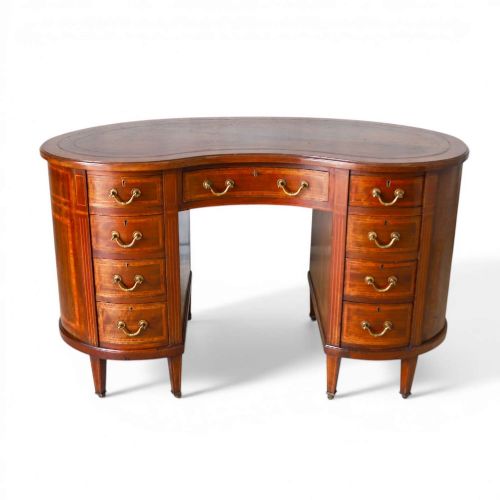
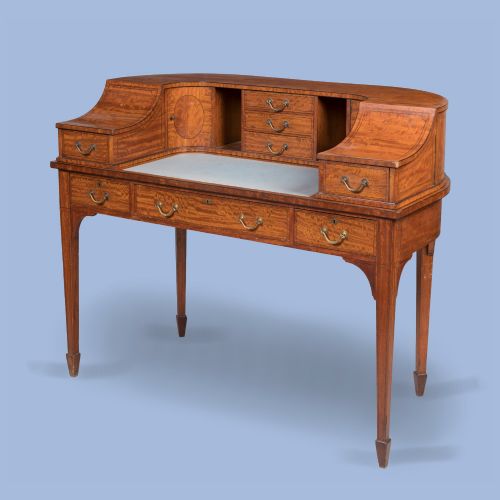


Edwardian Inlaid Executive Desk
An edwardian inlaid executive desk brings together rich mahogany, satinwood inlay, and leather writing surfaces for a distinguished workspace.
Edwardian Inlaid Executive Desk
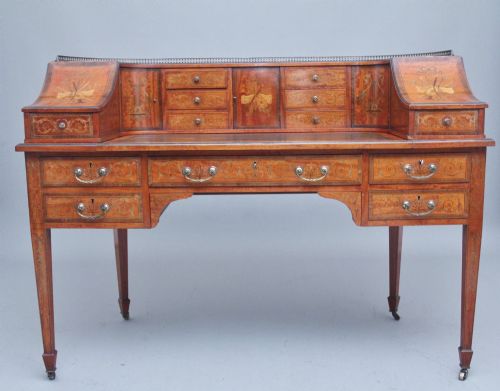
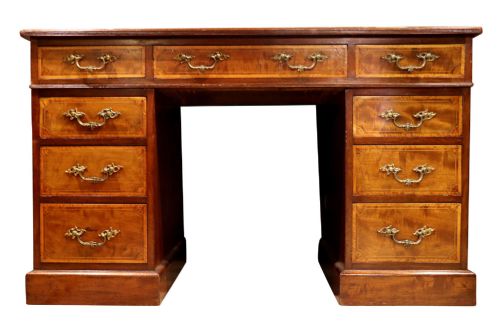
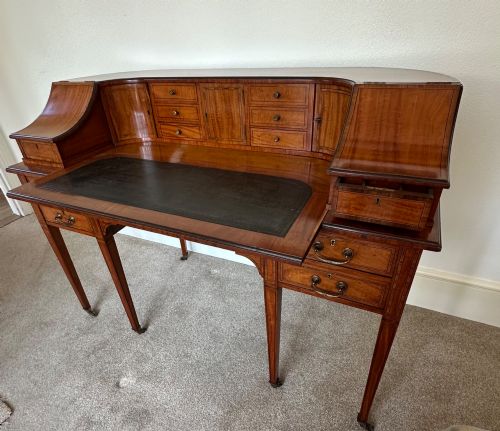
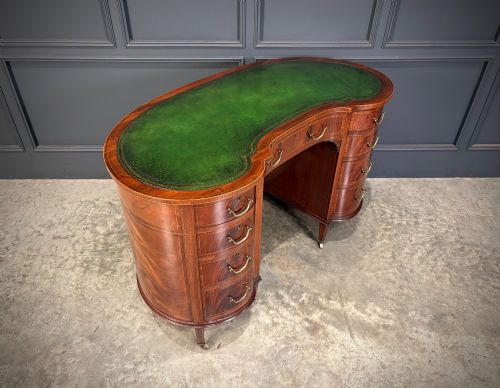
An edwardian inlaid executive desk encompasses sturdy pedestal forms, kidney-shaped writing tables, and elaborate Carlton House configurations. These pieces originate predominantly from the Edwardian era and the late nineteenth century, reflecting the tastes of period workshops.
Makers on this page incorporate classical styling such as Sheraton Revival motifs alongside mahogany and satinwood construction. Buyers encounter twin pedestal desks alongside kneehole tables and compact writing desks suited for refined studies.
The selection frequently highlights contrasting wood grains and delicate stringing, setting these tables apart from standard utilitarian office furniture. Each format provides a dedicated surface for correspondence and paperwork.
How they were made
Craftsmen built these desks using solid mahogany and walnut frameworks, often applying satinwood veneers for decorative contrast. Inlaid stringing and banding define the borders of writing surfaces and drawer fronts.
Leather writing inserts, frequently tooled in gold, form the central working area on many pedestals and kidney shapes. Original brass handles and mounts complete the construction, secured to multiple drawers of varying depths.
Listings feature mahogany, satinwood, and walnut, complemented by brass mounts and leather writing surfaces.
What varies in quality
Quality rests in the crispness of the cabinetwork, the choice of timber figures, and the finesse of the satinwood inlay. Desks bearing signatures from established London firms demonstrate superior joinery and thoughtful proportions compared to anonymous workshop examples.
The retention of original hardware, including brass handles and leather inserts, elevates the standing of a piece. Finer examples display meticulous attention to secondary timbers and interior drawer construction.
Edwards & Roberts·Wolfe & Hollander·Gill & Reigate·James Shoolbred·Maple & Co
The Edwardian Inlaid Executive Desk Glossary
- Pedestal desk
- A heavy freestanding writing table supported by two banks of drawers flanking a central kneehole. This form provides substantial storage capacity while maintaining a formal presence in a room.
- Kidney desk
- A writing table shaped with a curved front indented for the user. These pieces often feature an arrangement of drawers beneath the main writing surface.
- Satinwood
- A pale, lustrous timber utilised extensively for veneers and decorative inlay during the Sheraton Revival period. It contrasts sharply against darker woods like mahogany and walnut.
- Kneehole desk
- A compact writing table featuring a central recess for the user's legs, flanked by smaller sets of drawers. These items suit smaller studies and private chambers.
- Stringing
- Narrow lines of contrasting wood inlaid into the surface of furniture to create geometric borders. This technique highlights the edges of drawers and tabletops.
Edwardian Inlaid Executive Desk: Frequently Asked Questions
How do I care for leather desk tops?
Leather writing surfaces benefit from occasional cleaning with specialised balms to prevent drying and cracking.
Avoiding direct sunlight helps preserve the colour and the gilt tooling along the edges.
Where were these desks used?
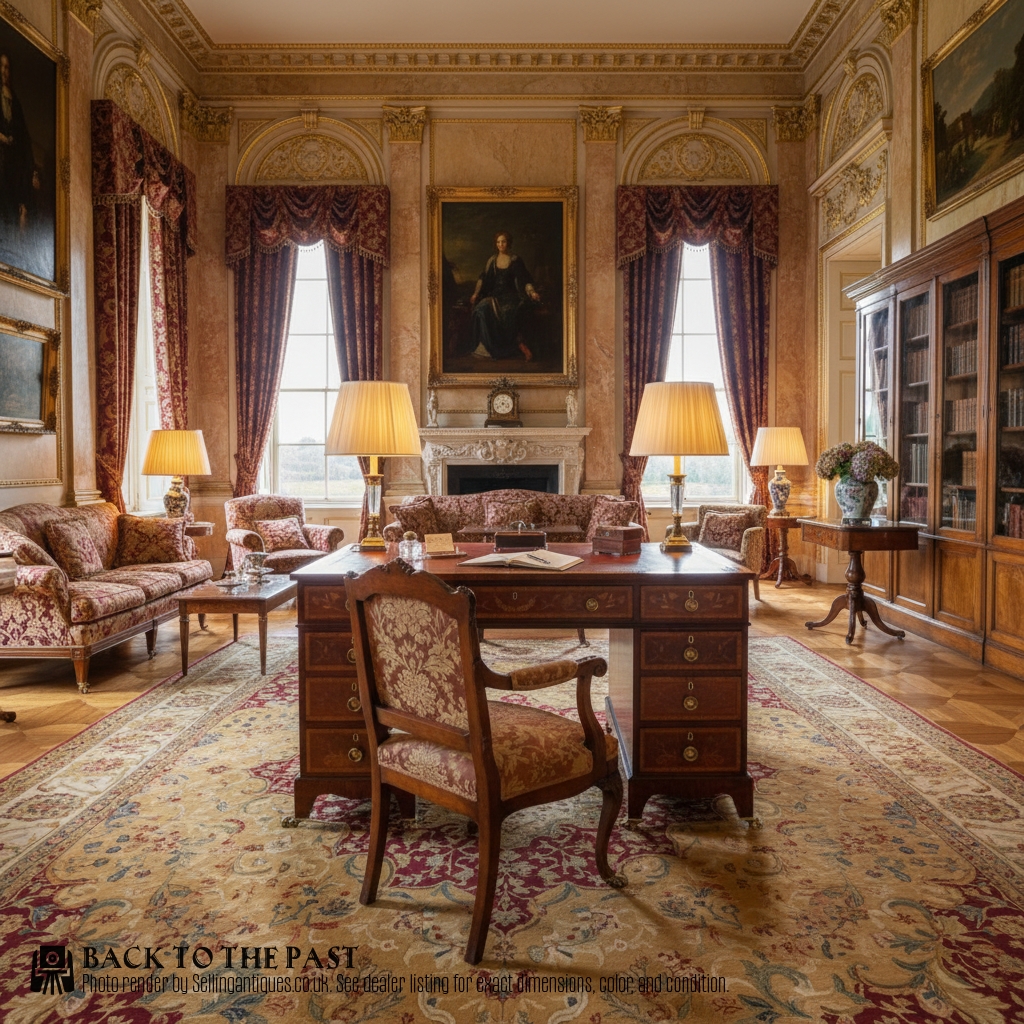
These desks served primarily in private libraries, studies, and executive offices of grand townhouses and country residences.
Their finished backs allowed them to sit in the centre of a room rather than against a wall.
How do I identify Sheraton Revival pieces?
Sheraton Revival furniture draws inspiration from eighteenth-century neoclassical designs, featuring light satinwood, graceful tapered legs, and floral marquetry.
Makers working around nineteen hundred utilised these classical motifs to satisfy demand for refined antique styles.