



Edwardian Inlaid Buffet Table
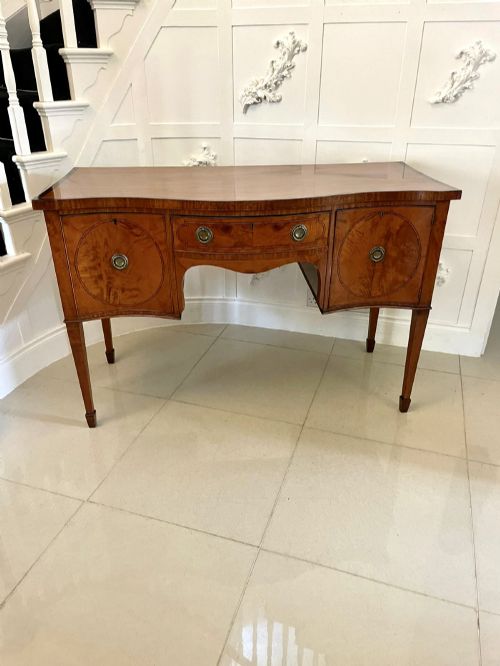
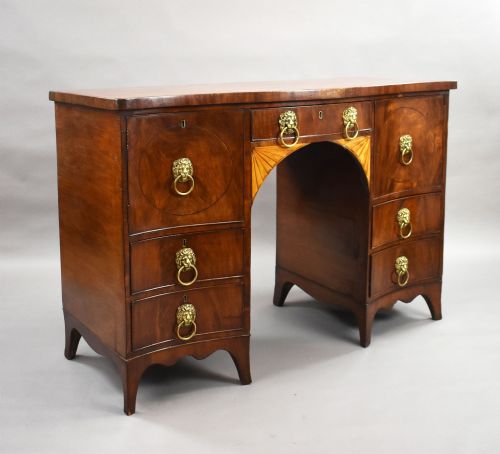
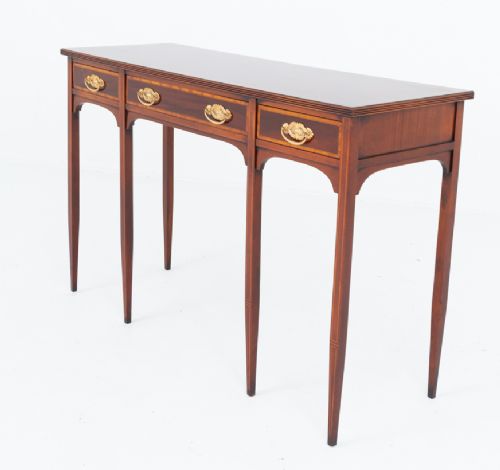
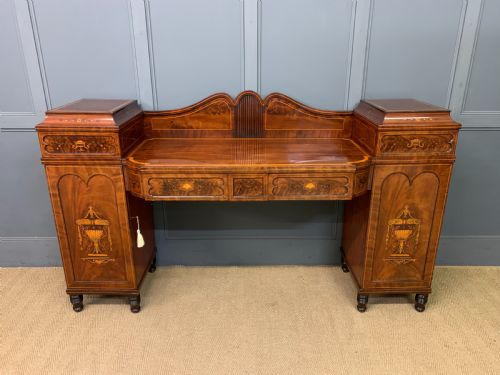
An edwardian inlaid buffet table brings refined mahogany and delicate stringing into the dining room, offering both surface display and deep storage for serving silver.
Edwardian Inlaid Buffet Table
When you search for an edwardian inlaid buffet table, you encounter formal dining furniture spanning several decades, most notably Edwardian pieces alongside Sheraton Revival revivals of earlier forms. The pieces on this page appear primarily in Edwardian and Victorian guises, adopting serpentine, bowfront and breakfront shapes designed to sit flat against a dining room wall.
Makers drew heavily on Georgian and Regency precedents, creating servers and sideboards that utilise mahogany carcasses enriched with lighter wood details. You will find items described variously as servers, serving tables and sideboards, each sharing the primary function of holding dishes and cutlery during family meals.
Materials and Technique
Cabinetmakers built the foundational structure using solid mahogany and mahogany veneer over secondary timbers, selecting cuts that displayed a rich grain and deep natural warmth.
Surface decoration relies on contrasting stringing and crossbanding executed in satinwood and boxwood, creating geometric borders and delicate floral or urn motifs typical of the Sheraton Revival style.
Several dining pieces manage to look impeccably formal while harbouring hidden drawers designed strictly for stashing away Sunday silverware.
Craftsmanship and Proportion
Superior examples distinguish themselves through the precision of the wood inlay and the crispness of the serpentine or bowfront shaping, where every curve meets the eye with absolute symmetry. Lesser pieces show simpler lines with minimal banding.
The choice of cabinet timber and the preservation of original brass handles or marble tops further separate standard production items from workshop pieces bearing maker stamps.
Robson and Sons·Howard And Sons
The Edwardian Inlaid Buffet Table Glossary
- Crossbanding
- A narrow strip of veneer laid perpendicular to the grain of the main surface, framing the top or drawer fronts of a sideboard.
- Serpentine
- A furniture front curved in a gentle wave, turning outward at the ends and inward at the centre.
- Sheraton Revival
- A late nineteenth-century design movement copying the light, neoclassical furniture forms associated with Thomas Sheraton.
- Bowfront
- A convex curved front that projects outward in a smooth arc, frequently seen on Edwardian sideboards.
- Stringing
- Thin lines of contrasting wood inlaid into channels cut into the surface of the timber to form borders and panels.
Edwardian Inlaid Buffet Table: Frequently Asked Questions
What is an edwardian inlaid buffet table used for?
These pieces served primarily in formal dining rooms for presenting dishes during meals and storing silverware, linen or serving platters within their drawers and cupboards.
Today, they function well in hallways or living spaces as serving surfaces or console tables, offering substantial interior storage while maintaining a slender profile against the wall.
How do I tell Edwardian from Georgian pieces?
Edwardian items frequently draw inspiration from earlier eras through the Sheraton Revival movement, utilising machine-cut veneers and specific secondary timbers typical of the late nineteenth and early twentieth centuries.
Authentic Georgian examples display eighteenth-century construction methods, hand-cut dovetails and timber patination developed over a longer period of age and use.
Where should I place a sideboard in my home?
A dining room remains the natural home for these tables, positioned along a main wall to assist with serving guests and storing dining accessories.
They also sit comfortably in spacious hallways or reception rooms where their polished mahogany surfaces and decorative inlay can be appreciated as a focal point.
What woods are commonly found on these tables?
Mahogany forms the primary structural timber and veneer for the vast majority of these dining servers, providing a dark and stable canvas for decoration.
Satinwood and boxwood appear as contrasting inlay materials, used alongside darker bandings to create geometric borders and delicate neoclassical motifs.