
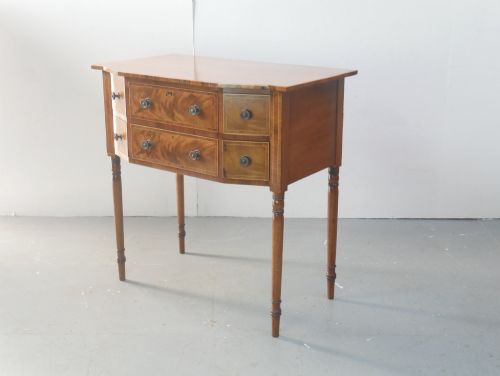

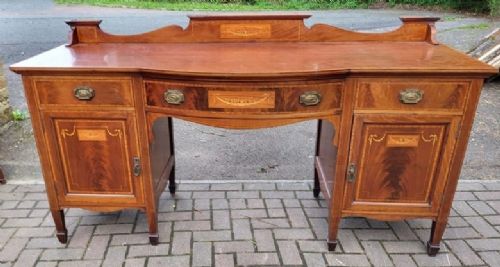
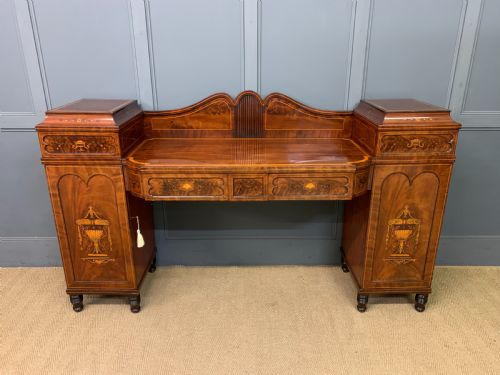

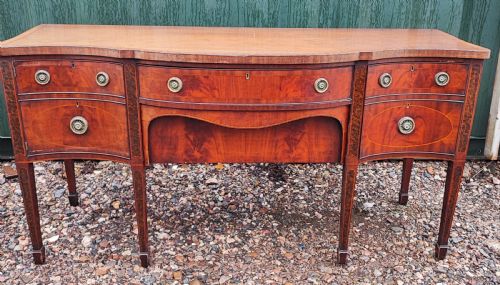


Inlaid Flame Mahogany Server
An inlaid flame mahogany server delivers immediate presence to a room through deep wood figuring and precise cabinetwork.
Inlaid Flame Mahogany Server
When searching for an inlaid flame mahogany server, you are looking at large dining room storage pieces primarily catalogued as sideboards, side cabinets, and dressers. These items span the eighteenth and nineteenth centuries, including Georgian, Regency, and Edwardian periods.
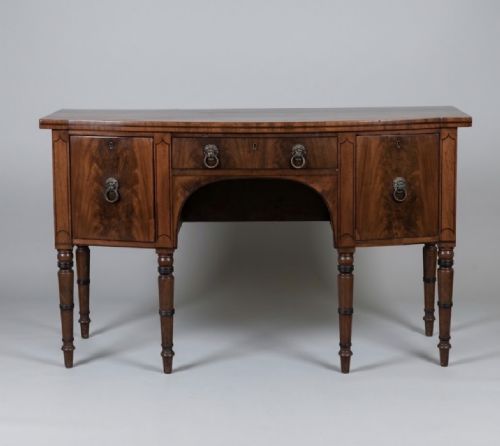
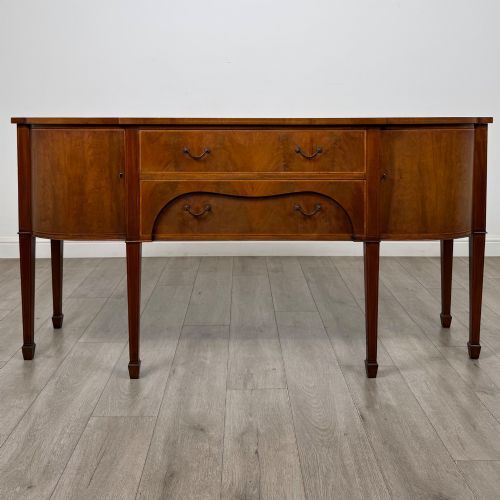
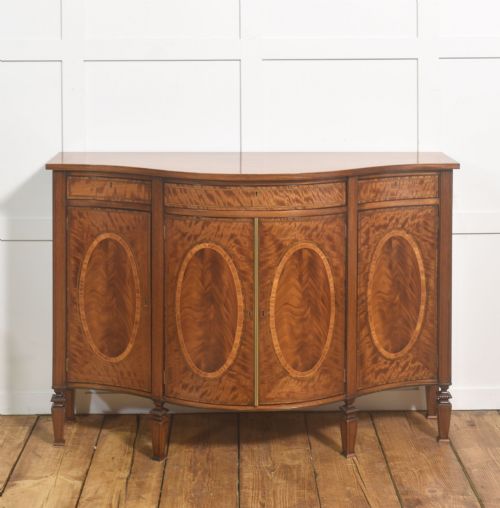
The most common form you will meet on this page is the bowfront or serpentine sideboard constructed from rich mahogany timber and detailed with contrasting stringing. They serve as substantial dining room furniture designed to hold silver, linen, and glassware while anchoring the room.
Makers utilised various geometric shapes, from straight fronts to breakfronts and stage-backs, incorporating brass feet or multiple legs for support. These pieces combine utility with decorative impact, showing the shift in taste across the Georgian and Victorian eras.
How they were made
Cabinetmakers selected mahogany for its dense grain and warm tone, often choosing flame mahogany veneers for the drawer fronts to create a striking pattern. They paired this primary wood with secondary timbers such as oak for drawer linings and internal structure.
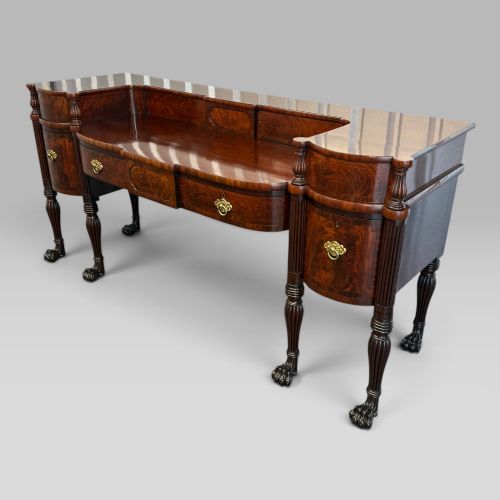
Inlay work relied on contrasting light woods like boxwood and satinwood, cut thinly and set into channels carved into the mahogany carcass. Brass hardware, including handles and lion paw feet, added functional and decorative weight to the finished furniture.
Listings feature mahogany, satinwood, and boxwood inlay across Georgian, Regency, and Edwardian periods, demonstrating enduring demand for figured timber.
What varies in quality
The choice of veneer sets the visual standard, with symmetrical figuring and careful book-matching marking out superior cabinetwork. Lesser examples feature plain timber or heavy repairs to the surface veneers where shrinkage has occurred over time.
The precision of the boxwood and satinwood inlay indicates the skill of the workshop, with tighter mitres and crisper lines separating finer items from simpler production. Original brasses and sound internal construction also elevate the standing of a piece.
Robson & Sons
The Inlaid Flame Mahogany Server Glossary
- Flame mahogany
- A veneer cut from timber where the branch meets the trunk, producing a rippling, flame-like pattern. This figuring was prized for principal display surfaces like drawer fronts and cabinet doors.
- Bow-front
- A convex, outward-curving front profile popular on sideboards and servers from the late eighteenth century onward. It softens the linear geometry of a dining room.
- Serpentine
- A front contour that curves outward in the centre and inward at the sides, or vice versa. This shape demands high carpentry skill to execute cleanly.
- Boxwood inlay
- Narrow strips of pale wood inserted flush into the darker mahogany surface to create geometric borders. It provides sharp visual contrast against the rich timber ground.
- Stage-back
- A raised tier or superstructure at the rear surface of a sideboard used for displaying plate. It adds height and architectural presence to the form.
Inlaid Flame Mahogany Server: Frequently Asked Questions
How do I spot a Georgian sideboard?
Look for elegant proportions, hand-cut dovetails in the drawer boxes, and understated brass hardware. The timber choice often leans towards rich, dense mahogany with subtle figuring rather than loud veneers.
Check the legs and stretcher arrangements, as eighteenth-century examples frequently employ tapered spade feet or multiple sturdy supports without heavy Victorian ornamentation.
What is the difference between a sideboard and a server?
Sideboards and servers both provide storage and display surfaces in dining spaces, though servers tend to be slightly more compact. In period terminology, these categories often overlap significantly.
Both forms utilise similar timber construction, inlay techniques, and regional cabinetmaking styles from the Georgian and Regency periods.
How should I care for flame mahogany veneer?
Keep the wood away from direct sunlight and strong heat sources to prevent the veneers from drying out and lifting. Regular dusting with a soft, dry cloth maintains the surface.
Apply a traditional beeswax polish sparingly when the wood appears dry, buffing it gently to preserve the deep lustre of the grain.
Are these pieces suitable for modern dining rooms?
Their deep storage capacity and flat upper surfaces make them practical for contemporary dining spaces or large hallways. They easily accommodate modern tableware while adding historical character.
The varied forms, from neat bowfronts to larger breakfronts, allow you to match the scale of the furniture to the proportions of your room.
What distinguishes Regency pieces from earlier styles?
Regency items often draw inspiration from classical antiquity, featuring bolder brass mounts, lion paw feet, and heavier architectural forms. The lines tend to be more striking and sculptural.
In contrast, earlier Georgian pieces rely more on subtle wood figure, fine stringing, and restrained proportions to create their decorative effect.