
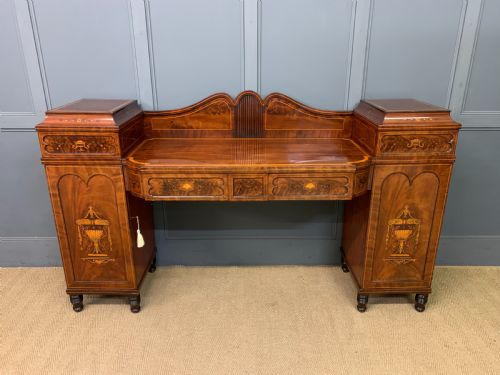


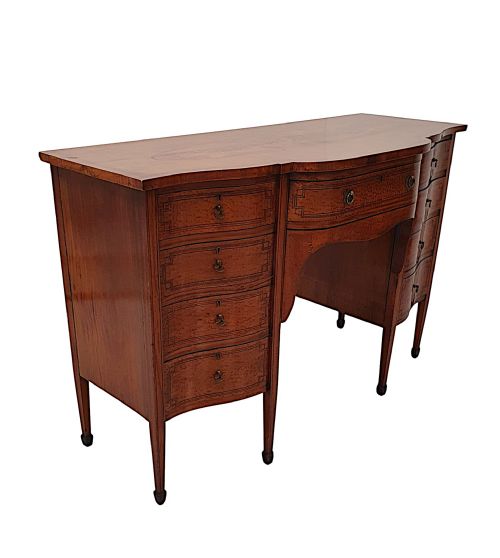


Sheraton Style Pedestal Sideboard
These Sheraton style pedestal sideboard examples bring balanced Georgian proportion and fine wood inlay into a dining room with quiet authority.
Sheraton Style Pedestal Sideboard
A Sheraton style pedestal sideboard combines a central serving surface with flanking side cupboards or urns, following the refined classical lines popularised in the late eighteenth century. These forms emerge from periods spanning the Georgian era, the nineteenth century, and the Edwardian epoch.
The versions most commonly met on this page employ mahogany as a primary timber, often enhanced with lighter stringing and contrasting crossbanding. Makers working in Edwardian and later periods adapted these classical proportions for formal dining spaces while retaining the characteristic bowfront or serpentine outline.
How they were made
Cabinet makers utilised solid and veneered mahogany over robust secondary woods, constructing the carcase to support heavy serving vessels and silverware. Surface enrichment relied upon precise wood inlay, incorporating satinwood and boxwood to delineate geometric panels and classical motifs.
Metal mounts and hardware, predominantly cast in brass, provided functional handles and escutcheons that complemented the reddish tones of the polished timber. Joinery techniques such as dovetailed drawer linings and pegged framing ensured structural longevity across decades of daily use.
Cutlery urns designed as classical vases kept silver forks secure while adding a touch of architectural theatre to the dining room.
What varies in quality
The distinction between standard commercial output and superior craftsmanship lies in the crispness of the wood inlay and the selection of figured mahogany veneers. Tighter grain patterns and harmonious colour matching across the central board and flanking pedestals indicate a more considered execution.
Subtlety in proportion and the integration of secondary timbers such as satinwood define the upper tier of pieces. Structural integrity, seen in the unwarped alignment of serpentine and bowfront doors, separates master workshops from routine production.
Goodall of Manchester
The Sheraton Style Pedestal Sideboard Glossary
- Bowfront
- A convex curved cabinet front that projects outward in a smooth arc. This shape softens the room's geometry and reflects light across polished mahogany surfaces.
- Crossbanding
- A border of veneer laid around the perimeter of a panel with the grain running perpendicular to the central section. It frames the primary wood and demonstrates cabinet-making skill.
- Pedestal
- An architectural support column or cupboard positioned at either end of a sideboard. These units balanced the composition and often housed bottle coolers or storage compartments.
- Satinwood
- A lustrous, yellow-toned timber imported from tropical regions used extensively for contrasting inlay and banding. Its bright grain illuminates darker field woods like mahogany.
- Stringing
- A narrow strip of contrasting light or dark wood inlaid into grooves on the furniture surface. This linear detail defines panels and outlines structural edges.
Sheraton Style Pedestal Sideboard: Frequently Asked Questions
What is a pedestal sideboard?
A pedestal sideboard is a large dining room cabinet comprising a central table flanked by distinct cupboards or urns. This tripartite arrangement originated in the Georgian period to facilitate formal dining service.
Cabinet makers designed these pieces to hold heavy serving platters, cutlery, and wine bottles. The configuration provides both display space and substantial enclosed storage within a unified architectural facade.
How do I date an inlaid sideboard?
Dating relies on examining the timber species, the style of the wood inlay, and the construction methods used inside the drawers. Georgian pieces typically feature hand-cut dovetails and native secondary woods, whilst Edwardian revivals often incorporate machine-cut elements and brighter satinwood.
Comparing the secondary woods and the specific geometry of the bowfront or serpentine curve helps distinguish eighteenth-century originals from later nineteenth and twentieth-century interpretations.
How do I care for mahogany furniture?
Mahogany furniture requires a stable environment away from direct sunlight and rapid temperature fluctuations to prevent the timber and veneer from splitting. Regular application of traditional beeswax nourishes the grain and maintains the polished finish.
Avoid using silicone-based sprays, which build up a residue over time and dull the natural warmth of the wood. Gentle dusting with a soft, dry cloth is sufficient for routine maintenance.
What rooms suit a pedestal sideboard?
These large sideboards suit spacious dining rooms or formal reception areas where their length and architectural presence can be appreciated. They require adequate floor clearance to allow the flanking cupboard doors or pedestal compartments to open fully.
In modern interiors, they function effectively as standalone serving consoles or storage buffets against long walls. Their classical proportions anchor the room and provide a practical surface for lamps or decorative objects.