
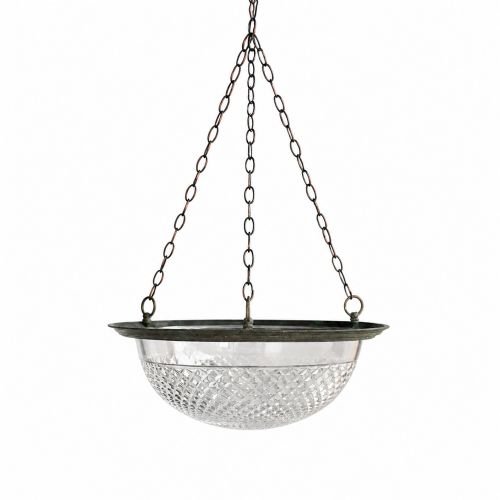


Edwardian Glass Bowl Chandelier
An edwardian glass bowl chandelier brings soft overhead light to a room, suspended on chains and shaped to diffuse brightness evenly.
Edwardian Glass Bowl Chandelier
When you search for an edwardian glass bowl chandelier, you encounter a hanging light fitting designed around a central glass or crystal bowl suspended from brass, bronze, silver plate, or wrought iron chains.
The listings show examples spanning the Edwardian era, the Victorian period, and the early twentieth century, alongside Arts and Crafts and Art Nouveau variations.
Plafonniers and dish lights share this general form, featuring shallow or deep bowls that hold the bulb and cast illumination through cut, frosted, or plain glass.
Materials and construction
These fixtures combine glass elements with metal mounts, utilising cut glass, crystal, and frosted glass alongside brass, bronze, silver plate, and wrought iron.
Glass bowls are formed and often cut or frosted to diffuse light, while metal frames provide structural support through chains, bands, and suspension rings.
The listings here feature cut glass, crystal, and frosted glass paired with brass, bronze, silver plate, and wrought iron across the Edwardian and Victorian periods.
Assessing quality in hanging bowl lights
Quality depends upon the clarity and depth of the glass cutting, the weight and finish of the metal mounts, and the harmony between the bowl and its suspension hardware.
Finely cast bronze or silver-plated frames combined with heavy, precisely cut crystal elevate a piece above simpler variants with pressed glass and plain iron.
Verrerie Des Vosges
The Edwardian Glass Bowl Chandelier Glossary
- Plafonnier
- A ceiling-mounted or close-hung bowl light that directs illumination downward. This French term typically describes fixtures sitting close to the ceiling plane.
- Dish light
- A shallow bowl-shaped pendant light suspended by chains. These fixtures distribute ambient light evenly across a space.
- Frosted glass
- Glass treated to have a diffuse, matte surface that softens bulb glare. Acid etching or sandblasting creates this texture.
- Silver plate
- A thin layer of silver applied over a base metal frame. This technique gives the appearance of solid silver with greater structural strength.
Edwardian Glass Bowl Chandelier: Frequently Asked Questions
How do these bowl chandeliers hang?
These fixtures suspend from ceilings using chains or metal rods attached to a central metal band encircling the glass bowl. The suspension hardware secures the weight while housing the internal electrical fittings.
Most examples connect to a ceiling rose via three or four chains, ensuring the bowl remains level and stable when hung.
What rooms suit an edwardian glass bowl chandelier?
The downward diffusion of light makes these fixtures suitable for hallways, dining spaces, and rooms with moderate ceiling heights. The enclosed bowl design keeps glare to a minimum.
Placing them in period interiors complements their Edwardian, Victorian, and Arts and Crafts aesthetic origins.
How do I distinguish Edwardian from Victorian lighting?
Edwardian pieces often feature lighter metalwork and cleaner lines compared to the heavier cast bronze and ornate ornamentation typical of Victorian designs. Stylistic shifts also introduce Art Nouveau curves and Arts and Crafts simplicity.
Examining the metal finish and glass cutting style helps clarify the period of manufacture.
Are these lights wired for modern use?
Many surviving fixtures have been rewired for contemporary electrical standards while retaining their original brass, bronze, or silver-plated frames. It remains prudent to check the internal wiring.
Professional installation ensures the weight of the glass bowl and metal chains is safely supported from the ceiling.