

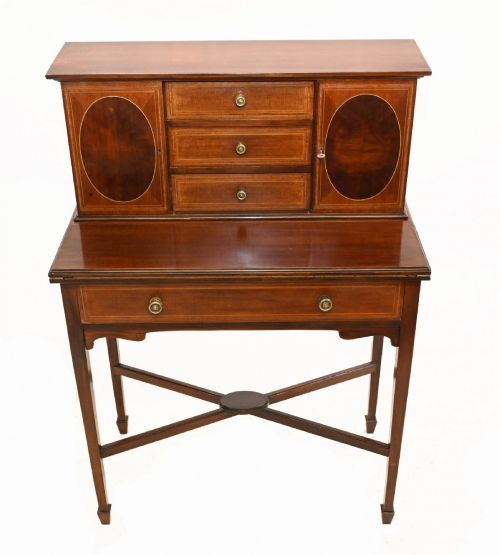
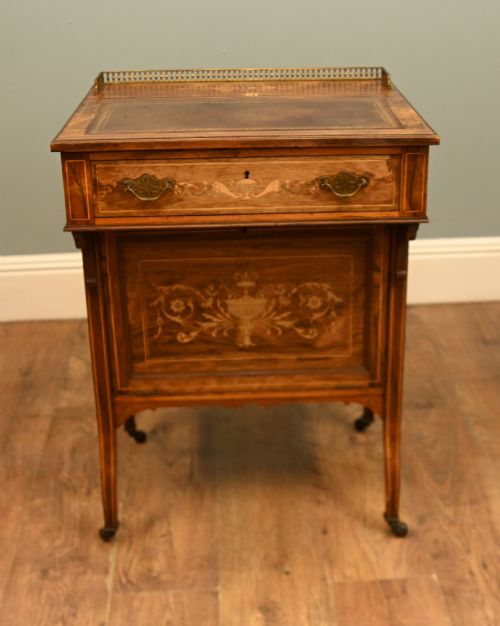
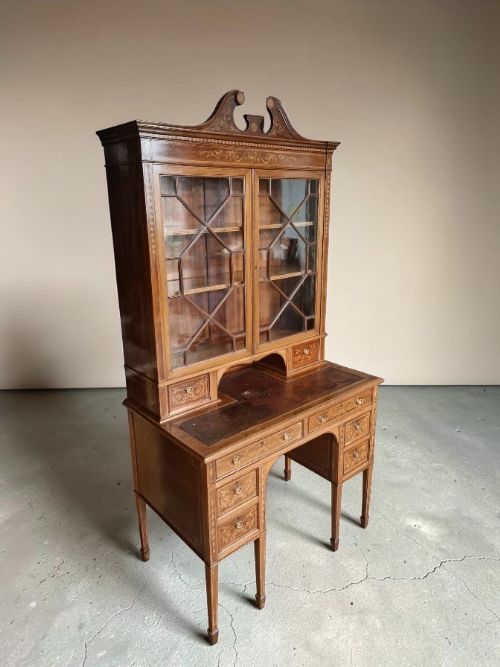
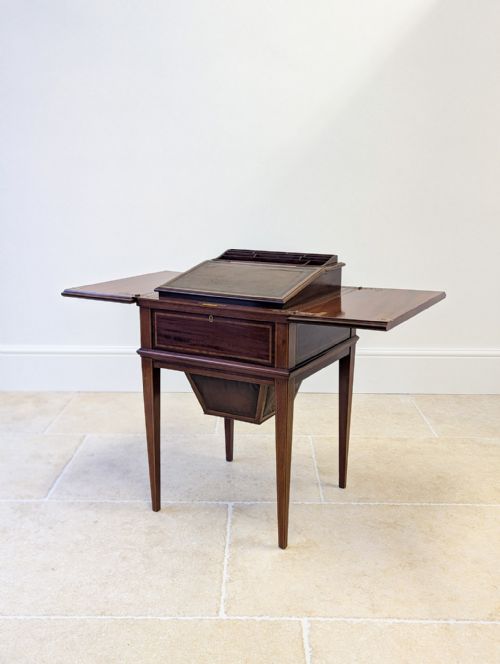
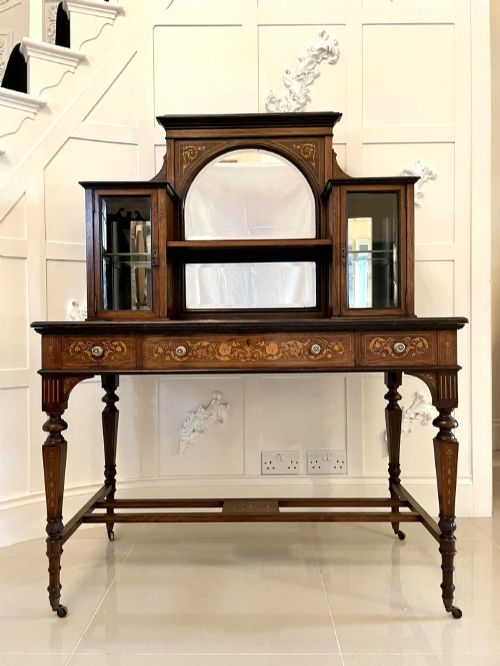
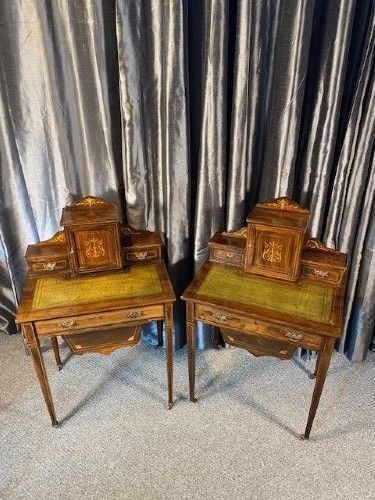

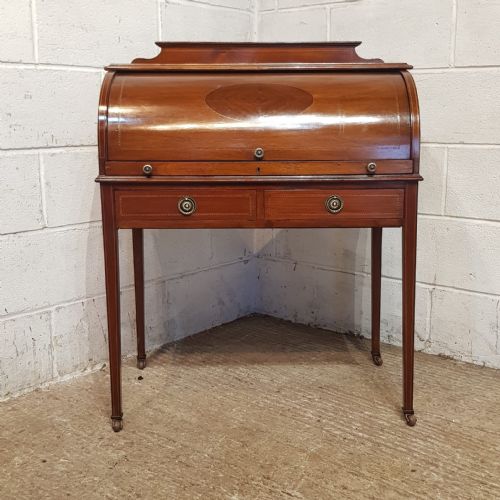


Edwardian Escritoire Desk
An edwardian escritoire desk offers refined compact writing accommodation with fitted pigeonholes and concealed compartments.
Edwardian Escritoire Desk
An edwardian escritoire desk combines writing surfaces with concealed compartments, appearing across Edwardian, Victorian, and Georgian periods alongside related writing tables, bureaus, and writing cabinets. The selection on this page centres on mahogany, rosewood, and satinwood forms, often enhanced by inlay.
Buyers encounter writing tables, bureau bookcases, cylinder desks, and bonheurs du jour alongside standard escritoire forms. These pieces serve domestic writing and storage needs within compact footprints, frequently incorporating boxwood stringing and brass hardware.
Materials and construction
Cabinetmakers utilised mahogany, rosewood, walnut, and satinwood as primary timbers, embellishing surfaces with intricate marquetry and boxwood stringing. Brass handles, escutcheons, and hinges provide functional contrast to polished wood grains.
Specialised forms incorporate leather writing inserts, mirrored superstructures, tambour fronts, and cylinder mechanisms. Structural techniques allow for fold-out writing surfaces and fitted interior compartments designed for correspondence and stationery.
Edwardian Escritoire Desk Retail Price Guide 2026
Typical asking prices for edwardian escritoire desk among the pieces listed under this phrase on Sellingantiques today, from the lower quarter to the upper quarter. They describe what is for sale here now, not the wider market.
Every secret drawer discovered inside an escritoire feels like a tiny victory over the original cabinetmaker.
Distinctions in quality
Quality rests upon the crispness of marquetry inlay, the selection of figured timber veneers, and the precision of mechanical writing surfaces. Smooth operation of cylinder fronts, tambour doors, and folding desks indicates superior cabinetmaking.
The integration of secondary woods, the execution of hand-painted decorative details, and the quality of original brass furniture distinguish standard utilitarian items from finer examples produced during the period.
Edwards & Roberts
The Edwardian Escritoire Desk Glossary
- Escritoire
- A small writing cabinet featuring a fall-front that opens to reveal drawers and pigeonholes. It provides a dedicated surface for correspondence while concealing private papers.
- Marquetry
- The art of applying decorative veneer pieces in wood, shell, or ivory to form geometric or pictorial designs. It decorates surfaces on cabinets and writing desks.
- Cylinder desk
- A writing desk with a curved, quarter-cylinder shutter that rolls back to reveal a sliding writing surface and interior drawers. This mechanism protects the desk interior when closed.
- Bonheur du jour
- A light ladies writing desk featuring a small cabinet or superstructure with shelves and drawers upon the main writing surface. It became popular during the eighteenth and nineteenth centuries.
- Boxwood stringing
- Thin inlay lines of pale boxwood inserted into contrasting darker timbers to outline drawers and panels. This technique defines the edges of furniture surfaces.
Edwardian Escritoire Desk: Frequently Asked Questions
What is an edwardian escritoire desk?
An edwardian escritoire desk is a compact writing cabinet featuring a fall-front writing flap that conceals internal compartments and pigeonholes. These pieces were designed for domestic correspondence and record keeping.
They combine decorative cabinetwork with practical storage, often utilising mahogany or satinwood veneers alongside inlaid boxwood details and brass hardware.
How do you use a cylinder desk?
A cylinder desk operates by sliding a curved wooden shutter downward to cover the workspace or upward to reveal the writing surface and interior drawers. The rolling mechanism conceals paperwork and stationery when not in use.
Many examples include a pull-out leather writing slide that extends forward to provide adequate legroom and a comfortable writing angle.
Where should I place an escritoire in a room?
An escritoire suits studies, bedrooms, or living rooms where floor space is limited yet a dedicated writing surface is desired. Their finished backs and compact proportions allow them to sit flush against walls or within alcoves.
Keep these pieces away from direct sunlight and heat sources to protect polished mahogany, rosewood, and satinwood surfaces from fading or drying out.
How do I care for inlaid wood furniture?
Care involves dusting regularly with a soft, dry cloth and applying natural wax sparingly to maintain the sheen of the timber. Avoid liquid polishes and silicone sprays that can damage antique French polish.
Maintaining stable room humidity prevents the boxwood stringing and delicate marquetry veneers from lifting or cracking over time.