


Edwardian Capstan Inkstand
These edwardian capstan inkstand pieces are classic desk accessories that bring period weight and polish to a traditional writing table.
Edwardian Capstan Inkstand
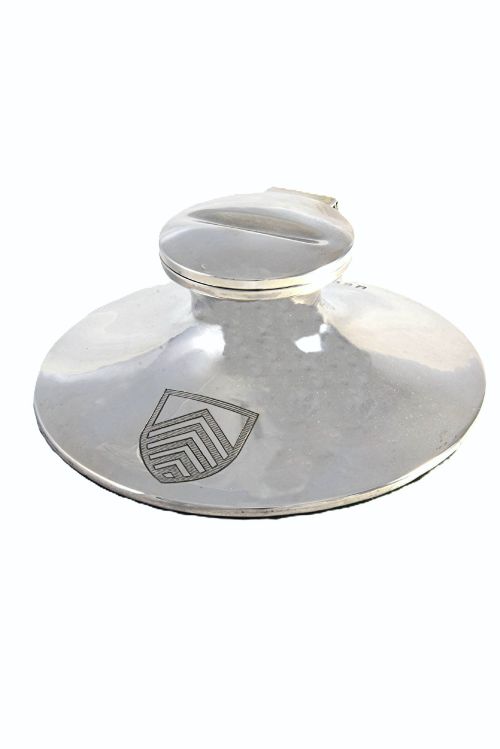
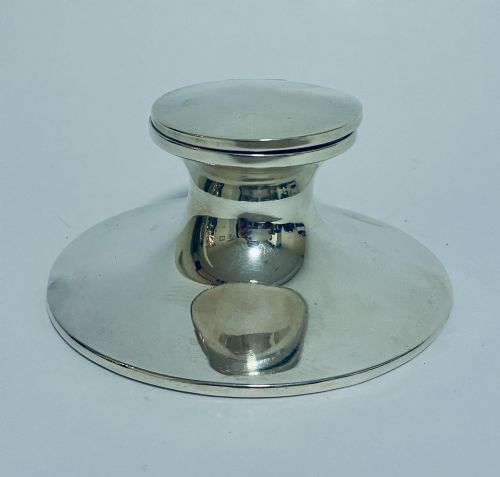
The edwardian capstan inkstand takes its name from the nautical device used on ships to haul heavy anchors, sharing that same wide-based, tapering silhouette. These desk accessories sit firmly on a writing surface to hold ink securely while adding substance to a study.
Most examples found on this page date from the Edwardian era and the early twentieth century, spanning the years from 1900 through to 1920. They take circular, square, and bell-shaped forms, occasionally incorporating integrated timepieces such as pocket watches or clocks into the design.
Makers produced these pieces predominantly in sterling silver, often pairing the metal with contrasting materials to catch the eye. The form remains a definitive desk accessory of its period, valued for both utility and decorative presence.
Materials and construction
Silversmiths constructed these pieces primarily from sterling silver, shaping the metal into the characteristic sloping capstan profile that houses the glass inkwell insert. Assay offices in Birmingham, London, Chester, and Manchester hallmarked the metal to guarantee its standard.
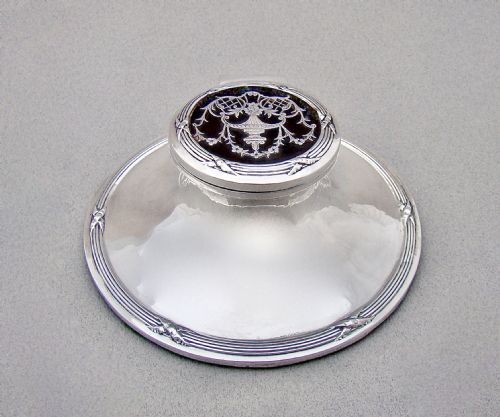
Craftsmen enhanced the silver bodies with decorative elements such as tortoiseshell panels and guilloche enamel floral medallions set into the lid. Glass components formed the internal reservoirs that held the fluid safely beneath the hinged silver caps.
Some writers managed to lose track of time entirely by checking the pocket watch built straight into their inkstand lid.
Judging quality in these desk pieces
The crispness of the hallmarks and the balance of the tapering silhouette indicate the care taken by the original maker. Substantial weight in the silver and integrated timepieces or clocks elevate an inkstand within its class.
Henry Matthews
The Edwardian Capstan Inkstand Glossary
- Capstan
- A desk accessory shaped like the barrel used on a ship for hoisting weights, featuring a wide base that tapers toward the top. This shape prevents the inkstand from tipping over during use.
- Guilloche enamel
- Decorative metalwork covered with translucent enamel over an engine-turned geometric pattern. It provides a coloured, reflective surface often seen on the lids of these pieces.
- Tortoiseshell
- The mottled brown material derived from the shell of certain turtle species, used as an overlay panel on silver desk wares. It creates a rich contrast against polished metal.
- Sterling silver
- An alloy consisting of pure silver and other metals, marked by assay offices to denote its fineness. It serves as the primary material for the bodies of these inkstands.
Edwardian Capstan Inkstand: Frequently Asked Questions
What is an edwardian capstan inkstand?
An edwardian capstan inkstand is a heavy desk accessory shaped like a ship's capstan, designed to hold ink securely.
These pieces typically feature a wide circular or square base tapering upward to a hinged lid and an internal glass well.
How were these inkstands used?
They sat on writing desks to provide a stable reservoir for ink used with dip pens.
The hinged lid protected the ink from dust and evaporation when the desk was not in use.
What materials make up these pieces?
Makers constructed the main bodies from sterling silver, supplemented by internal glass inserts.
Some examples also incorporate decorative elements like tortoiseshell panels or guilloche enamel medallions.
How do you identify the period?
Hallmarks stamped on the silver by assay offices in cities like Birmingham and London indicate the exact year of production.
The styles reflect early twentieth-century design preferences, spanning the Edwardian era up to 1920.