

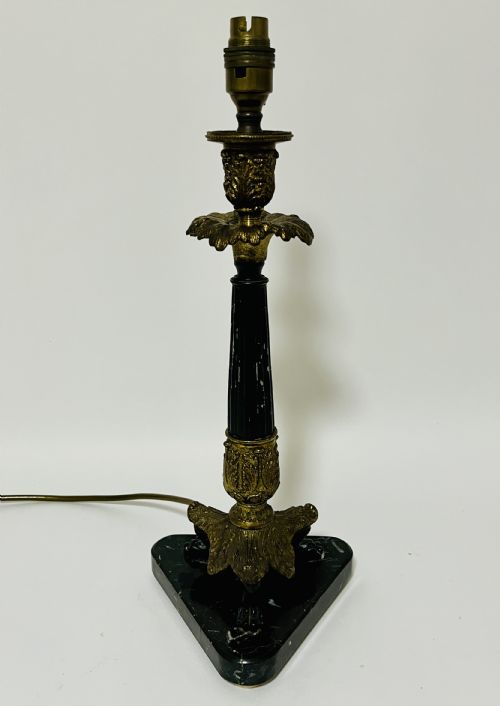


Edwardian Bronzed Reading Light
These edwardian bronzed reading light pieces combine heavy metalwork with practical illumination, offering serious period character for a collector's desk.
Edwardian Bronzed Reading Light
An edwardian bronzed reading light brings functional task illumination and heavy period presence to a room, drawing on designs from the late nineteenth and early twentieth centuries. These fittings take the form of adjustable table lamps, desk lamps, and tall floor or standard lamps.
Most examples you encounter here belong to the Edwardian period or date from around nineteen hundred, alongside nineteenth century pieces and later variants up to nineteen thirty. Styles range from straightforward column lamps to French Empire, Art Nouveau, Jugendstil, and Belle Epoque designs.
The form often includes adjustable stems or shades designed to direct light downward for reading or paperwork. Materials like bronze, brass, ormolu, and gilt bronze predominate, frequently paired with glass, marble, and fabric.
How they were made
The construction of an edwardian bronzed reading light relies heavily on cast bronze, brass, and ormolu, often incorporating patinated finishes to achieve the characteristic dark metallic tone. Metal components are turned, cast, and joined to create sturdy columns, bases, and adjustable arms.
Makers integrated decorative elements such as glass cabochons, frosted glass shades, and marble bases to elevate the visual weight of the lamp. Mechanical joints, screws, and sliding mechanisms were engineered into the metalwork to allow movement without compromising stability.
Edwardian Bronzed Reading Light Retail Price Guide 2026
Typical asking prices for edwardian bronzed reading light among the pieces listed under this phrase on Sellingantiques today, from the lower quarter to the upper quarter. They describe what is for sale here now, not the wider market.
Listings feature periods spanning from the late nineteenth century through to nineteen thirty, utilising bronze, brass, ormolu, marble, and glass.
What varies in quality
The distinction between ordinary and superior pieces rests on the crispness of the bronze casting and the precision of the adjustable mechanisms. Finer examples display sharp detailing in the metalwork and smooth articulation in the joints, while simpler items feature standard cast components with basic movement.
Materials also drive the hierarchy, with heavy gilt bronze, ormolu, and genuine marble bases marking out the more ambitious pieces. The integration of specialised glass elements, such as frosted shades or inset cabochons, separates standard utility lighting from decorative works of art.
The Edwardian Bronzed Reading Light Glossary
- Bronzed
- A finish applied to base metals to simulate the appearance of genuine bronze. This treatment gives the metal a dark, metallic patina popular in period lighting.
- Ormolu
- Gilded bronze produced by applying a high-carat gold amalgam to a bronze base. It provides a bright, durable golden surface often seen in French decorative styles.
- Cabachon
- A polished, convex gem or piece of glass cut without facets. In these lamps, glass cabochons are frequently set into the metal frame for decorative effect.
- Standard Lamp
- A heavy floor-standing lamp designed to provide ambient or reading light at height. These fixtures typically feature a weighted base to support a tall central column.
Edwardian Bronzed Reading Light: Frequently Asked Questions
How do I adjust the height on these reading lights?
Many of these lamps feature sliding columns or pivoting arms secured with metal keys or screws. Loosening the fitting allows you to raise or lower the shade before tightening it back into place.
Take care to support the weight of the metal shade while making adjustments to protect the vintage joints from undue strain.
Where should I place a bronze desk lamp?
These lamps suit writing desks, library tables, and sideboards where their directed light and heavy metal construction can anchor a room's scheme. Their adjustable nature makes them practical for focused tasks like reading.
Ensure the surface is sturdy enough to hold the weight of solid bronze and brass fittings.
How do I identify an Edwardian reading light?
Edwardian lighting often favors restrained neoclassical lines, column forms, and dark bronzed finishes that evolved from nineteenth-century designs. Look for proportions and maker traits typical of the period around nineteen hundred.
Compare the style markers, such as Art Nouveau curves or columnar symmetry, against the listed dates of manufacture.
What is the difference between a notary lamp and a standard desk lamp?
Notary lamps are typically designed with a specific tubular or trough-shaped shade, often in frosted glass, meant to cast a wide beam across documents. Standard desk lamps may use various shade shapes and adjustable arms for general task lighting.
Both forms utilise heavy metal bases to ensure stability during daily office use.