
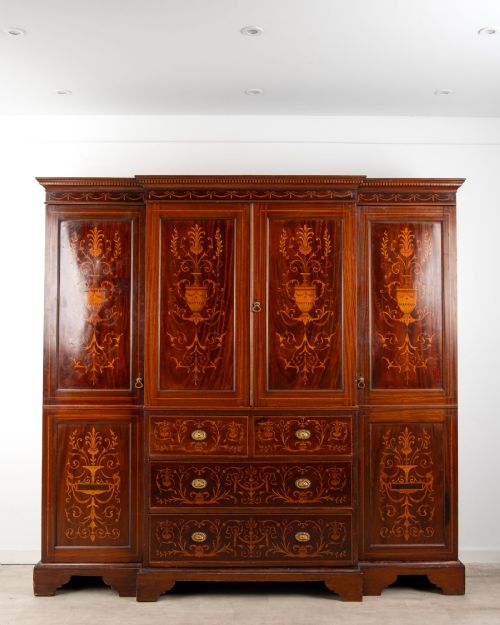


Edwardian Breakfront Wardrobe
An edwardian breakfront wardrobe offers monumental presence and generous bedroom storage, combining architectural lines with refined marquetry.
Edwardian Breakfront Wardrobe
When you search for an edwardian breakfront wardrobe, you encounter large bedroom pieces defined by a central section projecting forward from recessed side bays. These substantial items originate predominantly from the Edwardian era and the Victorian period, appearing frequently in mahogany, satinwood, and rosewood.
You will notice forms described variously as triple wardrobes, compactums, and clothes presses, occasionally accompanied by matching dressing tables or bedside cabinets. The design relies on architectural projection to break up long expanses of timber, creating deep internal compartments for hanging garments and linen.
Most examples you meet incorporate panelled doors, often centred with large mirror glass plates, above base drawers. The proportions demand high ceilings and generous bedroom space, reflecting the domestic architecture of their period.
How they were made
Cabinet makers constructed these large pieces using solid timber frames faced with carefully selected veneers of mahogany, satinwood, and rosewood. Sections of boxwood and satinwood inlay create crisp decorative banding and floral marquetry across the doors and cornices.
Functionality dictated internal engineering, utilising solid mahogany and walnut for sliding trays and drawer linings within compactum configurations. Brass hanging rails, locks, and door bolts provided durable mechanical fittings to secure heavy timber doors.
Many large breakfront carcases were engineered to dismantle into modular sections, including cornices, bases, and wardrobes sides, allowing installation in upper rooms.
Some larger wardrobes dismantle into exactly six modular sections, concealing their complex engineering behind polite Edwardian panels.
What varies in quality
The standard of timber selection and veneer matching defines the visual hierarchy between standard production and exhibition pieces. Highly figured flamed mahogany and dense satinwood grain distinguish superior commissions from plainer utilitarian wardrobes.
The complexity and precision of inlay work dictate execution quality, ranging from simple boxwood stringing to elaborate multi-timber floral marquetry and carved mouldings. Maker attribution, such as work by Maples, Edwards & Roberts, or Howard & Sons, signals workshop pedigree.
Structural integrity depends on the retention of original mirror glass, brass hardware, and the smooth operation of modular dismantling joints.
Lamb of Manchester·Edwards & Roberts·Maples & Co·Howard & Sons Of London
The Edwardian Breakfront Wardrobe Glossary
- Breakfront
- A cabinet design where the central section projects forward from the flanking wings. This architectural arrangement creates varied depth and shadow across the facade.
- Compactum
- A multi-functional wardrobe featuring a combination of hanging space, linen slides, and drawers within a single large carcase. It provides comprehensive bedroom storage.
- Marquetry
- Decorative patterns formed by fitting together contrasting veneer pieces into a wood background. Makers employed this technique to render floral and neoclassical motifs.
- Satinwood
- A pale, lustrous timber imported from the tropics, prized for its golden sheen. Cabinet makers used it either as solid wood or fine veneer for high-status bedroom suites.
- Clothes press
- A traditional piece combining upper storage shelves with lower drawer units for folded garments. Victorian and Edwardian examples frequently merged this form with the wardrobe.
Edwardian Breakfront Wardrobe: Frequently Asked Questions
How do I dismantle a breakfront wardrobe?
Most large breakfront wardrobes separate into distinct modules including a heavy cornice, a projecting base plinth, and three vertical wardrobe sections locked together by internal bolts.
Working with a partner is essential to support the heavy mirror doors and timber panels while unscrewing internal fixings and sliding the carcase joints apart.
What is the difference between a compactum and a wardrobe?
A standard wardrobe provides vertical hanging space behind full-length doors, whereas a compactum divides the interior space to include internal drawers and linen slides.
This multi-compartment layout reflects period requirements for storing folded garments alongside coats and dresses.
How should I care for antique mahogany and satinwood?
Keep wooden surfaces away from direct sunlight and strong heat sources to prevent the natural timber veneers and delicate boxwood inlay from drying out and cracking.
Apply traditional beeswax sparingly and buff gently with a soft cloth to maintain the natural lustre without building up heavy silicone residues.