


Ebony Walking Stick
An ebony walking stick carries the dense weight of the nineteenth or early twentieth century, balancing practicality with unmistakable gentlemanly authority.
Ebony Walking Stick
An ebony walking stick is a dense hardwood support often finished with precious metal mounts, horns, or functional concealed blades.
The pieces available span the Victorian and Edwardian eras, encompassing both plain solid shafts and elaborate gadget sticks.
Origins stretch from English workshops and continental makers to Chinese export houses and the Raj period in India.
Materials and construction
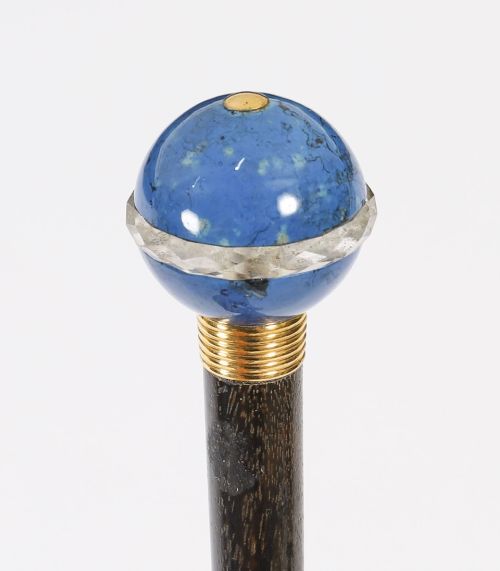
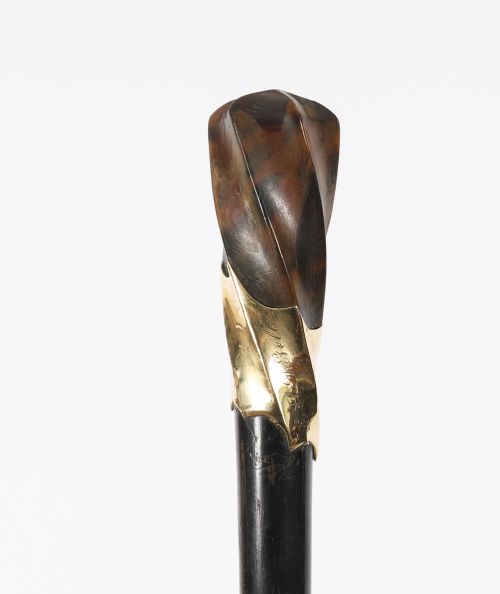
Makers utilised heavy dark hardwood, turning the timber into solid shafts paired with contrasting natural materials like horn, lapis lazuli, and rock crystal.
Ornate detailing relied on silver and gold pommels, sometimes featuring engine turning, embossing, or engraved crests.
Specialist variants incorporated hidden mechanisms, housing concealed sword blades or practical snuff boxes within the pommel structure.
Materials recorded across the archive include solid ebony, hardwood, silver, gold, lapis lazuli, rock crystal, and horn.
Distinctions in quality
Superior examples reveal themselves through the precision of the metalwork, particularly genuine hallmarked silver or solid gold pommels rather than light plating.
The fineness of hand-carved details, whether on horn handles or wooden shafts, separates standard utility pieces from high-status gentleman's accessories.
Briggs·Wang Hing and Company·Henry Borlase Stevens·Jonathan Howell
The Ebony Walking Stick Glossary
- Pommel
- The knob or handle at the top of the stick. It often bears hallmarks, decorative engraving, or houses a hidden compartment.
- Gadget stick
- A walking cane concealing a functional tool, such as a sword blade or a snuff box.
- Engine turned
- A decorative mechanical pattern of precise geometric lines engraved into metal pommels.
- Anglo-Indian
- Items produced in India during the colonial period, typically featuring characteristic local carving styles on imported or native hardwoods.
- Hallmark
- An official stamp applied to precious metals indicating the standard of purity and the place of assay.
Ebony Walking Stick: Frequently Asked Questions
What periods do these sticks come from?
The available evidence spans the nineteenth century through to the Edwardian period and the early 1920s.
Victorian and Edwardian examples represent the majority of surviving specimens.
Are the metal mounts solid silver?
Many pommels consist of hallmarked silver or gold, while others feature embossed or plated metal finishes.
Checking for official assay office stamps confirms the metal standard.
How should I care for an ebony stick?
Keep the dense hardwood away from extreme temperature fluctuations and direct sunlight to prevent timber splitting.
Gentle application of appropriate wood wax preserves the natural dark finish.