

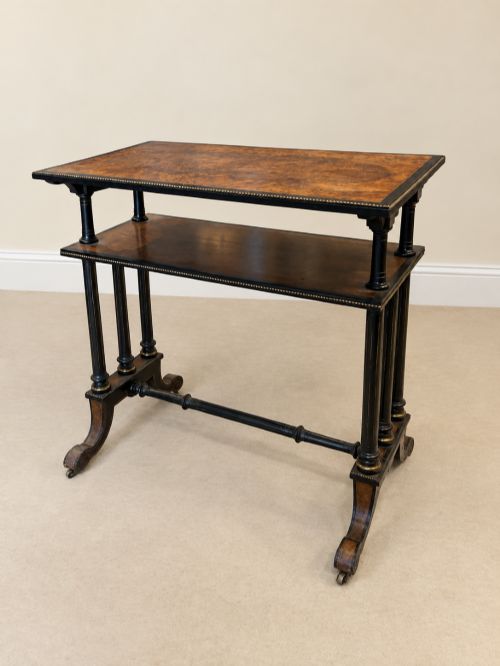
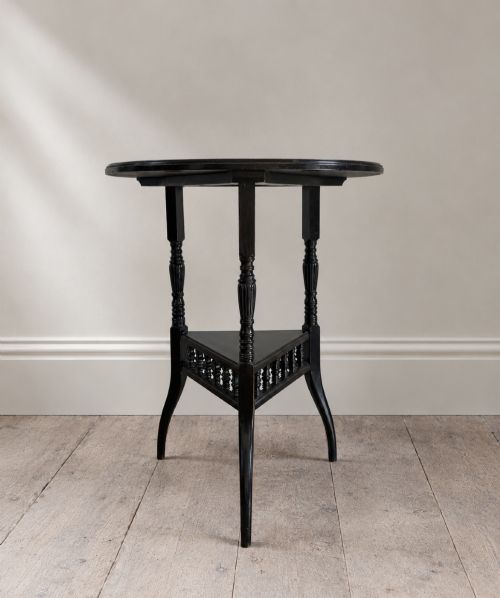
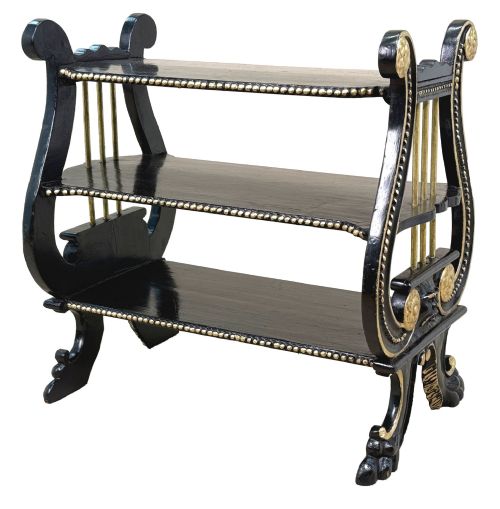
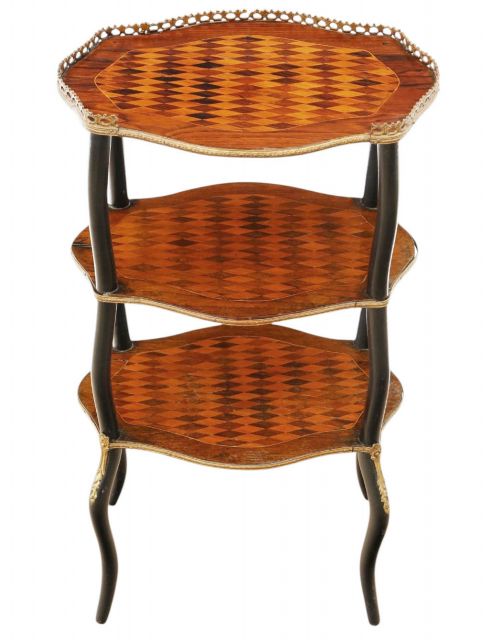


Ebonised Tier Stand
An ebonised tier stand brings dark elegance and vertical display space to a room, offering multiple surfaces for books, plants, and decorative objects.
Ebonised Tier Stand
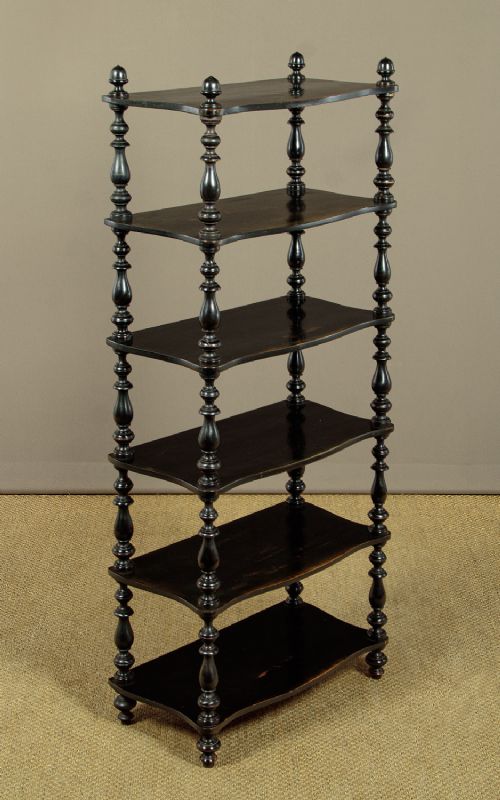
An ebonised tier stand is a multi-level display piece finished to resemble ebony, commonly encountered in forms such as étagères, whatnots, side tables, and plant stands. These items emerged across the nineteenth century, including Victorian, Aesthetic Movement, and French Napoleon III periods, often serving functional display purposes in parlours and drawing rooms.
The selection ranges from simple two-tier occasional tables to complex six-tier dumb waiters and corner units. Most pieces date from the mid-nineteenth century through to the early twentieth century, showing influences from Anglo-Japanese design and Arts and Crafts principles.
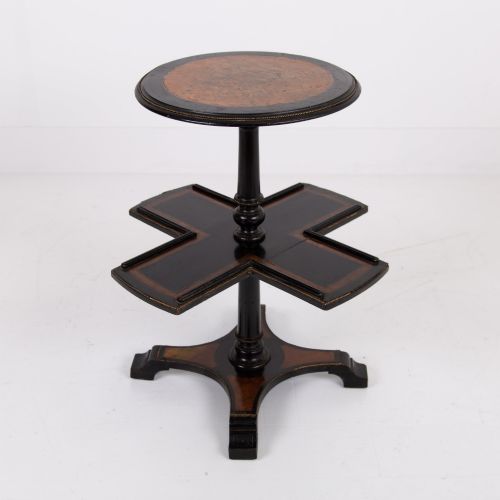
Buyers frequently encounter variations combining ebonised wood with contrasting materials like amboyna, walnut, and parcel gilding. These multi-tiered forms provide practical shelving while maintaining a slender, space-saving footprint.
Materials and construction
Carpeneters built these stands using a foundation of hardwoods, frequently applying an ebonising process to stain or paint the timber deep black in imitation of costly ebony. Workshops combined this dark finish with contrasting secondary timbers such as walnut, mahogany, and rosewood.
Many examples incorporate decorative elements like brass mounts, porcelain inserts, and intricate marquetry or parquetry inlay. More elaborate pieces feature parcel gilding, hand-painted surfaces, or exotic veneers like burr walnut and amboyna on the tiers.
Ebonised Tier Stand Retail Price Guide 2026
Typical asking prices for ebonised tier stand among the pieces listed under this phrase on Sellingantiques today, from the lower quarter to the upper quarter. They describe what is for sale here now, not the wider market.
Listings feature stands spanning the Victorian, Edwardian, and Art Deco eras, constructed in ebonised hardwood, walnut, mahogany, and rosewood.
Assessing quality
Quality rests upon the crispness of the turning, the stability of the tiered structure, and the precision of the joinery connecting each shelf. Superior examples maintain firm uprights and level platforms without wobble across multiple tiers.
The refinement of the surface finish and the selection of secondary woods dictate distinction, with finer items utilising genuine exotic veneers and delicate parcel gilding rather than plain painted pine. Detail in inlay work and hardware integration further separates standard production from superior pieces.
Liberty of London
The Ebonised Tier Stand Glossary
- Ebonised
- Wood treated with stain or paint to achieve the dark, dense appearance of ebony. This finish gained immense popularity during the Victorian and Aesthetic Movement periods.
- Étagère
- A piece of furniture consisting of a set of open shelves for displaying small objects or ornaments. These usually feature three or more tiers supported by slender columns.
- Whatnot
- A tall, multi-shelved piece of furniture used for storing or displaying ornaments and books. They appeared frequently in Victorian interiors as corner or freestanding units.
- Parcel gilded
- Partially gilded with gold leaf or powder, usually to highlight carved details, mouldings, or turned elements against a dark ebonised ground.
- Amboyna veneer
- A rich, mottled reddish-brown wood veneer derived from the burl of the narra tree. It provides a striking contrast when paired with ebonised framing.
Ebonised Tier Stand: Frequently Asked Questions
What is an ebonised tier stand used for?
These stands provide stacked surface areas designed to hold decorative objects, small plants, books, and collections without occupying excessive floor space. Their vertical tiered construction allows multiple items to be shown clearly within a compact footprint.
Historically, households placed them in drawing rooms, parlours, and hallways to display porcelain, silver, and ornamental curiosities. Today, they serve similar decorative functions in living spaces while adding architectural interest to empty corners.
How do I identify an Aesthetic Movement stand?
Aesthetic Movement stands often show distinct Japanese design influences, featuring clean linear forms, ebonised surfaces, and sometimes bamboo or woven reed elements. They lean towards simplicity and artistic arrangement rather than heavy Victorian ornamentation.
Look for echoes of designers like E.W. Godwin in the framework, where slender uprights support simple square or round tiers. These pieces date predominantly to the late nineteenth century.
Are these stands sturdy enough for daily use?
Most tier stands are remarkably functional, though their stability depends on the number of tiers and the overall design. Tall structures with numerous shelves require careful placement to prevent tipping.
While robust enough for books and ceramics, heavier items should sit on the lowest, widest shelf. Lighter decorative objects suit the upper tiers best.
How do I care for ebonised wood?
Ebonised surfaces require gentle dusting with a soft, dry cloth to prevent scratching the dark finish. Avoid placing them in direct sunlight or near heat sources, which can cause timber to warp and finishes to fade.
Occasional treatment with appropriate furniture wax helps maintain the lustre of the black finish. Moisture should be wiped away immediately to protect the underlying wood and any delicate veneer.