
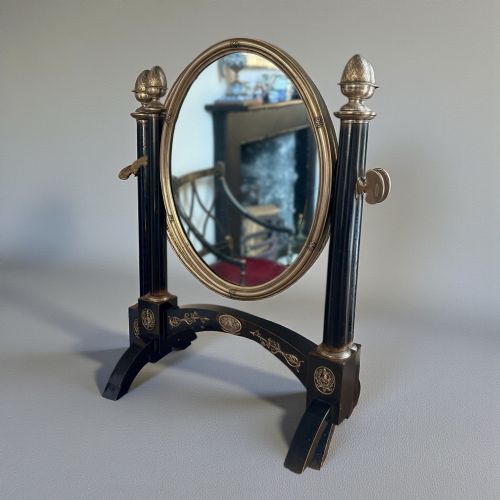
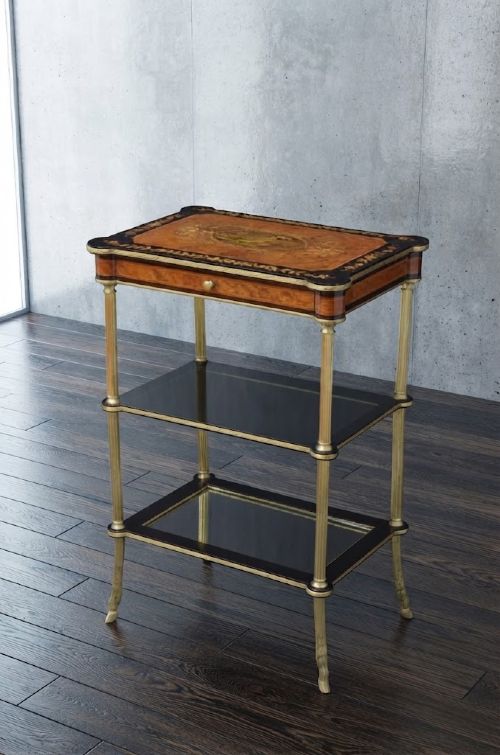
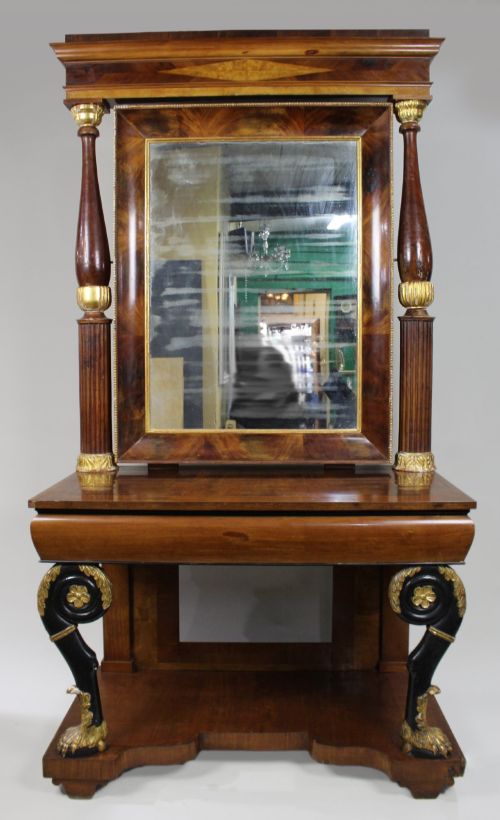
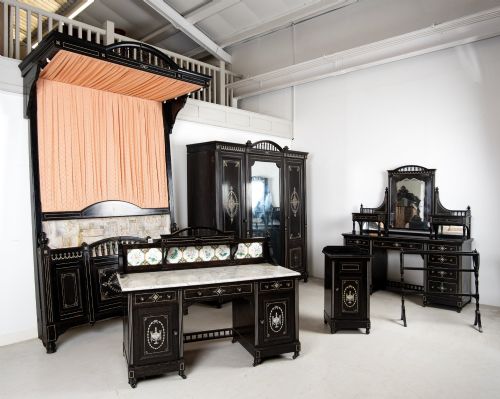


Ebonised Table Mirror
An ebonised table mirror brings rich, dark timber tones and reflective depth to a room, catching the light in a way few other small antiques manage.
Ebonised Table Mirror
When you search for an ebonised table mirror, you are looking at small-scale dressing and vanity glasses produced largely during the nineteenth century. These pieces range from simple Regency hand-held items to elaborate Victorian dressing mirrors and Chinoiserie examples.
The most common form you will meet on this page is the compact table mirror, often designed to sit upon a matching dressing table or pedestal base. Many examples incorporate pivoted frames and modest drawers for small personal items.
Origins stretch across Britain, France, and northern Europe, taking in diverse stylistic influences from Regency elegance to the heavy decorative schemes of the late Victorian period. The unifying thread is the dark, treated surface that mimics costly ebony.
Materials and construction
Timbers such as mahogany, fruitwood, and birch are heavily stained or painted to achieve the characteristic ebonised finish, often paired with parcel gilt accents to highlight carved details. Brass fittings, ormolu mounts, and original mirror plates are frequently integrated into the construction.
Construction techniques rely on traditional cabinetmaking methods, joining solid woods and veneers to create stable frames for heavy glass plates. Stencilled decoration and inlaid motifs sometimes adorn the surrounding woodwork.
Judging quality in these mirrors
Quality rests primarily on the depth and integrity of the ebonised finish, the crispness of any parcel gilt or inlay work, and the survival of the original mirror plate. Finer examples retain their intended brass hardware and smooth pivoting mechanisms without structural wobble.
The weight of the timber and the subtlety of decorative flourishes, such as hand-stencilling or fine carving, separate standard domestic wares from more ambitious continental pieces.
The Ebonised Table Mirror Glossary
- Ebonised wood
- Timber stained, painted, or chemically treated to imitate true ebony, a technique widely used in nineteenth-century furniture to create a sleek, black finish.
- Parcel gilt
- A decorative method where only specific raised portions or carved details of an object are gilded with thin gold leaf, contrasting sharply with the dark ebonised background.
- Ormolu
- Gilded bronze or brass mounts applied to furniture and mirror frames for decorative effect, common in nineteenth-century French and English design.
- Chinoiserie
- European theatrical interpretation of Chinese and East Asian artistic traditions, frequently featuring hand-painted motifs on lacquered or ebonised surfaces.
- Biedermeier
- A central European style spanning the early to mid-nineteenth century, known for utilitarian comfort and clean lines that showcase native wood grains.
Ebonised Table Mirror: Frequently Asked Questions
Where should I place an ebonised table mirror?
These mirrors suit dressing tables, sideboards, or console tables where their dark timber frames can stand against a lighter wall for contrast.
They also sit comfortably on chest of tops in bedrooms or hallways, bringing functional reflection and period character to small surfaces.
How do I clean an ebonised frame?
Dust the timber gently with a dry, soft microfibre cloth to prevent any buildup of grime in the carved recesses or around the joints.
Avoid using liquid polish, water, or modern chemical sprays, as moisture can damage both the historic ebonised finish and the underlying wood.
Are the mirror plates original?
Many nineteenth-century pieces retain their original glass, which often exhibits minor foxing, dark speckling, and slight distortion that testify to its age.
Replacement plates do appear on the market when older glass has cracked or deteriorated beyond practical use over decades of domestic life.
How do I tell Victorian pieces apart from Regency ones?
Regency mirrors tend to display restrained classical lines, simpler brass accents, and leaner proportions influenced by ancient Roman and Greek revival styles.
Victorian examples frequently introduce heavier carving, more elaborate Chinoiserie decoration, or combination pieces involving small drawers and tier structures.