

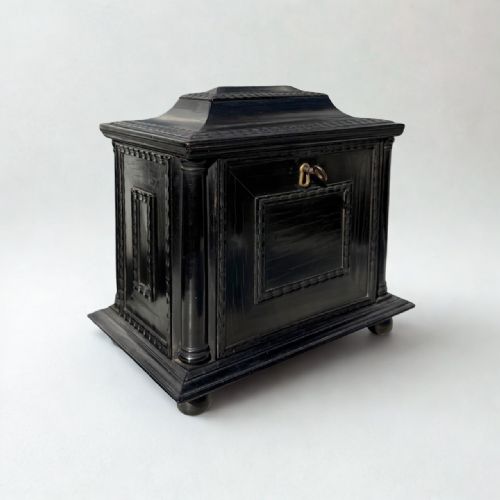


Ebonised Table Chest
An ebonised table chest brings the deep, dark timber of earlier centuries into a room as a compact focal point.
Ebonised Table Chest
When you search for an ebonised table chest, you are looking at small storage pieces designed to sit upon furniture rather than stand on the floor. The examples on this page span several centuries, reaching back as far as the seventeenth century and moving forward through the eighteenth century.
The forms you are most likely to meet on this page include table cabinets, caskets, and small chests created in styles such as Flemish Baroque, Spanish Baroque, and Italian variants. These items range from simple utilitarian boxes to elaborate cabinets fitted with internal drawers.
Makers and workshops across Europe produced these dark wood pieces to hold precious items, documents, or jewellery. Their small scale allows them to sit comfortably on modern surfaces while retaining a strong historical presence.
Materials and construction
The construction relies heavily on dense woods like ebony and walnut, often finished with ebonising to achieve a rich, black surface. Artisans combined these dark timbers with contrasting elements such as bone inlay, tortoiseshell, and kingwood to create visual depth.
Parquetry and fine joinery govern the exteriors, while internal compartments demand precise miniature cabinet-making techniques. Metal mounts in brass frequently secure the corners and provide working hinges and locks for the small doors and lids.
Some seventeenth-century chests hide tiny secret compartments behind decorative panels, designed for the truly paranoid collector.
Assessing quality and craftsmanship
The distinction between standard pieces and the finest work lies in the complexity of the internal configuration and the precision of the parquetry. Superior examples display meticulous attention to the grain of the wood and the integration of secondary materials like tortoiseshell or bone inlay.
The crispness of the mouldings and the original state of the brass mounts separate exceptional creations from simpler boxes. Depth of colour in the ebonised finish and the survival of internal drawers dictate the standing of a piece within the range.
Lamb of Manchester
The Ebonised Table Chest Glossary
- Ebonised
- Wood treated to imitate ebony by staining or painting the surface black. This technique was popular in seventeenth-century furniture and later revival periods to create high contrast.
- Parquetry
- Geometric wood mosaic work used for ornamentation on floors or cabinet surfaces. Artisans cut small pieces of contrasting timber to form intricate patterns.
- Table Cabinet
- A miniature cabinet designed to rest upon a table, desk, or chest rather than stand independently on the floor. These pieces often contain multiple small drawers for valuables.
- Baroque
- An ornate artistic style prevalent from the late sixteenth to early eighteenth century, characterised by drama, rich detail, and deep relief. Flemish and Spanish variations appear frequently in early cabinet work.
Ebonised Table Chest: Frequently Asked Questions
What were ebonised table chests used for?
These small chests served to store precious documents, jewellery, and small collectible items securely in private chambers. Their portability allowed owners to move them between rooms as needed.
Today, they function well as decorative display pieces on sideboards or desks while continuing to offer discreet storage for modern small items.
How old are these table chests?
The examples seen here date from the seventeenth and eighteenth centuries, with certain pieces reflecting later stylistic revivals. Dating relies on construction methods, timber choice, and stylistic markers.
Earlier pieces often display heavy baroque influence and complex internal drawer arrangements, while later iterations reflect the tastes of the nineteenth and twentieth centuries.
How do I care for ebonised wood?
Ebonised surfaces require gentle dusting with a soft, dry cloth to prevent the accumulation of grit. Avoid harsh chemical cleaners and modern polishes that can lift the dark finish.
Keep the timber away from direct sunlight and steady heat sources to prevent the wood from drying out or warping over time.