

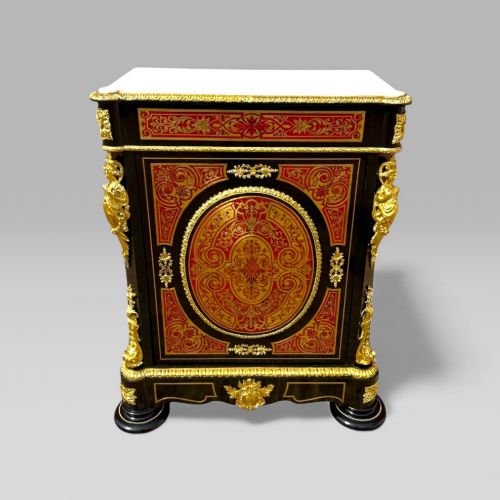


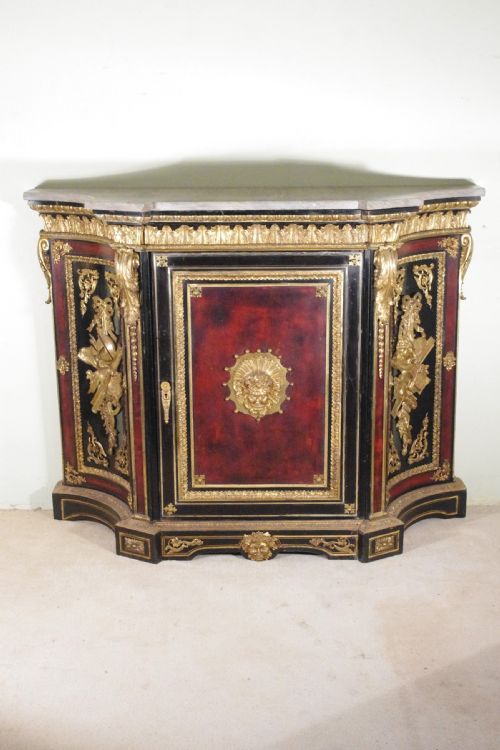


Ebonised Marble Top Cabinet
These ebonised marble top cabinet examples bring architectural polish and rich dark contrast to a room through heavy stone surfaces and deep blackened timber.
Ebonised Marble Top Cabinet
When you search for an ebonised marble top cabinet, you encounter sturdy timber storage pieces topped with heavy stone slabs and finished in dark blackened coatings. The pieces appearing here span the nineteenth century, including Victorian examples alongside French Napoleon III and Louis XVI revival designs.
Forms vary between side cabinets, pier cabinets, display cabinets, and smaller side tables or desks. Many items originate from French workshops, bringing formal proportions and decorative metal mounts to the dark wood carcases.
How they were made
Carcases utilise timbers such as walnut, rosewood, kingwood, or hardwood, which undergo ebonisation to achieve a dense, light-absorbing black surface. This dark ground contrasts sharply with fitted slabs of marble placed on the upper surface.
Decorations often incorporate brass and tortoiseshell boulle work, marquetry floral panels, and ormolu or gilt metal mounts. Inlaid brass lines trace the contours of doors and panels, while cast metal mounts secure the corners and feet.
Ebonised Marble Top Cabinet Retail Price Guide 2026
Typical asking prices for ebonised marble top cabinet among the pieces listed under this phrase on Sellingantiques today, from the lower quarter to the upper quarter. They describe what is for sale here now, not the wider market.
Listings feature pieces from the Victorian era and the nineteenth century, utilising materials like marble, ebonised wood, ormolu, brass, tortoiseshell, walnut, and kingwood.
What varies in quality
The standard of an ebonised marble top cabinet rests upon the crispness of the brass inlay and the precision of the marquetry. Superior examples display tightly fitted metal mounts and meticulously cut tortoiseshell rather than simple painted lines.
Stone selection also dictates the grade of the piece, with thicker, more richly figured marble slabs demonstrating higher ambition. The depth and durability of the ebonised finish on the underlying wood further distinguish finer workshops from standard production.
Befort Jeune
The Ebonised Marble Top Cabinet Glossary
- Ebonised
- Wood treated to imitate ebony by staining or painting it black. This finish gained popularity during the nineteenth century for furniture requiring a uniform dark appearance.
- Boulle work
- A style of marquetry using brass and tortoiseshell inlaid together. Named after a French royal cabinet maker, it creates a rich patterned surface.
- Ormolu
- Gilt bronze mounts applied to furniture for decoration. These metal details provide highlights against dark ebonised wood.
- Pier cabinet
- A narrow cabinet designed to stand against a wall between windows. These pieces often feature glass doors to display ornaments.
- Marquetry
- Veneers applied to a carcase in patterned pictorial designs. Craftsmen cut pieces of different coloured woods to form floral or geometric motifs.
Ebonised Marble Top Cabinet: Frequently Asked Questions
What is an ebonised marble top cabinet?
These are nineteenth-century storage pieces built from wood treated to look like ebony and finished with a stone slab top. They frequently appear in French revival styles with decorative metal mounts.
Craftsmen produced them in various forms including side cabinets, pier cabinets, and display furniture to serve both decorative and practical functions in formal rooms.
How do you clean the marble top?
Stone surfaces require gentle washing with warm water and mild soap to avoid etching the polish. Acidic substances can damage the finish permanently.
Dry the marble thoroughly with a soft cloth after washing to maintain the natural sheen of the stone.
How do I identify a Napoleon III cabinet?
Napoleon III pieces often feature deep ebonised finishes combined with elaborate brass inlay, tortoiseshell, and gilt metal mounts. The aesthetic draws heavily on earlier French royal styles.
These items frequently date from the mid to late nineteenth century and display confident, ornate proportions.
Where should I place a pier cabinet?
Pier cabinets suit narrow wall spaces, particularly the architectural sections between windows or flanking a fireplace. Their shallow depth prevents them from blocking walkways.
Glass-fronted versions work well for displaying small collections while keeping items protected from dust.