
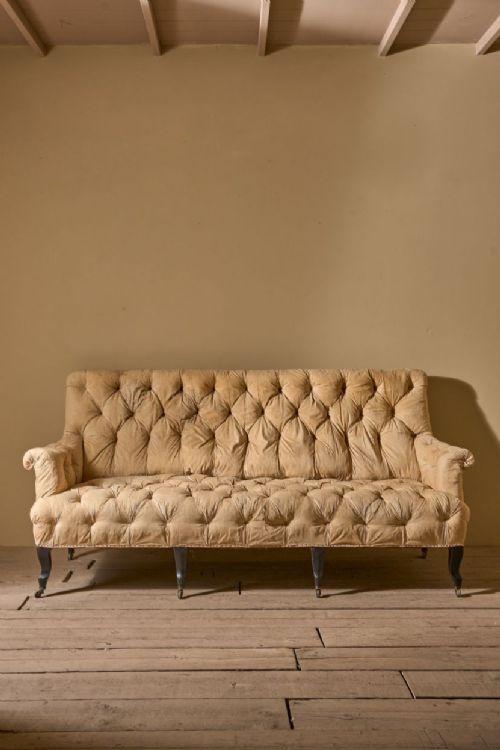
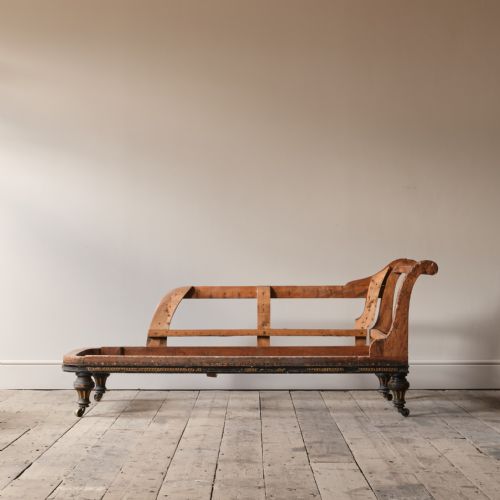
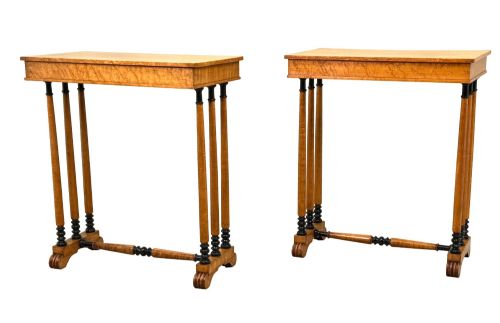
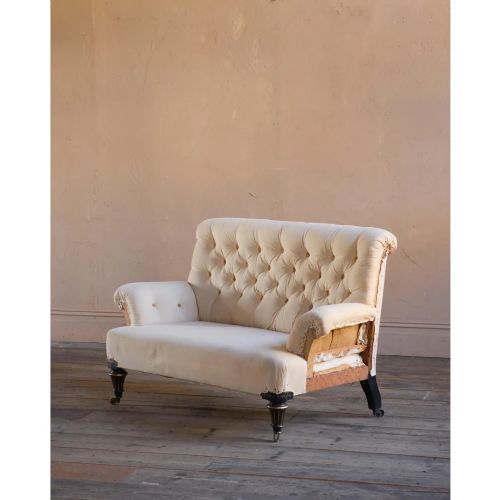
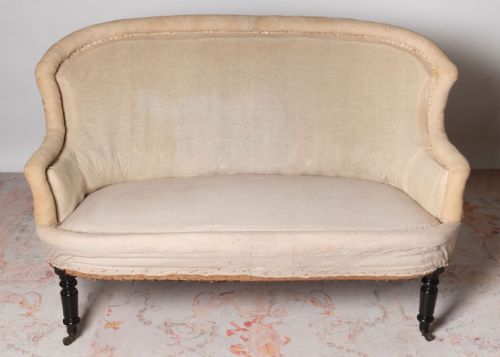
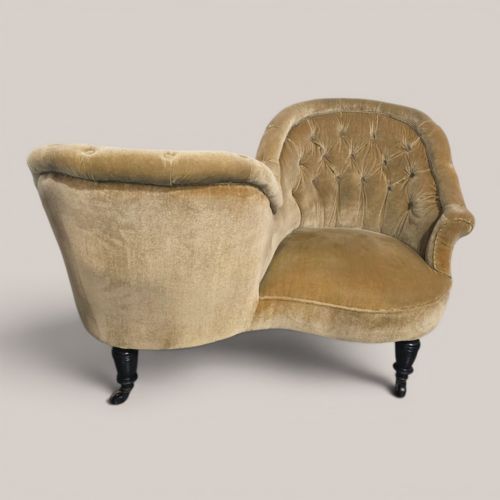
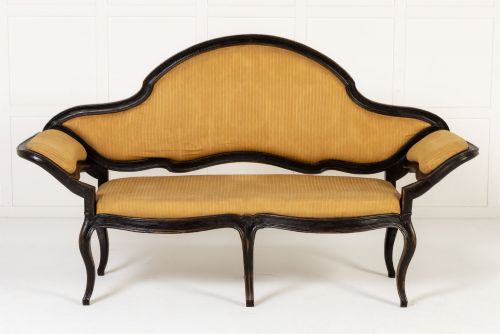
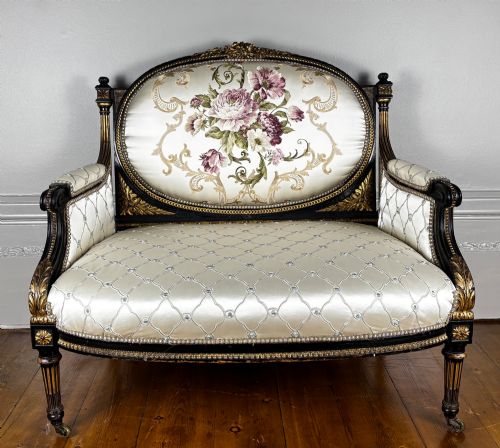


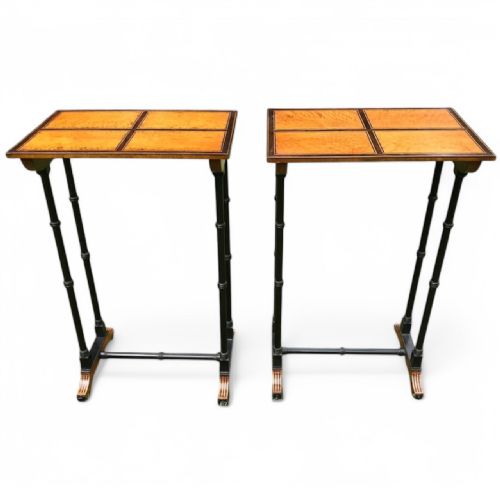


Ebonised Leg Sofa
An ebonised leg sofa brings dark, polished timber supports to seating from the Regency, Victorian, and Napoleon III periods.
Ebonised Leg Sofa
An ebonised leg sofa combines dark wooden supports with upholstered seating across the 18th, 19th, and 20th centuries.
The phrase ebonised leg sofa covers pieces ranging from buttoned Napoleon III examples to English Regency designs and Victorian conversation seats.
Buyers encounter forms upholstered in velvet, calico, linen, and heavy cotton, resting on darkened hardwood frames.
How they were made
Cabinet makers utilised hardwoods, timber, and occasionally ebony or birdseye maple, finishing selected components with ebonisation to mimic costly tropical woods.
Upholstery techniques involved traditional stuffing covered in textiles such as velvet, calico, and linen, often finished with brass details or tasseled trims.
Victorian conversation sofas allowed two people to sit facing opposite directions while maintaining a polite distance.
What varies in quality
The refinement of the carved wooden frame and the precision of the ebonised finish set finer examples apart from simpler workshop productions.
Proportion, timber selection, and the integrity of the original upholstery scheme determine the standing of each piece.
Holland and Sons·Jackson and Graham·Willian Trotter
The Ebonised Leg Sofa Glossary
- Ebonised
- Wood treated with a dark stain or finish to imitate ebony. This technique was widely utilised during the Victorian and Napoleon III periods.
- Regency
- An English period dating from the early 19th century. Pieces from this era often display classical restraint and veneered exotic timbers.
- Aesthetic Movement
- A late 19th-century design style focusing on visual beauty. Furniture from this movement often incorporates ebonised surfaces and contrasting details.
Ebonised Leg Sofa: Frequently Asked Questions
What periods do these sofas come from?
The pieces span the 18th century, the Regency era, and the late 19th century, including Victorian and Napoleon III designs.
Ebonised supports appear across various European and English workshops throughout these periods.
How do I care for ebonised wood?
Dust the dark wooden legs gently with a dry, soft cloth to prevent scratching the polished surface.
Avoid placing the sofa in direct sunlight or near heat sources to protect both the timber finish and the upholstery.
What fabrics cover these sofas?
Upholstery materials recorded include velvet, calico, linen, and heavy cotton.
Some examples feature buttoned backs or tasseled trims characteristic of their respective periods.
Are these sofas English or French?
Evidence shows both English and continental origins, including French Napoleon III and Italian styles.
Craftsmen across different regions utilised ebonised timber for furniture supports.